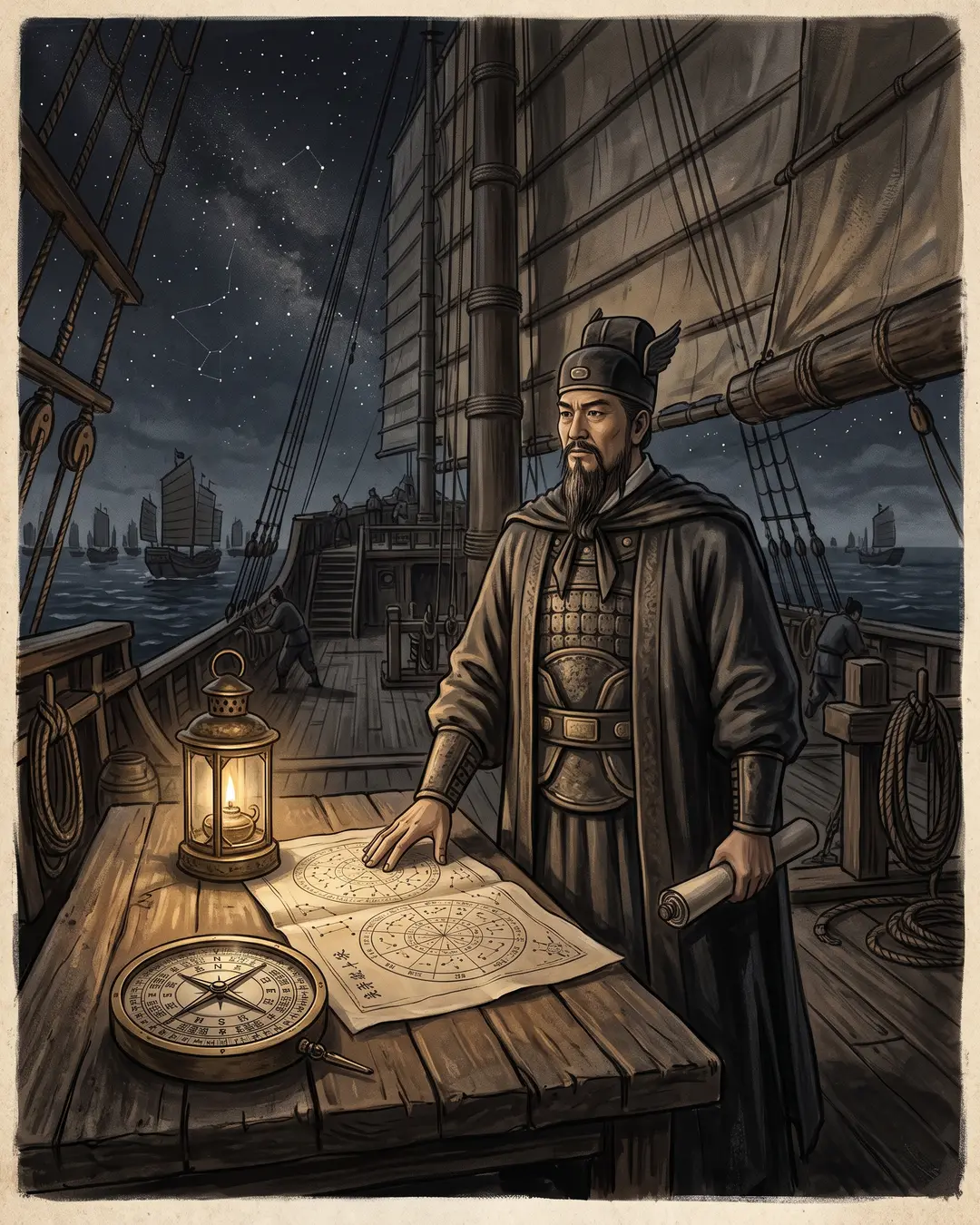
From Captive to Confidant
He was born Ma He around 1371 in Yunnan, into a Muslim family that traced its line to a Central Asian governor who had served the Mongols. When Ming armies conquered the province, the boy was taken prisoner, castrated, and placed in the household of a prince of the new dynasty. That prince, Zhu Di, seized the throne in a civil war in 1402 and ruled as the Yongle Emperor. Ma He had fought for him, and the emperor rewarded him with the surname Zheng and with command of an enterprise no palace eunuch had ever been given.
The scale is difficult to overstate. Between 1405 and 1433 Zheng He led seven expeditions carrying, by the official histories, more than twenty thousand men in fleets of hundreds of vessels. The largest treasure ships are described in Ming sources as over four hundred feet long, figures that naval historians still contest as implausible for wooden hulls of the period. Whatever their true dimensions, the ships were far larger than anything Europe would launch for another century, and they were built for spectacle as much as for cargo.
Tribute, Trade, and Force
The voyages reached Champa, Java, Malacca, Sri Lanka, Calicut, Hormuz, and the Swahili ports of Mogadishu and Malindi. Their purpose was not discovery. These routes were ancient, and Arab, Indian, and Malay sailors had charted them long before. Zheng He came to enroll foreign rulers in the Ming tribute system, escort envoys to and from the capital, and make Yongle's legitimacy visible abroad after a usurpation at home. He brought back pepper, gems, and, famously, a giraffe from Bengal that courtiers presented as the qilin, an auspicious beast confirming heaven's favor.
The fleets were armed, and they used their weapons. In Sumatra, Zheng He captured the pirate leader Chen Zuyi and sent him to Nanjing for execution. In Sri Lanka he intervened in a local conflict and carried the ruler Alakeshvara back to China as a prisoner. On a later voyage he seized a rival claimant in Sumatra. The expeditions were restrained beside the European voyages that followed, but they were not benign. They were the projection of an empire's power, and small kingdoms understood the difference between an invitation and a demand.
The Records Are Burned
Yongle died in 1424 and the mood at court shifted. Confucian officials had long resented the expense, the cargoes of luxuries, and above all the influence the voyages handed to palace eunuchs. Money was needed for the northern frontier and for the new capital at Beijing. A final expedition sailed in 1431, and Zheng He most likely died on the return leg in 1433, probably at sea near Calicut. Later ministers suppressed the voyage archives, and a well-known account holds that an official hid or destroyed the documents to prevent any revival of the fleets.
China did not abandon the sea after that, but the state left ocean-going commerce to private merchants whom it periodically outlawed. Modern retellings turn Zheng He into a symbol, sometimes of peaceful engagement, sometimes of an empire that let its chance slip. Both are political readings of a life whose sources are thin and partly official flattery. What is certain is that a captured, castrated boy from Yunnan commanded the greatest fleets then afloat, and that his own government decided the achievement was better forgotten.


