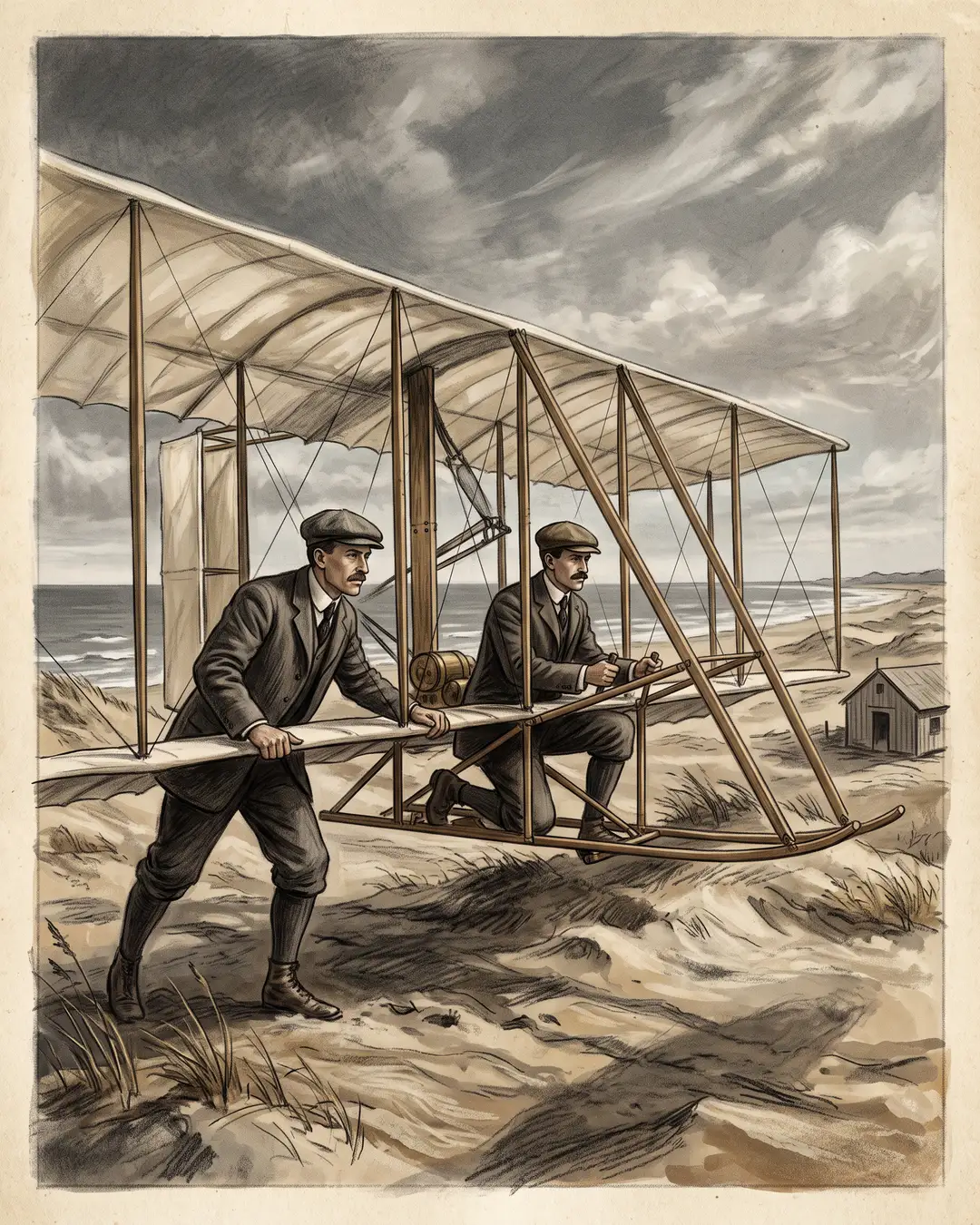
The Bishop's Sons
Wilbur Wright, born 1867, and Orville, born 1871, were sons of a Dayton bishop whose itinerant church politics taught them to trust family and fight long. Neither finished high school formally; a toy helicopter from their father, a printing business, and then a bicycle shop schooled them instead in precision mechanics and balance. The death of the glider pioneer Otto Lilienthal in 1896 fixed their attention: flight, Wilbur concluded, was a problem not of power but of control, which cyclists understood in their bodies.
They read everything the Smithsonian would mail them, corresponded with the engineer Octave Chanute, and watched buzzards twist their wingtips. Their answer, wing warping for banked turns, was tested on kites and gliders in the steady winds of Kitty Hawk, North Carolina. When the standard lift tables of the field failed them, they built a six-foot wind tunnel above the bike shop in 1901 and re-derived the data for hundreds of wing shapes themselves, a two-man research program that quietly corrected the published science of their day.
December 17, 1903
With a lightweight engine built by their machinist Charlie Taylor, a third collaborator the legend usually forgets, and propellers they reasoned out as rotating wings, the brothers returned to the dunes. On December 17, 1903, before five witnesses, Orville flew 120 feet in twelve seconds; the fourth flight that morning, Wilbur's, covered 852 feet in 59 seconds. A local lifesaver's snapshot became one of history's most examined photographs. Days earlier, the government-funded aerodrome of Samuel Langley had twice pitched into the Potomac, at a cost of some seventy thousand public dollars against the Wrights' roughly one thousand.
Almost as remarkable is what followed: near silence. Skeptical editors ran garbled accounts; the brothers, wary of imitators, flew circles over a Dayton cow pasture through 1904 and 1905, perfecting the first practical airplane while the world declined to look. Only in 1908, when Wilbur flew figure-eights before crowds at Le Mans, France, did doubt collapse overnight; European aviators, who had sniffed at bluffing Yankees, lined up to apologize. That same year Orville crashed at Fort Myer, breaking bones and killing his passenger, Lieutenant Selfridge, powered flight's first fatality.
The Patent and the Price
Then the lawyers took the controls. The Wrights' broad 1906 patent covered lateral control itself, and they enforced it fiercely, above all against Glenn Curtiss, in litigation that consumed Wilbur's final years; he died of typhoid in 1912 at forty-five, and the family blamed the strain. Historians still debate how much the patent war retarded American aviation before the government forced a wartime pool in 1917, but the leadership in flight the brothers won for their country had, by then, migrated to Europe. Their sister Katharine, who managed their public life and finances, remains the partnership's underwritten member.
Orville, no businessman, sold the company in 1915 and spent three more decades as aviation's reserved elder statesman, feuding with the Smithsonian, which long credited Langley's machine as capable of flight; the original 1903 Flyer went to London until the institution recanted, and it was installed in Washington only in 1948, weeks after Orville's death. He lived to see flight cross oceans and level cities, and told friends the airplane had gone the way of all inventions: he still believed the inventing had been right, whatever men did with it.


