When computer meant a person
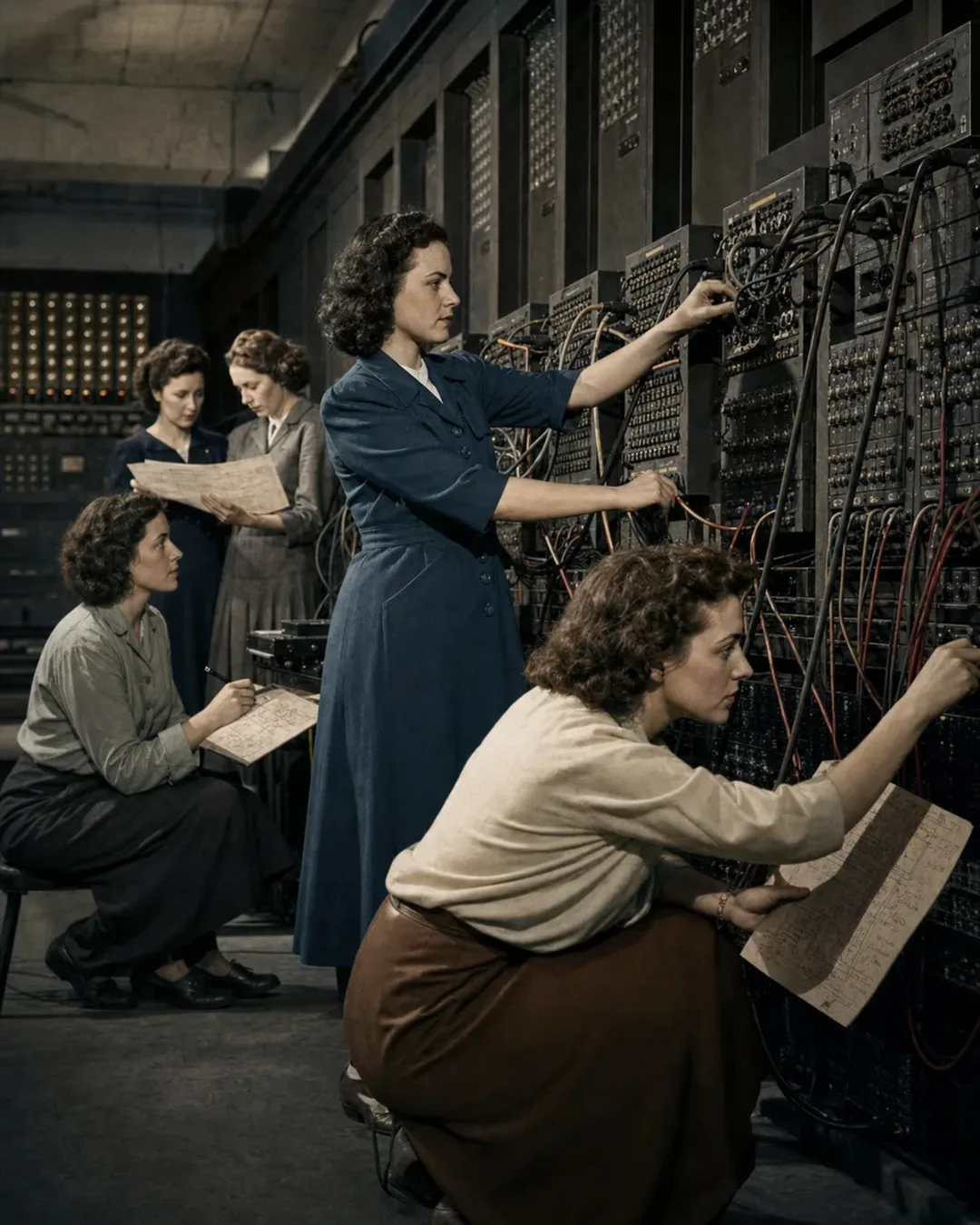
During the Second World War, the US Army employed women to calculate artillery firing tables. They were called computers. At the Moore School of Electrical Engineering, a team selected six of these mathematicians to program ENIAC: Frances Bilas Spence, Kathleen McNulty Mauchly Antonelli, Betty Jean Jennings Bartik, Ruth Lichterman Teitelbaum, Marlyn Wescoff Meltzer and Betty Snyder Holberton.
ENIAC filled a large room with electronic panels. It had no modern programming language, stored program or keyboard. To prepare a calculation, the women studied logical diagrams, decomposed equations into operations, configured switches and connected units with cables.
Programming before the profession
The programmers learned the machine deeply enough to diagnose faults and plan how data moved through its accumulators. Their work joined mathematics to intimate hardware knowledge. A successful run depended on sequencing operations and anticipating how one part of the machine triggered another.
When ENIAC was publicly demonstrated in February 1946, it calculated a trajectory in seconds. Contemporary publicity emphasized the machine and its male designers. The women's technical role received little recognition; in some photographs they were mistaken for models standing beside the equipment.
Recovering the record
Later oral histories, archives and researchers helped restore their names to the story. Several continued in computing. Holberton contributed to early programming systems and language standards; Bartik worked on converting ENIAC to a stored-program form and on later computers.
Their history changes what counts as invention. Hardware did not become useful by itself. The ENIAC programmers created methods for expressing a problem in operations a machine could execute. At the beginning of electronic computing, programming was already a discipline of logic, collaboration and painstaking translation.


