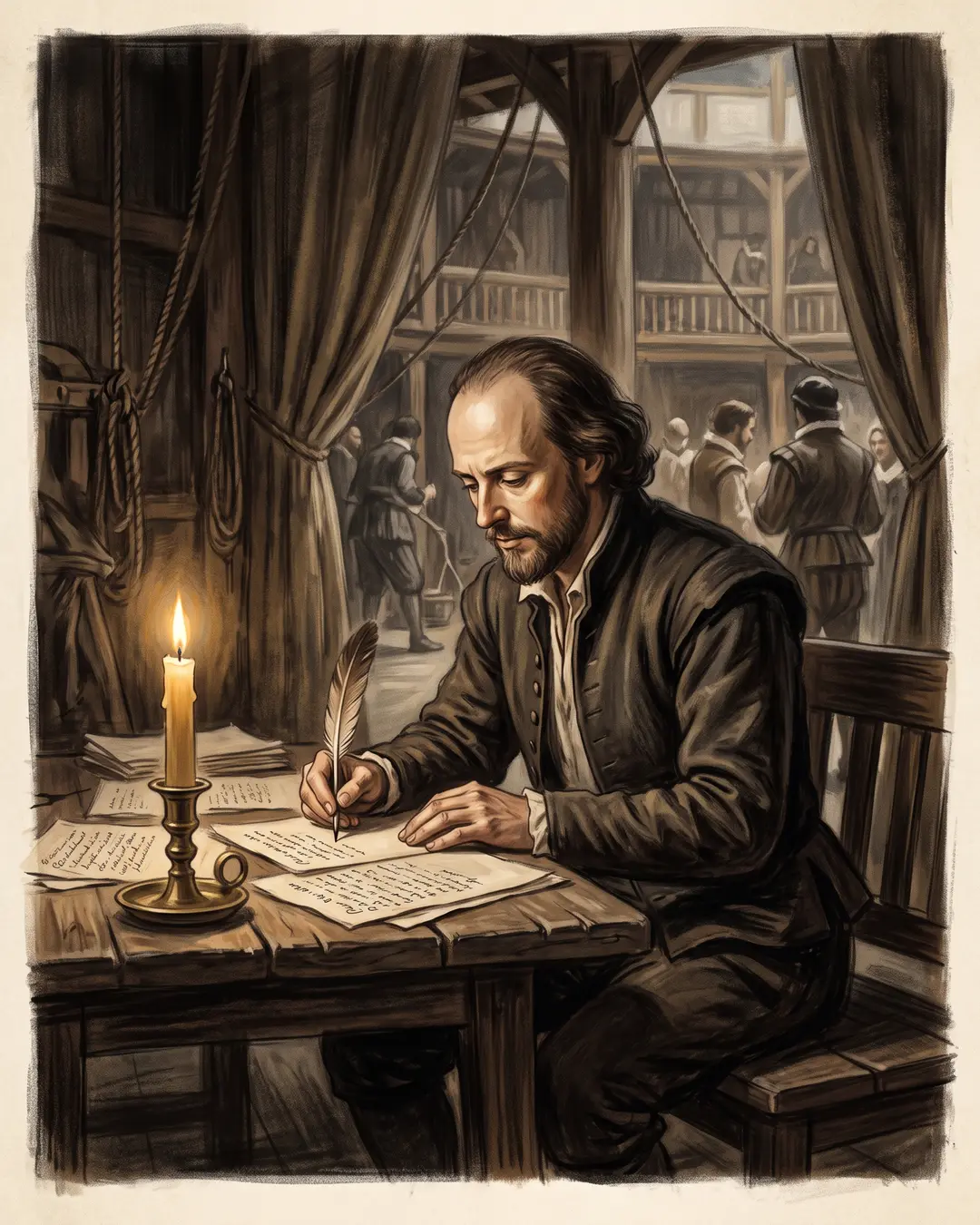
From Stratford to the Globe
William Shakespeare was baptized in Stratford-upon-Avon in April 1564, son of a glover who rose to town office and later fell into debt. He almost certainly attended the local grammar school, an education soaked in Latin rhetoric, though no enrollment records survive. At eighteen he married Anne Hathaway, with whom he had three children. Then the documents fall silent for years, the so-called lost years, until 1592, when a dying London playwright, Robert Greene, sneered in print at an upstart crow from the provinces who fancied himself the only Shake-scene in the country.
By 1594 Shakespeare was a founding shareholder in the Lord Chamberlain's Men, later the King's Men, the most successful playing company of the age. That business position, rare among playwrights, made him prosperous: he co-owned the Globe theatre from 1599, bought one of Stratford's grandest houses and dealt shrewdly, sometimes grasping, in land, tithes and grain. The records that survive him are mostly of this kind, lawsuits, leases and a will, the paper trail of a working man of the theater rather than a legend.
A working playwright
Across roughly twenty-five years Shakespeare wrote about thirty-eight plays, moving through histories, comedies and the great tragedies, Hamlet, Othello, King Lear, Macbeth, into late romances like The Tempest. He wrote for particular actors, recycled old plots from chronicles and Italian tales, and collaborated as the trade demanded: scholars now credit portions of several plays to co-authors, including Thomas Middleton and John Fletcher. He also published narrative poems during plague closures and, in 1609, the Sonnets, whose autobiographical content remains unresolvable speculation.
His language reshaped English less by coining thousands of words, a claim modern scholarship has trimmed, than by demonstrating what the language could do: soliloquies that think in real time, prose that shifts register mid-scene, blank verse flexible enough for kings and gravediggers. The plays survive because of an act of friendship. In 1623, seven years after his death, his fellow actors John Heminges and Henry Condell assembled the First Folio, preserving eighteen plays, including Macbeth and Twelfth Night, that had never before been printed.
Documents, doubts and afterlife
The gap between the modest documentation and the towering work has bred conspiracy theories assigning the plays to Francis Bacon, the Earl of Oxford or Christopher Marlowe. Academic consensus finds no substance in them: contemporary title pages, official records and the testimony of fellow writers, including Ben Jonson's Folio tribute, identify the Stratford actor as the author. The doubt itself is a nineteenth-century invention, born partly of snobbery about what a grammar-school glover's son could achieve.
The afterlife has no parallel. The plays crossed languages within decades of his death and have since been translated into more than a hundred, performed and reinvented on every continent, quarried by opera, cinema and politics. Each age finds its own Shakespeare, which is possible because the plays argue with themselves: about power, conscience, race, gender and mercy. The man remains partly out of reach, a citizen of parish registers and property deeds; the work remains the most continuously alive body of literature ever produced by one writer.


