A stone from far away
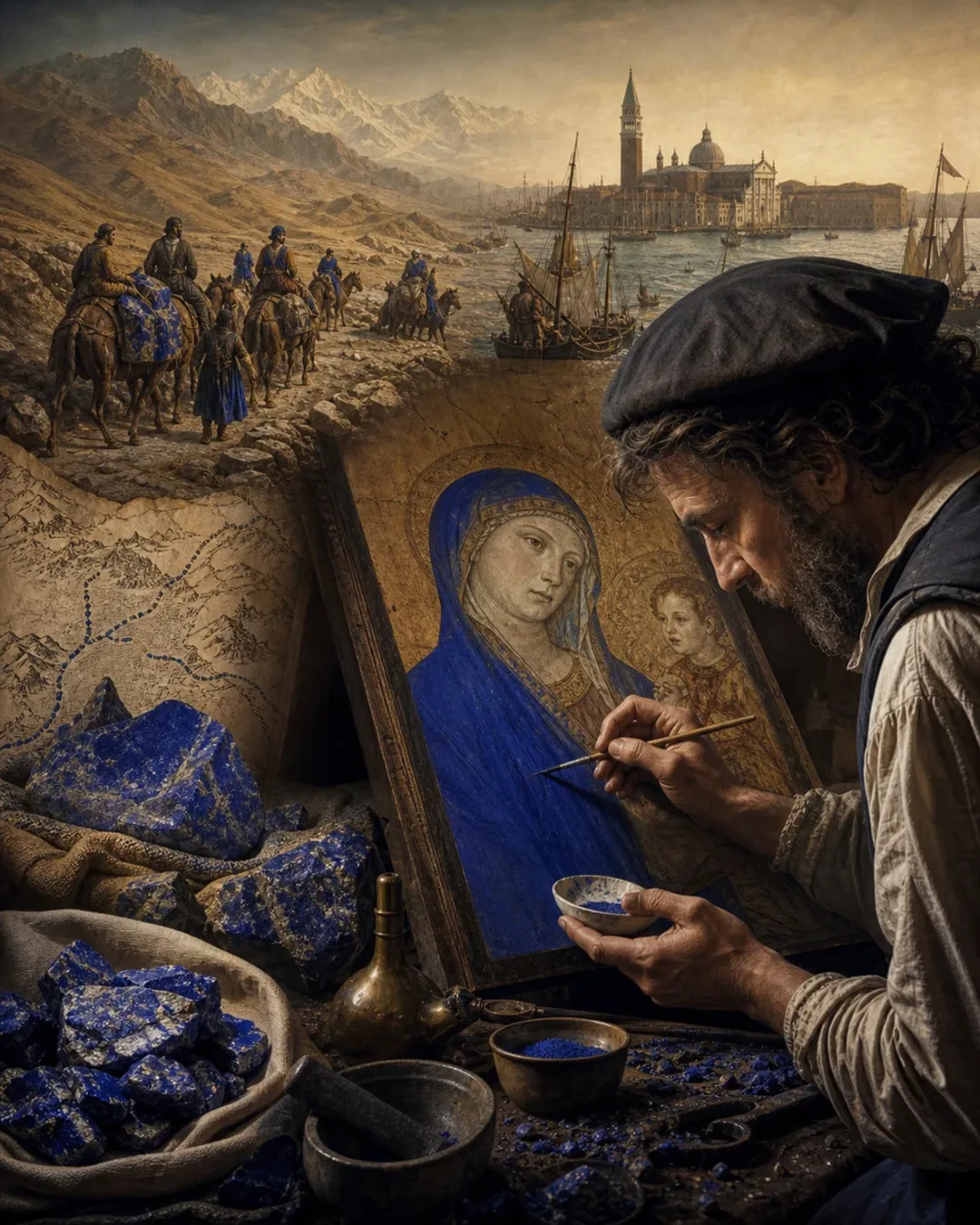
For centuries, the finest natural ultramarine began in lapis lazuli mined in the mountains of what is now Afghanistan. The stone travelled through networks of merchants and ports before reaching European workshops. Its name derives from the idea of coming from 'beyond the sea.' Distance was built into its prestige.
Turning lapis into paint was not a matter of simply grinding it. The blue-bearing mineral lazurite had to be separated from pale impurities through a laborious process involving waxes, resins and repeated kneading. The richest early extraction produced the deepest color; later washes yielded paler grades.
A color with a contract
In Renaissance Europe, natural ultramarine could be extraordinarily costly. Patrons sometimes specified its quantity and quality in contracts. Painters reserved it for passages meant to carry visual and spiritual weight, including the robes of the Virgin Mary.
Price did not stay constant everywhere, and the familiar phrase 'more expensive than gold' should be treated as context-dependent rather than a universal rule. Still, the pigment's documented expense shaped how it was bought, layered and seen. Color was material evidence of devotion and status.
The chemistry of abundance
In the 1820s, a competition encouraged the development of a synthetic alternative. Artificial ultramarine made a brilliant, stable blue far more widely accessible. What had depended on rare stone and long-distance trade could now be produced through chemistry.
The older paintings keep the geography of natural ultramarine within them. A patch of blue can connect a mine in Central Asia, merchants across continents, a patron's budget and the trained hand of a workshop. Pigment is never merely color; it is a map of labor and exchange.


