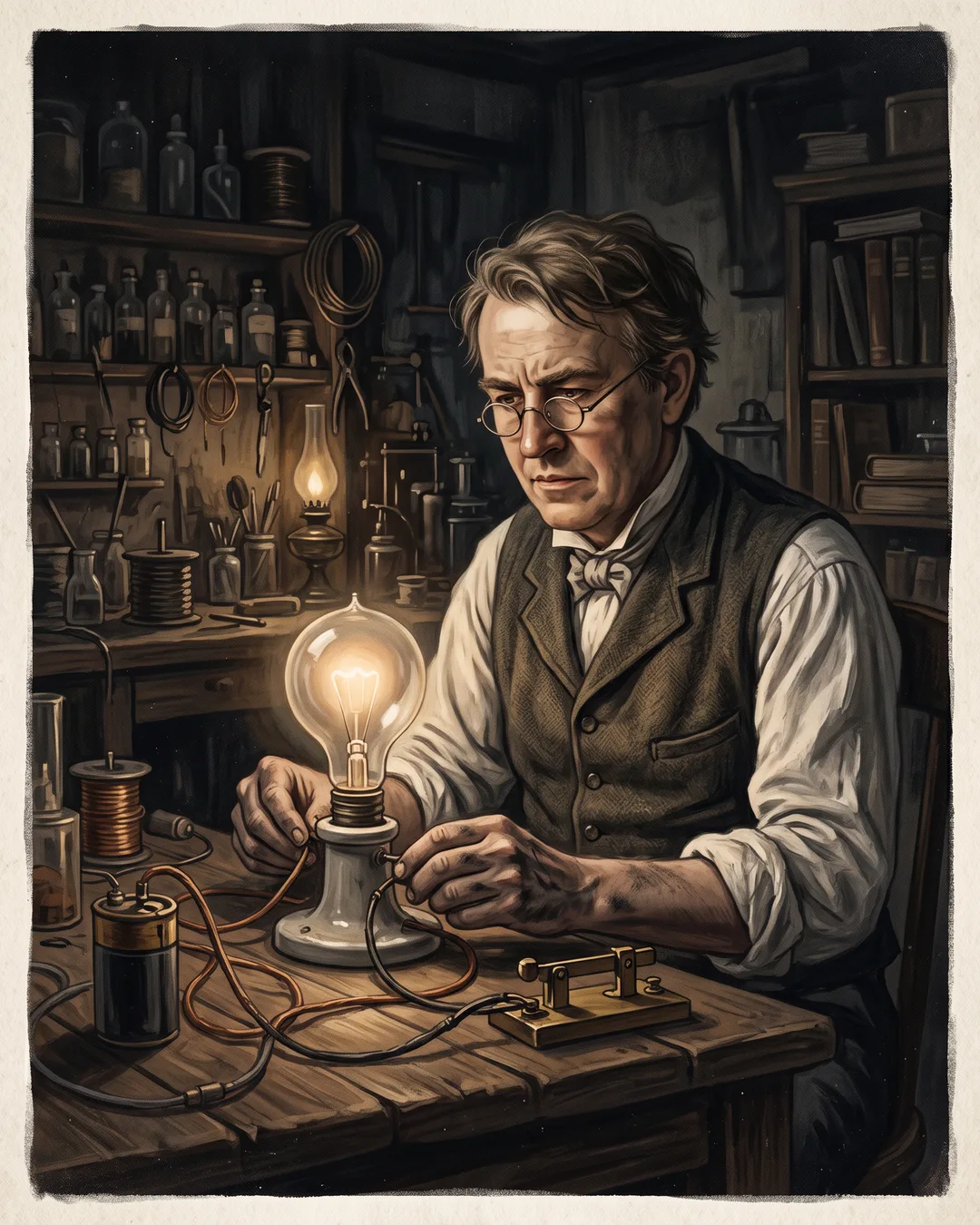
The Wizard Was a Team
Thomas Alva Edison, born in Ohio in 1847 and raised in Michigan, was a hustling newsboy and tramp telegrapher, largely deaf from childhood, who taught himself electricity on night shifts. Early patents in telegraphy bought him something unprecedented in 1876: Menlo Park, New Jersey, the first industrial research laboratory, staffed with machinists, chemists, and mathematicians and aimed, he said, at a minor invention every ten days and a big thing every six months. The wizard image was publicity; the reality, an invention factory, was more original than any single device.
The muckers, as his crew called themselves, deserve names: Charles Batchelor, his closest collaborator on nearly everything; the mathematician Francis Upton; the machinist John Kruesi, who built the first phonograph from a bench sketch in 1877. That talking machine, which genuinely astonished the world, was Edison's most nearly solo stroke. The incandescent lamp of 1879 was the opposite: carbon-filament lamps had precursors, Joseph Swan lit one in England, and Edison's victory lay in the system, a durable filament plus dynamos, meters, wiring, and in 1882 the Pearl Street station lighting lower Manhattan.
Currents and Cruelty
Edison the businessman fought dirtier than Edison the inventor. Committed to direct current, he watched George Westinghouse and Nikola Tesla's alternating current win on physics, and responded with a fear campaign: his camp publicized animal electrocutions with AC and maneuvered to power the first electric chair with a Westinghouse generator in 1890, hoping people would say a criminal had been westinghoused. The 1903 film of Topsy the elephant's electrocution at Coney Island, often hung on Edison personally, was shot by his film company at an amusement park's killing; the myth outruns the crime, but the current wars were ugly enough without it.
Tesla, who worked for him briefly, left embittered by a disputed bonus story; either way, Edison underpaid brilliance systematically. His movie trust litigated rivals so hard that filmmakers fled to California, accidentally founding Hollywood. Yet the ore-milling venture that swallowed millions shows the other face: he absorbed colossal failure cheerfully, recycled the machinery into a cement business, and kept his laboratories, moved to West Orange in 1887, producing: a practical storage battery, the fluoroscope, movie cameras, dictation machines. His 1,093 US patents remain a record for one name, resting on many hands.
What the Legend Is Worth
The Edison of schoolbooks, the lone genius of one percent inspiration and ninety-nine percent perspiration, was partly his own manufacture, tended with reporters over midnight sandwiches. The historical Edison is more instructive: a manager of innovation who systematized trial and error at industrial scale, tested thousands of filament materials because theory could not yet shortcut the search, and understood that an invention is not a device but a business embedded in wires, patents, and press. Modern R and D departments, from Bell Labs to Silicon Valley, descend from Menlo Park more than from any single machine.
He worked nearly to his death in October 1931, deaf, imperious, and beloved; on the night of his funeral, at the president's suggestion, Americans dimmed their lights in tribute. The reassessments since have restored his collaborators, tallied the sharp practice, and punctured the myths, including the durable internet fiction that he stole everything from Tesla, which flattens two complicated men into a morality play. What survives audit is formidable: recorded sound, workable urban light and power, the movie studio, and the institution, the organized invention of invention, that produced them.


