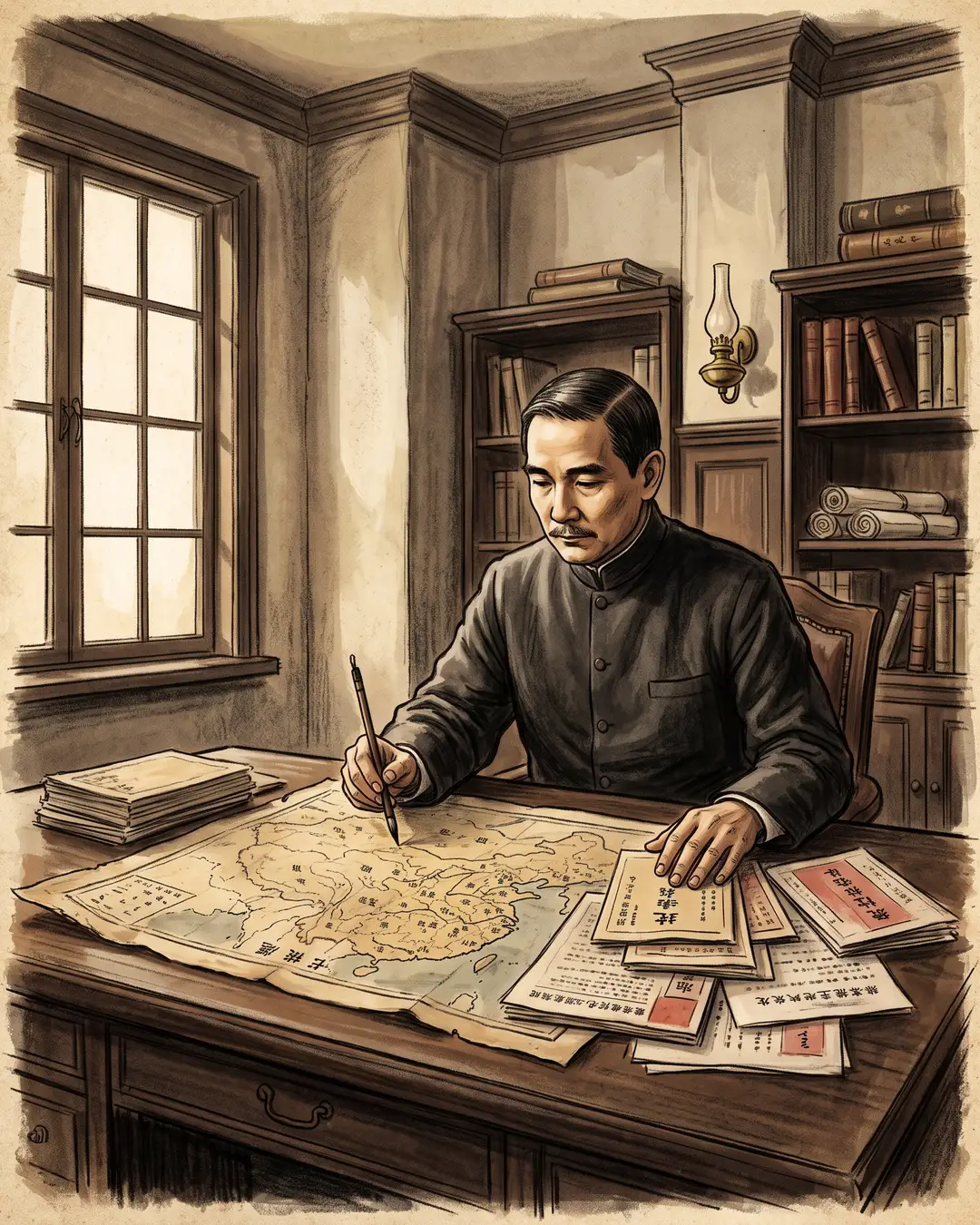
A Doctor Chooses a Larger Patient
Sun Yat-sen was born in 1866 to a farming family in Cuiheng village, Guangdong, and remade at thirteen by emigration: sent to an elder brother in Hawaii, he absorbed English, Christianity, and constitutional ideas, then trained as a physician in Hong Kong, graduating in its medical college's first class in 1892. Watching the Qing dynasty lose war after war and concession after concession, he concluded the empire itself was the disease. After a rebuffed reform petition in 1894, he founded the Revive China Society in Honolulu among merchants and laborers of the overseas Chinese world that would fund him for life.
His first uprising, at Canton in 1895, collapsed before it began; colleagues were executed, and Sun began sixteen years of exile with a price on his head. In London in 1896 Qing agents lured him into their legation and prepared to ship him home for execution; smuggled messages to his old Hong Kong teacher James Cantlie brought the Foreign Office and the press down on the kidnappers, and the freed prisoner woke up world-famous. He spent the following years circling the globe, out-organizing rival reformers in Chinatowns from Vancouver to Penang, a revolutionary sustained by laundrymen's donations.
Three Principles and Ten Failures
In Tokyo in 1905 he merged rival groups into the Revolutionary Alliance and articulated the Three Principles of the People: nationalism, meaning the end of Manchu rule and foreign domination; democracy, arriving by stages; and people's livelihood, a land-and-welfare program vague enough to be claimed later by parties that despised each other. Roughly ten risings financed and launched from abroad failed between 1895 and 1911, each consuming money and martyrs. When the Wuchang garrison mutinied on October 10, 1911, and the dynasty began to fall in earnest, Sun read about it in a Denver newspaper between fundraising stops.
He hurried home via London, seeking loan guarantees, and delegates at Nanjing elected him provisional president of the Republic of China on January 1, 1912. Within weeks he honored a bargain: the presidency passed to Yuan Shikai, the general who could deliver the emperor's abdication but not his own loyalty to republicanism. Yuan hollowed the parliament, arranged the assassination of Sun's ally Song Jiaoren in 1913, and eventually tried on the throne itself. Sun fled again, and his second act was harder-edged: a Canton-based rival government, alliances of convenience with warlords, and a party reorganized in 1924 on Leninist lines with Soviet advisers and money, accepting Communists as members.
An Unfinished Man, Claimed by Everyone
Honesty complicates the halo. Sun was a mediocre administrator and a sometimes reckless conspirator; he traded promises to Japanese backers that critics called concessions of sovereignty; his final party-state design, with democracy deferred through a period of tutelage, furnished authoritarian tools to successors on both sides of the Chinese civil war. His personal life had its own asymmetries: the arranged first wife of his village youth, and his 1915 marriage to the young Soong Ching-ling over her family's objection. He died of cancer in Beijing in March 1925, urging in his will that the revolution was not yet finished.
Death made him infinitely useful. The Nationalists built him a colossal mausoleum in Nanjing and a cult as Father of the Nation; the Communists canonized him as a forerunner whose widow stood on their rostrum in 1949; today Taipei and Beijing, agreeing on almost nothing, both hang his portrait. That double canonization is possible because his program was capacious and his death early, but also because the core aspiration was real: that China's ancient civilization could govern itself as a modern republic of its own people. The centenary of his death found the argument over his inheritance still, unmistakably, alive.


