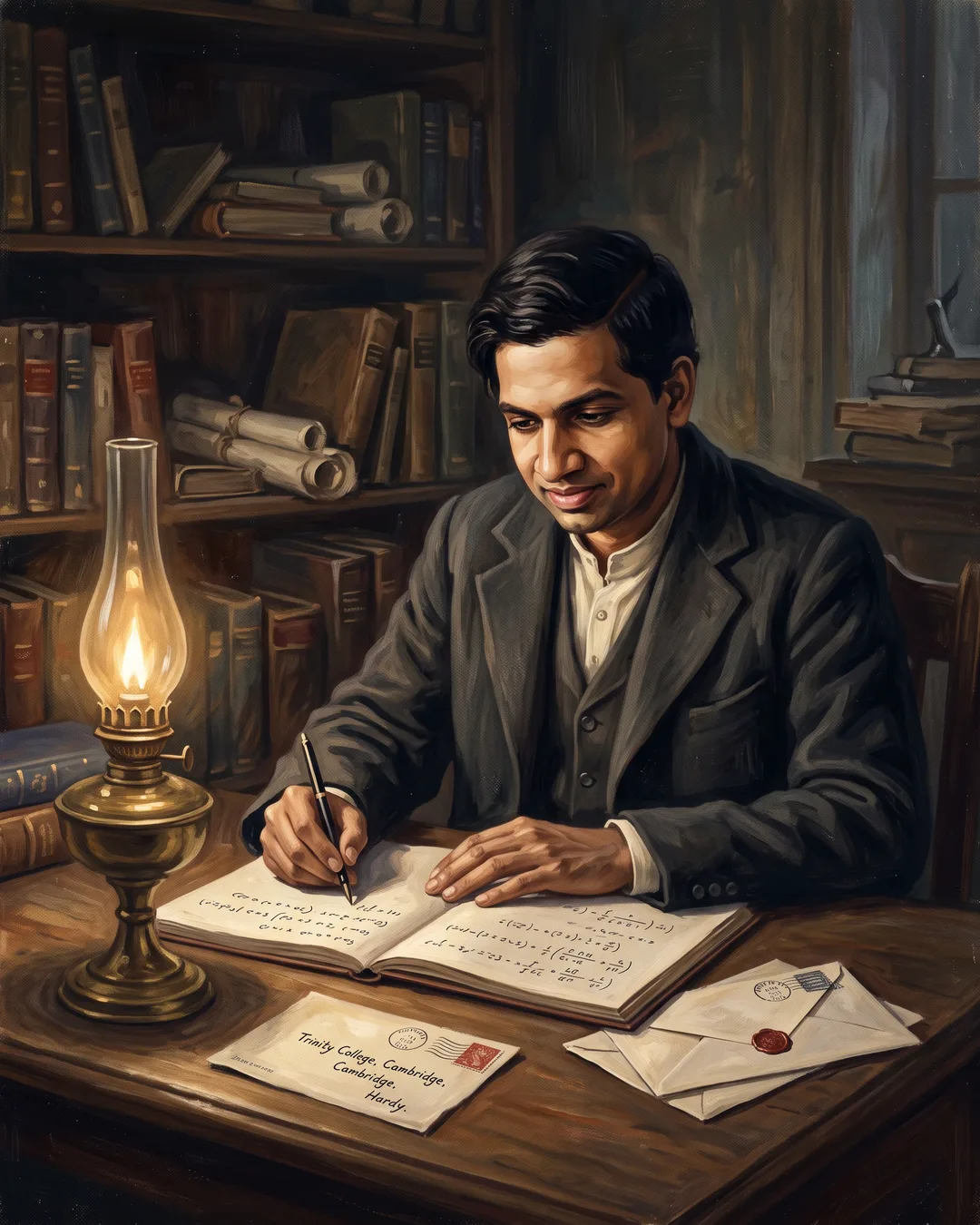
The Notebooks of Kumbakonam
Srinivasa Ramanujan was born in 1887 in Erode and raised in Kumbakonam in South India, the son of a sari shop clerk and a mother, Komalatammal, whose fierce belief in him never wavered. A borrowed synopsis of five thousand theorems, Carr's dry Cambridge cram book, detonated something: the teenager began filling notebooks with results of his own, rediscovering a century of European mathematics and then passing it. The cost was total; obsessed, he failed his other college subjects twice, lost his scholarships, and drifted for years in poverty, a genius with no credential and no audience.
Marriage at twenty-one to ten-year-old Janaki, a match arranged in the custom of the time, forced him toward employment, and Indian patrons of mathematics eventually placed him as a clerk at the Madras Port Trust, where sympathetic superiors let him calculate. He attributed his formulas to the goddess Namagiri of his family's devotion, saying an equation meant nothing to him unless it expressed a thought of God. Whatever one makes of the theology, the psychology is clear: he experienced mathematics as revelation, arriving whole, with proofs to be arranged afterward, if at all.
Hardy's One Romantic Incident
In January 1913 Ramanujan mailed nine pages of theorems to G. H. Hardy of Trinity College, Cambridge. Two earlier letters to other English mathematicians had gone unanswered; Hardy nearly dismissed this one too, then spent an evening with Littlewood over the strange formulas and concluded they must be true, because no one would have had the imagination to invent them. Hardy later called the correspondence the one romantic incident of his life. Overcoming caste prohibitions on crossing the sea, blessed reportedly by Namagiri in a dream of his mother's, Ramanujan sailed in 1914.
The five Cambridge years were a collision of gifts: Ramanujan's oracular leaps and Hardy's rigor produced landmark work, including the circle method and their astonishing formula for counting partitions. Honors followed against the era's grain: Fellow of the Royal Society in 1918, among the youngest ever, and the first Indian elected Fellow of Trinity. But wartime England starved a strict Brahmin vegetarian, the climate battered him, and isolation deepened into a depression so severe that he attempted suicide on the London Underground. Genius was celebrated; the man sustaining it was quietly coming apart.
The Lost Notebook
Diagnosed with tuberculosis, though modern reviews suspect hepatic amoebiasis, a treatable parasitic infection, he returned to India in 1919 and died in April 1920, aged thirty-two, with Janaki nursing him. He worked until the end; the famous taxicab exchange, in which he instantly identified 1729 as the smallest number expressible as a sum of two cubes in two different ways, dates from his sickbed. His notebooks held nearly four thousand results, many without proof, which mathematicians led by Bruce Berndt spent decades verifying, almost all successfully.
In 1976 George Andrews found the so-called lost notebook in a Trinity College box: one hundred pages from Ramanujan's final year, including mock theta functions whose depths connected, decades later, to black hole physics and string theory. Janaki, who lived until 1994 doing tailoring work and asking why honors came so late, saw his reputation grow into national sainthood; India now marks his birthday as National Mathematics Day. Hardy, asked to rate mathematicians on pure talent, gave himself 25, Hilbert 80, and Ramanujan 100, a joke he did not entirely intend as one.


