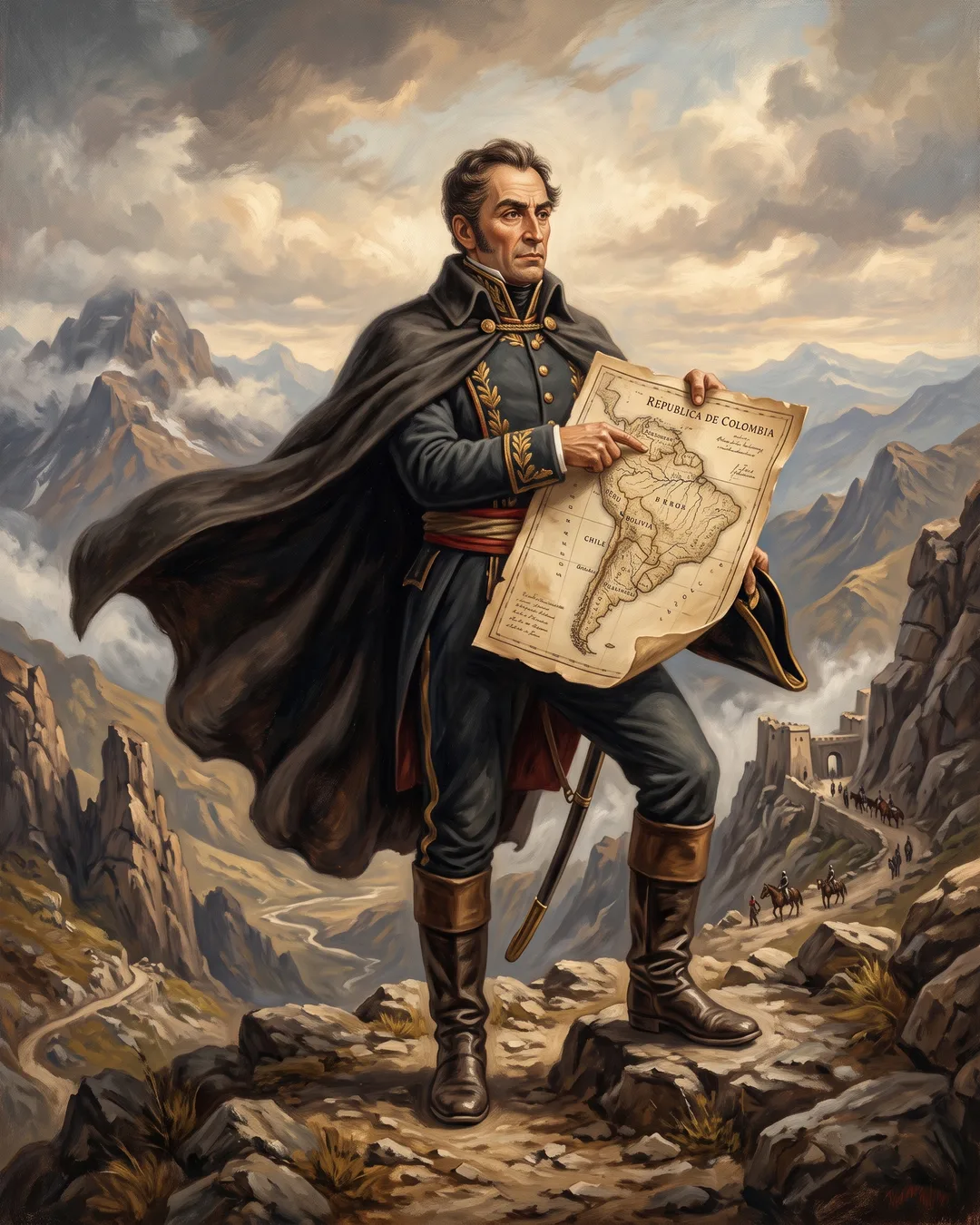
A Rich Orphan Becomes a Republican
Simon Bolivar was born at Caracas in 1783 into one of the wealthiest creole families in Venezuela, its fortune built on cacao, copper, and the labor of enslaved Africans on family estates. Both parents died before he was ten. His education fell to tutors, above all the eccentric Simon Rodriguez, who fed him Rousseau and made him walk. In Europe as a young man he married, lost his wife Maria Teresa to fever within a year, and turned from private life to the politics of a Spanish empire being shaken by Napoleon.
The first Venezuelan republic collapsed in 1812, undone by an earthquake, royalist resistance, and its own narrow base. Bolivar concluded that moderation had failed. In 1813 he issued the Decree of War to the Death, promising execution to Spaniards who did not actively join the cause and pardon to Americans even if guilty. It was a deliberate act of terror meant to force a colonial society to choose sides, and it produced atrocities on both sides that scarred the war for a decade.
Crossing the Andes
Exiled again, he found refuge in Haiti, where President Alexandre Petion supplied arms and ships on the condition that he free the enslaved in the territories he liberated. Bolivar decreed emancipation in 1816 and pressed freedmen into his armies; implementation was uneven, and slavery persisted in parts of the region for decades after his death. The turn came in 1819, when he took an army across flooded plains and a freezing Andean pass into New Granada and destroyed a royalist force at Boyaca, winning a whole viceroyalty in about ninety days.
Carabobo in 1821 secured Venezuela. Antonio Jose de Sucre, the ablest of his generals, won Pichincha in 1822 and then Ayacucho in 1824, which effectively ended Spanish rule on the mainland. The victories were never his alone. The llanero cavalry of Jose Antonio Paez, British and Irish volunteers, and the discipline of Sucre mattered as much as Bolivar's own extraordinary stamina, and his later quarrels with those same men would help pull the new republics apart.
The Authoritarian Turn
Bolivar's political thought grew steadily darker about what liberated peoples could sustain. The constitution he wrote for Bolivia in 1826 proposed a president for life with the power to name his successor, a design he defended as the only stable ground between anarchy and monarchy. In 1828, with Gran Colombia fracturing, he assumed dictatorial powers and abolished the vice presidency of his rival Francisco de Paula Santander. In September that year conspirators broke into his residence, and he escaped through a window after his companion Manuela Saenz delayed them.
The union of Venezuela, New Granada, and Ecuador dissolved in 1830. Paez led Venezuela out; Sucre was assassinated in June; Bolivar resigned, planned exile in Europe, and died of tuberculosis near Santa Marta in December, aged forty-seven, disillusioned and largely unmourned by the politicians he had made. Latin American governments of every stripe have claimed him since, which tells more about them than about him. The record shows a liberator of rare daring and a ruler who, faced with disorder, reached for unchecked power.


