Before the Bus
Rosa Louise McCauley was born in Tuskegee, Alabama, in 1913 and raised partly by a grandfather who sat up nights with a shotgun when the Klan rode. She married Raymond Parks, an activist raising money for the Scottsboro defendants when such work could get a man killed, and in 1943 became secretary of the Montgomery NAACP. For twelve years she documented the underside of Jim Crow: registering to vote on the third humiliating attempt, and in 1944 traveling to Abbeville to investigate the gang rape of the sharecropper Recy Taylor, helping force the case into national attention though the rapists were never charged.
The bus system was a daily front in that war. Drivers carried guns, took Black passengers' fares at the front, and made them reboard through the rear door; one driver, James Blake, had ejected Parks himself in 1943. In March 1955 the teenager Claudette Colvin was arrested for the same refusal; movement lawyers judged the moment and the plaintiff, unmarried and pregnant, wrong for a test case, a calculation history should record rather than smooth over. Parks, meanwhile, spent the summer of 1955 at Highlander Folk School, an integrated organizing workshop, and came home, she said, ready.
Three Hundred Eighty-One Days
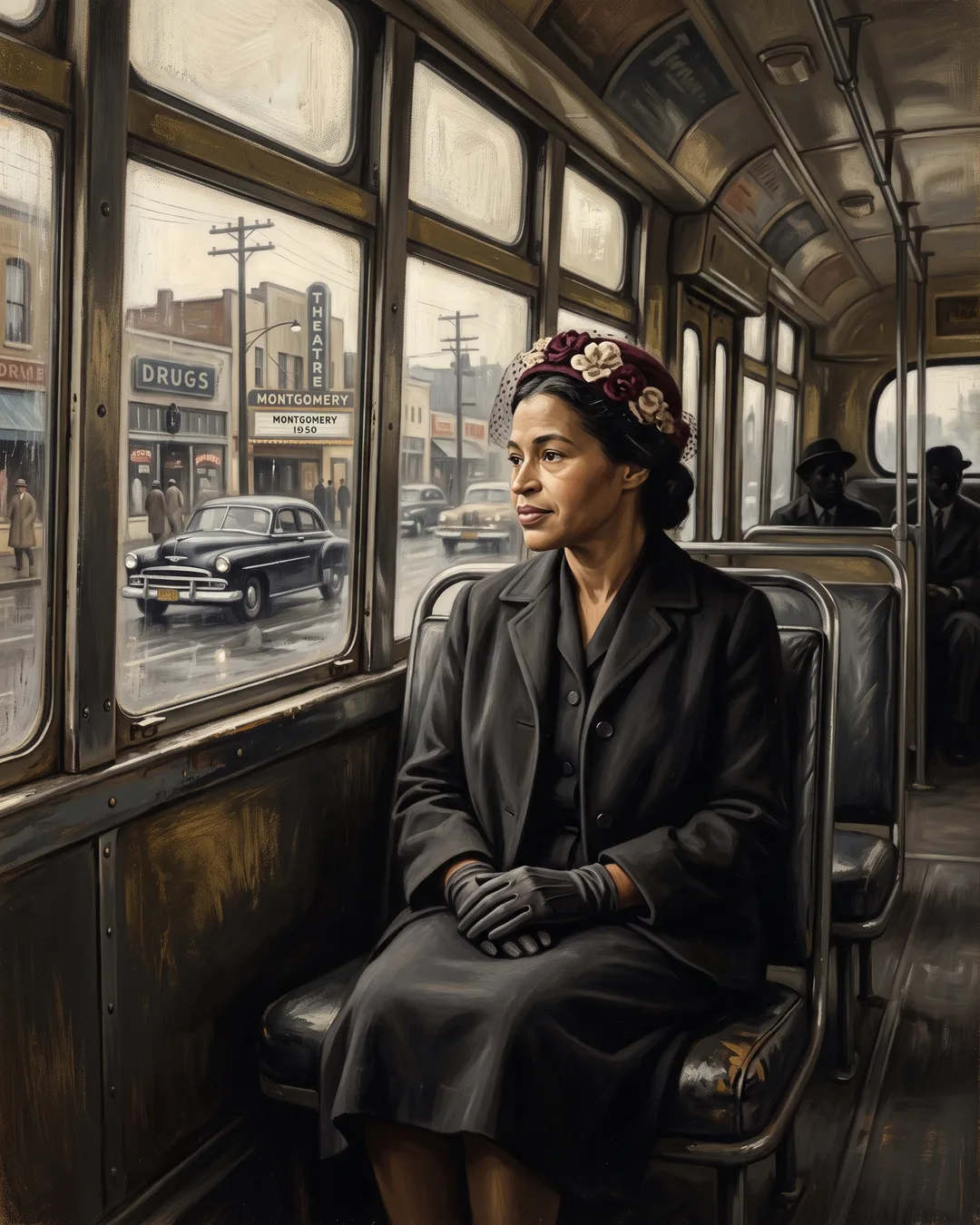
On December 1, 1955, on Blake's bus again, Parks refused his order to surrender her seat in the unmarked middle section to a standing white man. She was not sitting in the white section, and she was not, she insisted all her life, physically tired: the only tired I was, she wrote, was tired of giving in. Her arrest gave E. D. Nixon and the Women's Political Council, whose Jo Ann Robinson mimeographed thirty-five thousand boycott leaflets overnight, the defendant they trusted. The one-day bus boycott called for December 5 held almost completely, and that evening a young pastor named Martin Luther King Jr. was drafted to lead it.
It lasted three hundred eighty-one days: carpools organized with military precision, mass meetings, indictments, and the firebombing of King's and Nixon's homes. Victory came through the courts, in Browder v. Gayle, a case built on Colvin and three other women, when the Supreme Court affirmed in November 1956 that bus segregation was unconstitutional. On December 21 Parks posed for photographers on an integrated bus. The cost was immediate: she and Raymond lost their jobs, the death threats never stopped, and in 1957 they left Alabama for Detroit, essentially broke.
The Long Second Act
The icon years came with thin material support, a gap the movement itself later acknowledged; she worked as a seamstress until 1965, when Congressman John Conyers hired her, and she served in his Detroit office for over twenty years, working on housing, prisons, and job discrimination. Her politics were broader than the schoolbook version: she attended Malcolm X's addresses with admiration, supported the Black Power conferences of the sixties, protested apartheid outside the South African embassy in her seventies, and co-founded an institute to carry youth through the history she had made.
Honors arrived in a late flood: the Presidential Medal of Freedom in 1996, the Congressional Gold Medal in 1999, and after her death in 2005, the first lying in honor of a woman in the Capitol Rotunda, where forty thousand people filed past. The myth of the meek, weary seamstress persists, and historians keep correcting it because the correction matters: what happened on that bus was not an accident of fatigue but a decision, prepared by years of unglamorous work, taken by a woman who knew exactly what it might cost.


