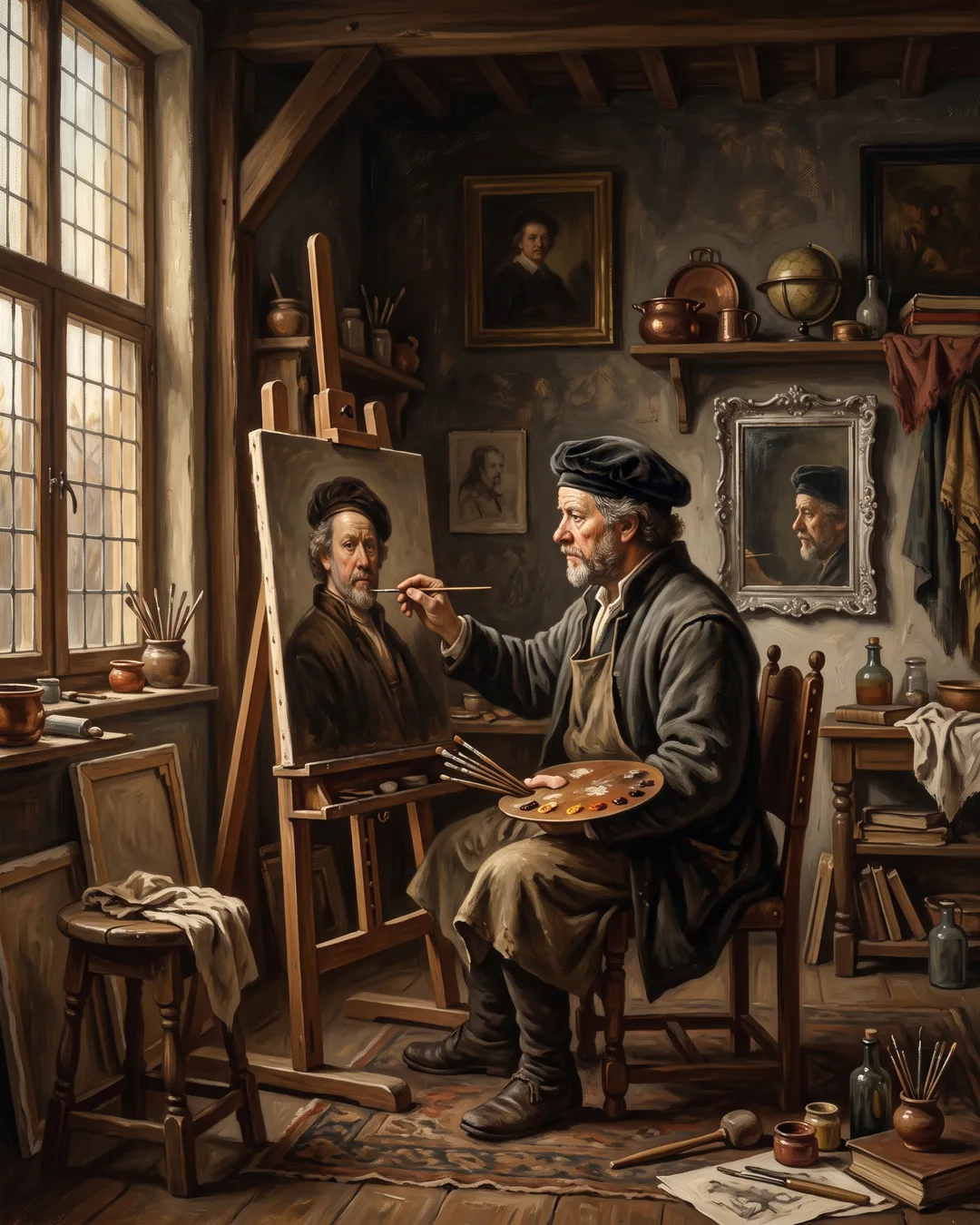
A Miller's Son Conquers Amsterdam
Rembrandt Harmenszoon van Rijn was born in Leiden in 1606, one of many children of a prosperous miller who sent him to Latin school and then to university, which he abandoned for painting. After a short apprenticeship with Pieter Lastman in Amsterdam he came home, set up with his friend Jan Lievens, and attracted the attention of Constantijn Huygens, secretary to the Dutch stadtholder. By his mid-twenties he had moved to Amsterdam and joined the workshop of the dealer Hendrick Uylenburgh, painting portraits for the merchants of the richest city in Europe.
Success came fast. His Anatomy Lesson of Doctor Nicolaes Tulp in 1632 announced a painter who could compose a crowd around a single dramatic act, and commissions followed from patricians and from the court at The Hague. In 1634 he married Saskia van Uylenburgh, the dealer's cousin, who brought a substantial dowry. Rembrandt bought a large house on the Breestraat on credit and filled it with armor, shells, prints, and busts. He was also a superb etcher, and the print market carried his name across Europe long before his paintings traveled.
The Great Year and the Losses
In 1642 he delivered the militia group portrait known as The Night Watch, a canvas that broke the convention of static rows by throwing a company into motion under a shaft of light. The persistent story that patrons hated it has little support; the painting hung in the militia hall until it was moved in 1715 and trimmed on all sides to fit a wall in the town hall, which is why the composition now sits slightly off balance. Its darkness came from varnish and grime, not from the artist's intention.
That same year Saskia died at thirty, months after the birth of their son Titus, the only one of their four children to reach adulthood. What followed is the hardest part of the record. Geertje Dircx, hired as Titus's nurse and later Rembrandt's companion, sued him for breach of promise; he was ordered to support her and then took part in having her confined to a house of correction in Gouda for years. His later companion, Hendrickje Stoffels, was summoned before the church council for living with him unmarried.
Bankruptcy and the Last Style
In 1656 he filed for a form of insolvency that avoided outright bankruptcy, and inventories were made of everything he owned. The house and the collection were auctioned over the following years at poor prices during a slump. Titus and Hendrickje set up a business to employ him as a salaried worker, an arrangement that let him keep painting while his creditors were kept off. He never recovered financially, and fashion moved toward the smooth, bright manner of younger painters that his rough surfaces plainly refused.
He kept working anyway, and the late pictures are the ones that changed art: paint laid on in ridges, faces built out of shadow, subjects caught in the moment before speech. Hendrickje died in 1663, Titus in 1668, and Rembrandt in October 1669, buried in a rented grave. He left roughly eighty self-portraits in paint, etching, and drawing, a record of one face aging without disguise. Modern scholarship has stripped hundreds of works from his catalogue, giving them back to his many pupils, which only sharpens what remains.


