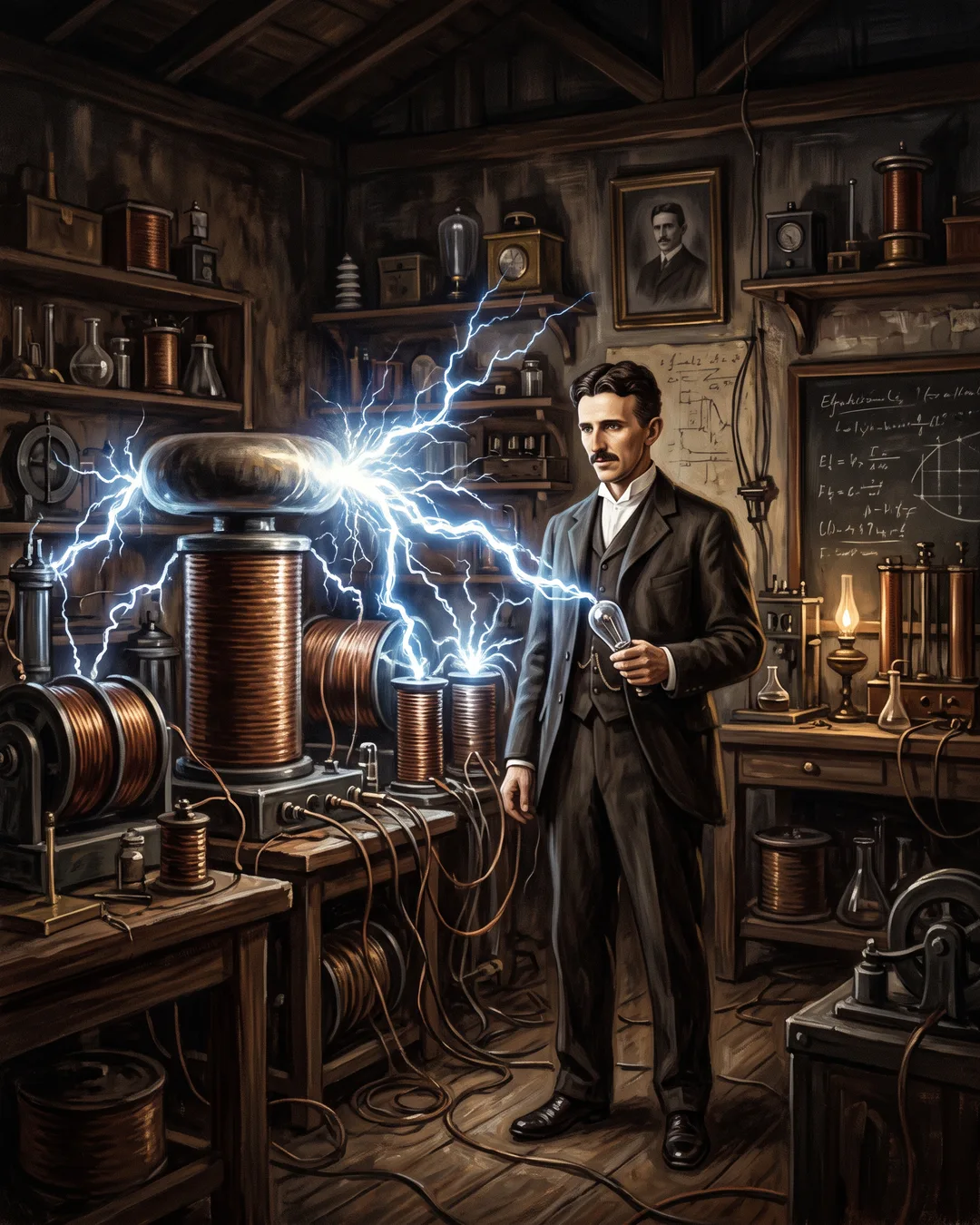
From Smiljan to Manhattan
Nikola Tesla was born in 1856 at Smiljan, in the Austrian Empire's Military Frontier, the son of a Serbian Orthodox priest who expected him to enter the church. An engineering scholarship took him to the polytechnic at Graz, where he worked ferociously, then stopped attending and left without a degree after gambling losses. He worked in Budapest on a telephone exchange and for the Continental Edison Company in Paris, where he first tried to interest employers in a motor driven by alternating current, and found no one willing to fund it.
He arrived in New York in 1884 and worked briefly for Thomas Edison, leaving after a dispute over payment for improvements he had made. For a period he dug ditches. By 1888 he held the key patents for a practical induction motor and polyphase system, and George Westinghouse licensed them. The so-called war of the currents that followed was a commercial fight in which Edison's camp publicized electrocutions to discredit alternating current. Tesla's system won because it could transmit power efficiently over distance, and the Niagara Falls plant proved it.
Genius Without a Ledger
He was a spectacular demonstrator, lighting lamps without wires at the 1893 Chicago exposition and filling laboratories with engineered lightning. He was also a poor businessman. By most accounts he tore up his royalty contract during Westinghouse's financial crisis, relinquishing a fortune to keep the company alive, and later versions of the story vary in detail. At Colorado Springs in 1899 he built enormous coils, produced discharges over a hundred feet long, burned out the town's generator, and recorded signals he suggested might come from Mars.
Wardenclyffe was the great failure. Backed by J. P. Morgan, Tesla began a tower on Long Island that he promised would carry messages across the Atlantic, then expanded the plan to transmit electrical power itself without wires. Morgan declined further funding once Marconi sent signals across the ocean more cheaply, work ended in 1906, and the tower was demolished for scrap in 1917. The scheme rested on assumptions about the earth's conductivity that do not hold, and no version of it has ever worked.
The Long Coda
His later years produced remarkable engineering, including a bladeless turbine and a radio-controlled boat demonstrated in 1898, and a stream of announcements that outran evidence, notably a directed-energy weapon he offered to governments in the 1930s. He lived in hotels, fed pigeons in Bryant Park, suffered from severe compulsions about numbers and cleanliness, and slid into debt. Westinghouse quietly paid some of his bills. He died alone at the Hotel New Yorker in January 1943, and his papers were seized by federal officials before being released to his family.
Months later the Supreme Court ruled on radio patents in a case that restored certain Tesla claims against Marconi's, a decision often misreported as proof that Tesla invented radio; it concerned specific prior art and a government liability suit. The modern cult, which treats him as a suppressed prophet, tends to flatten a more interesting figure. He gave the world the polyphase system that carries its electricity, and he pursued, with equal conviction, ideas that were never going to work.


