Marble and the Medici Garden
Michelangelo Buonarroti was born in 1475 at Caprese in Tuscany to a family of minor officials who considered artisan work beneath them and beat him for wanting it. Apprenticed to the painter Domenico Ghirlandaio at thirteen, he moved within a year to the sculpture garden of Lorenzo de' Medici, where he studied antique fragments and lived among the humanists of the Medici household. That access shaped him permanently. He learned anatomy by dissecting corpses at a Florentine hospital, and he learned that a craftsman with the right patrons could argue with princes.
The Pieta, carved in Rome and finished around 1499, made his name before he was twenty-five, and it carries the only signature he ever cut into stone. In 1501 Florence gave him a tall block of marble that other sculptors had gouged and abandoned. Out of that damaged column came the David, unveiled in 1504 as a civic emblem of a republic surrounded by enemies. He was already famous for speed, for stubbornness, and for an ability to see a finished body inside a defective piece of rock.
The Ceiling He Did Not Want
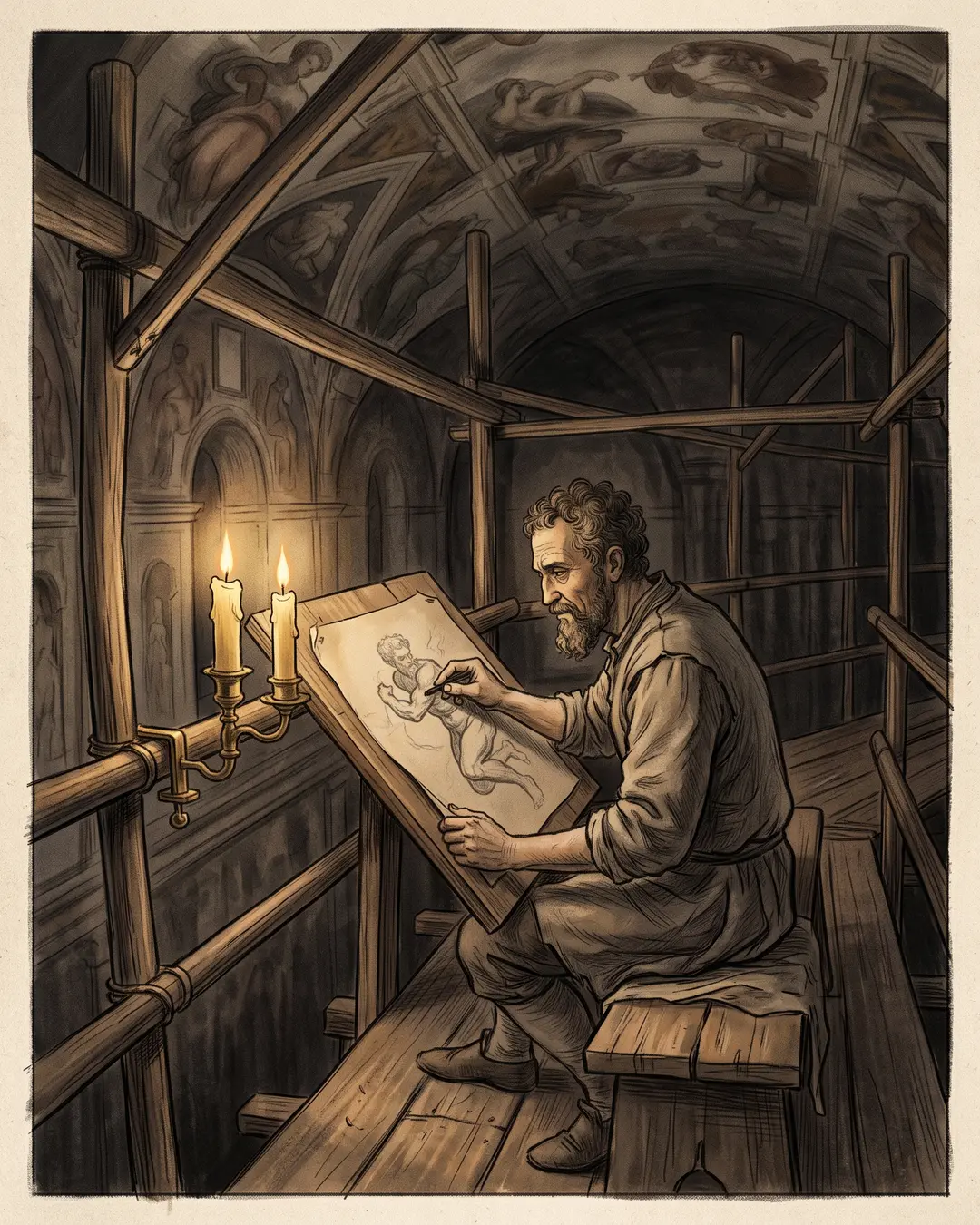
In 1508 Pope Julius II ordered him to paint the Sistine Chapel vault. Michelangelo protested that he was a sculptor and suspected the commission was a trap arranged by rivals to make him fail in an unfamiliar medium. He worked from 1508 to 1512, standing on a scaffold of his own design rather than lying on his back, and he wrote a bitter comic poem about the strain in his neck and eyes. The romantic image of a man entirely alone is false: he hired assistants and plasterers from Florence, though he dismissed several and repainted much of their work.
He returned to the chapel in 1536 for the Last Judgment on the altar wall, finished in 1541 in a Rome shaken by sack and reformation. The swirling mass of naked bodies scandalized clerics almost at once, and after his death the painter Daniele da Volterra was hired to add draperies, earning the nickname the breeches-maker. Meanwhile the tomb of Julius II, contracted in 1505, dragged on for four decades through shrinking versions and lawsuits. Michelangelo himself called the project a tragedy, and the Moses is its magnificent surviving fragment.
The Long, Difficult Old Age
He was not an easy man. His letters are full of complaints about money although he grew wealthy, bought property, and supported relatives who exasperated him. He quarreled with Leonardo, disparaged Raphael's borrowings, and drove assistants away. He also wrote hundreds of poems, many addressed to the young nobleman Tommaso de' Cavalieri and to the poet Vittoria Colonna, whose religious circle drew him toward a stark, inward faith. His grandnephew altered pronouns in the first printed edition, an early attempt to tidy a life that resisted tidying.
In 1546, at seventy-one, he became chief architect of St Peter's Basilica and refused a salary, calling the work a service to God. He redesigned the crossing and drove the great dome toward completion, dying in Rome in 1564 at eighty-eight with the building unfinished. His body was smuggled to Florence for a state funeral. Two biographies appeared in his lifetime, by Vasari and by his pupil Condivi, both shaped by the artist himself, so the legend of the divine solitary genius is partly a work he authored too.


