From Castle Town to the Banana Hut
Matsuo Basho was born in 1644 near Ueno in Iga Province, into a samurai family of modest rank and thinner means. As a boy he entered the service of Todo Yoshitada, a young lord who shared his taste for haikai, the playful linked verse of the day. When Yoshitada died suddenly in 1666, Basho left castle service and drifted toward Kyoto and then Edo, earning his way as a teacher and judge of poetry. He was ambitious and sociable, and by his thirties he was already a recognized master with a circle of paying students.
In 1680 he withdrew across the river to a plain cottage in Fukagawa, on the edge of Edo. A disciple planted a basho, a banana tree, beside the door, and the poet took his name from its wide, easily torn leaves. The move was a deliberate turn away from fashionable wordplay toward something sparer, colored by his study of Zen and of classical Chinese poets. Out of that hut came the famous frog poem of 1686, a small verse about water and sound that quietly rewrote the rules of Japanese poetry.
Walking as a Way of Writing
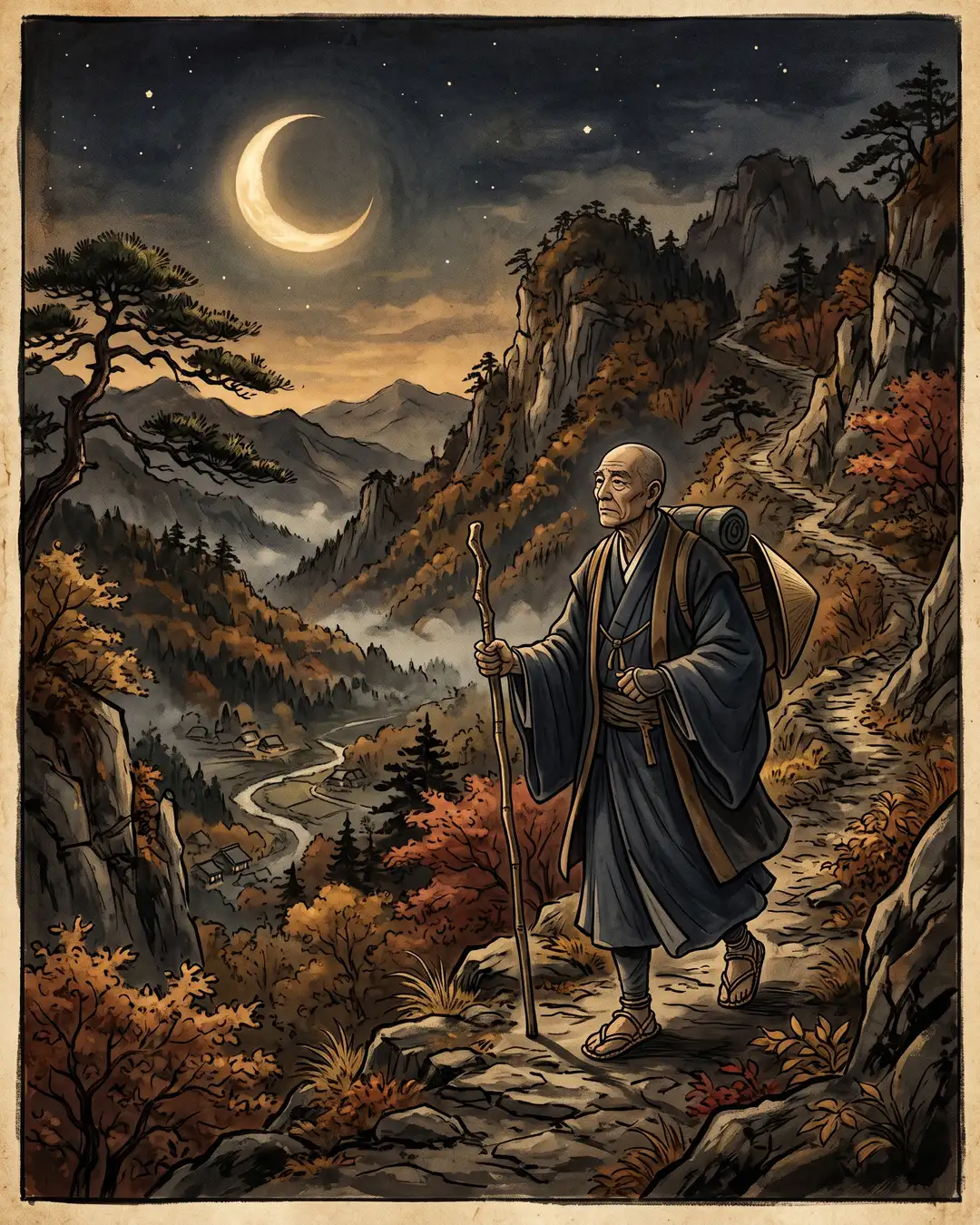
His greatest works are travel journals, above all Oku no Hosomichi, The Narrow Road to the Deep North, drawn from a five-month journey of roughly 1,500 miles through northern Honshu in 1689. He walked with his companion Kawai Sora, visiting places already thick with poetic and religious memory. The book braids terse prose with haiku, and it is art rather than reportage: comparison with Sora's plainer diary shows that Basho rearranged events, improved the weather, and polished encounters for years afterward. He finished the text around 1694, shortly before his death.
Nor was he the solitary wanderer of legend. Haikai was a social art, and Basho was its most sought-after guest, composing linked-verse sequences with merchants, doctors, and farmers who fed and lodged him along the road. Disciples such as Kikaku, Ransetsu, and Sora spread his school, and much of his teaching survives only in their notes. The lonely sage in a straw hat is partly a portrait his followers painted after his death, and partly a role that Basho himself, a careful editor of his own image, chose to play.
Doubt at the Height of Fame
Success sat uneasily on him. Basho complained that visitors gave him no peace, and around 1693 he briefly shut his gate to everyone, questioning whether poetry itself was an attachment a serious seeker should abandon. His late ideal of karumi, lightness, asked poets to find depth in ordinary domestic things without straining for effect, and some students resisted the plainness. His private life remains obscure; letters mention a woman named Jutei and her children, whose relationship to him scholars still debate. He died in Osaka in 1694, mid-journey, surrounded by disciples.
His last recorded verse speaks of dreams wandering over withered fields, and it has been read ever since as a self-portrait. Later centuries canonized him; Shinto authorities granted him deific honors, and schoolbooks made him the saint of haiku. The record is more interesting than the halo. Basho was a professional writer who revised relentlessly, borrowed from Chinese masters, depended on patrons, and doubted his own path, and from those ordinary materials he made a handful of seventeen-syllable poems that much of the world now knows by heart.


