Groomed for a throne he did not seek
Marcus was born in Rome in 121 CE into a wealthy senatorial family with roots in Spain, and the emperor Hadrian took an interest in him while he was still a boy. Hadrian arranged the succession in layers, adopting Antoninus Pius on condition that Antoninus in turn adopt Marcus and the young Lucius Verus. So Marcus grew up as an heir, studying rhetoric with Fronto, whose affectionate letters survive, and philosophy with Junius Rusticus, who handed him a copy of the discourses of the former slave Epictetus.
He came to power in 161 and immediately did something no emperor had done: he insisted that Lucius Verus rule beside him as full colleague, splitting an authority he could have kept whole. He married Faustina the Younger, daughter of Antoninus, and they had at least thirteen children, most of whom died before he did. Roman gossip accused Faustina of infidelity, but the accusations come from a late and unreliable source, and his own writing about her is affectionate.
A book nobody was meant to read
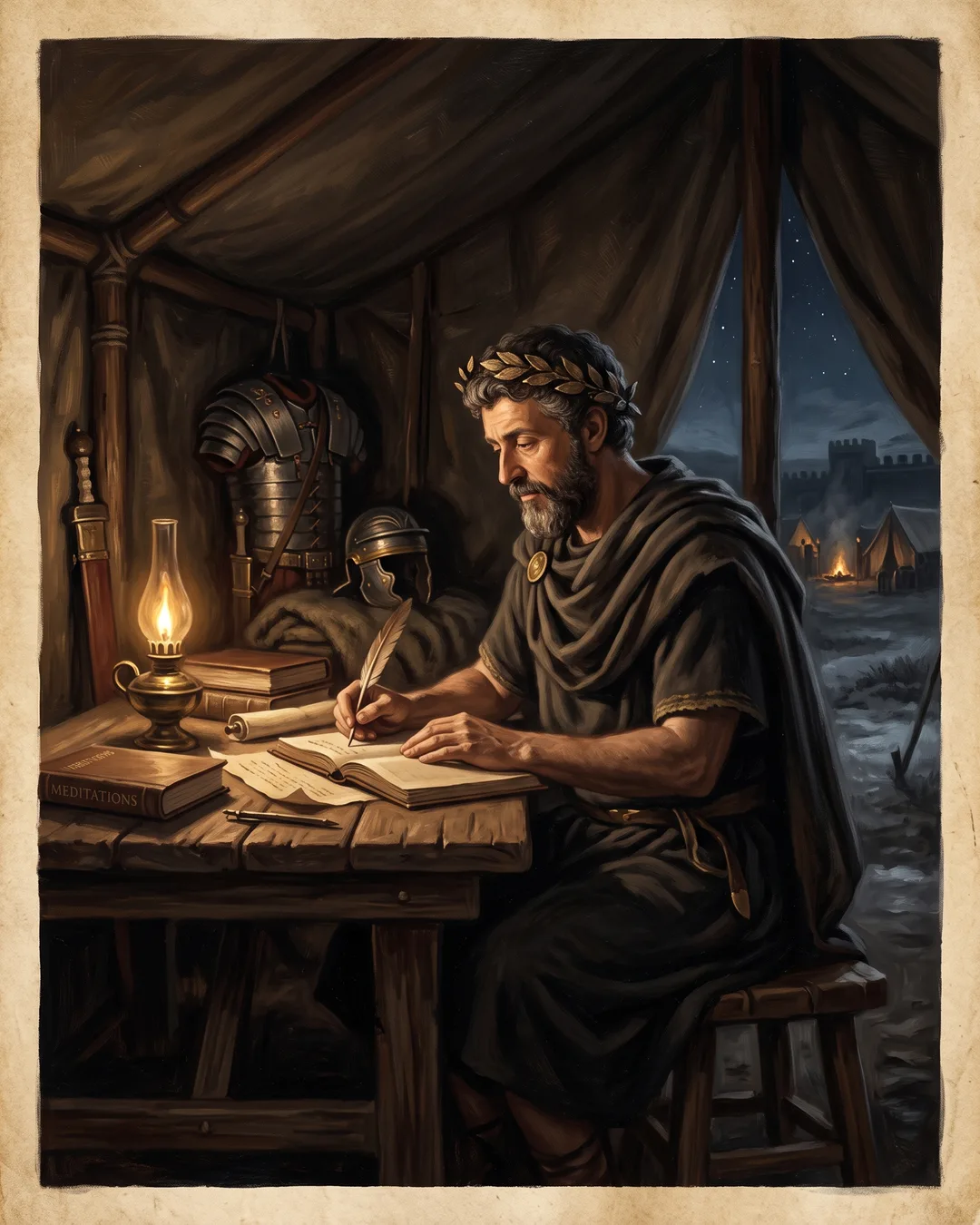
The Meditations were composed in the last decade of his life, largely on campaign, and written in Greek, the language of philosophy rather than of government. He gave the work no title; the heading used in the manuscripts means simply to himself. It is not a treatise and does not argue with an opponent. It repeats, circles and scolds, because it was a practice, an emperor talking himself each night out of anger, vanity and the fear of dying.
The Stoicism in it is stripped to essentials. Only judgement is truly ours; everything else, including reputation, health and the affection of others, is on loan from nature and can be recalled. Do the work in front of you, without theatre. Remember that the people who irritate you are acting from their own confusion. That such a manuscript survived at all is close to luck: it is barely mentioned for centuries, reaches us through a thin line of copies, and was first printed only in 1559.
Plague, revolt, and Commodus
His reign was war almost without pause. A Parthian campaign in the east ended in victory, and the returning armies brought back an epidemic, probably smallpox, that swept the empire for years and killed an unknown but enormous number of people. Germanic and Sarmatian peoples pressed across the Danube, and Marcus spent most of his final fourteen years on that frontier. He devalued the coinage and sold imperial treasures to pay for it, and in 175 his most trusted eastern general, Avidius Cassius, revolted.
The philosopher-king image needs qualification. Christians were executed under his rule, notably at Lyon in 177, and a passage in the Meditations dismisses their willingness to die as mere obstinacy. Above all, he broke with the adoptive succession that had produced him and left the empire to his own son Commodus, whose reign ended in murder and civil war. Marcus had, for the first time in generations, a surviving biological heir; the decision was human, and it was still a catastrophe.


