The empire behind the caravan
Mali was founded in the thirteenth century by Sundiata Keita and grew rich on position rather than production: it sat astride the routes carrying gold north from the Bambuk and Bure fields and salt south from the Saharan mines at Taghaza. Musa became mansa, or ruler, around 1312. A story preserved by the Egyptian official al-Umari has his predecessor sailing west into the Atlantic with a great fleet and never returning, a single second-hand report that modern enthusiasts have stretched far past what it can carry.
Nearly everything known about him comes from outside. Al-Umari wrote in Cairo from the memories of people who had met the pilgrimage; Ibn Battuta reached Mali in 1352, after Musa's death; Ibn Khaldun assembled an account decades later from travellers. Within Mali, history was carried by the griots, hereditary oral specialists whose Sundiata epic survives in performance rather than manuscript. The most famous African ruler of the medieval world left no written record of his own reign.
Cairo, 1324
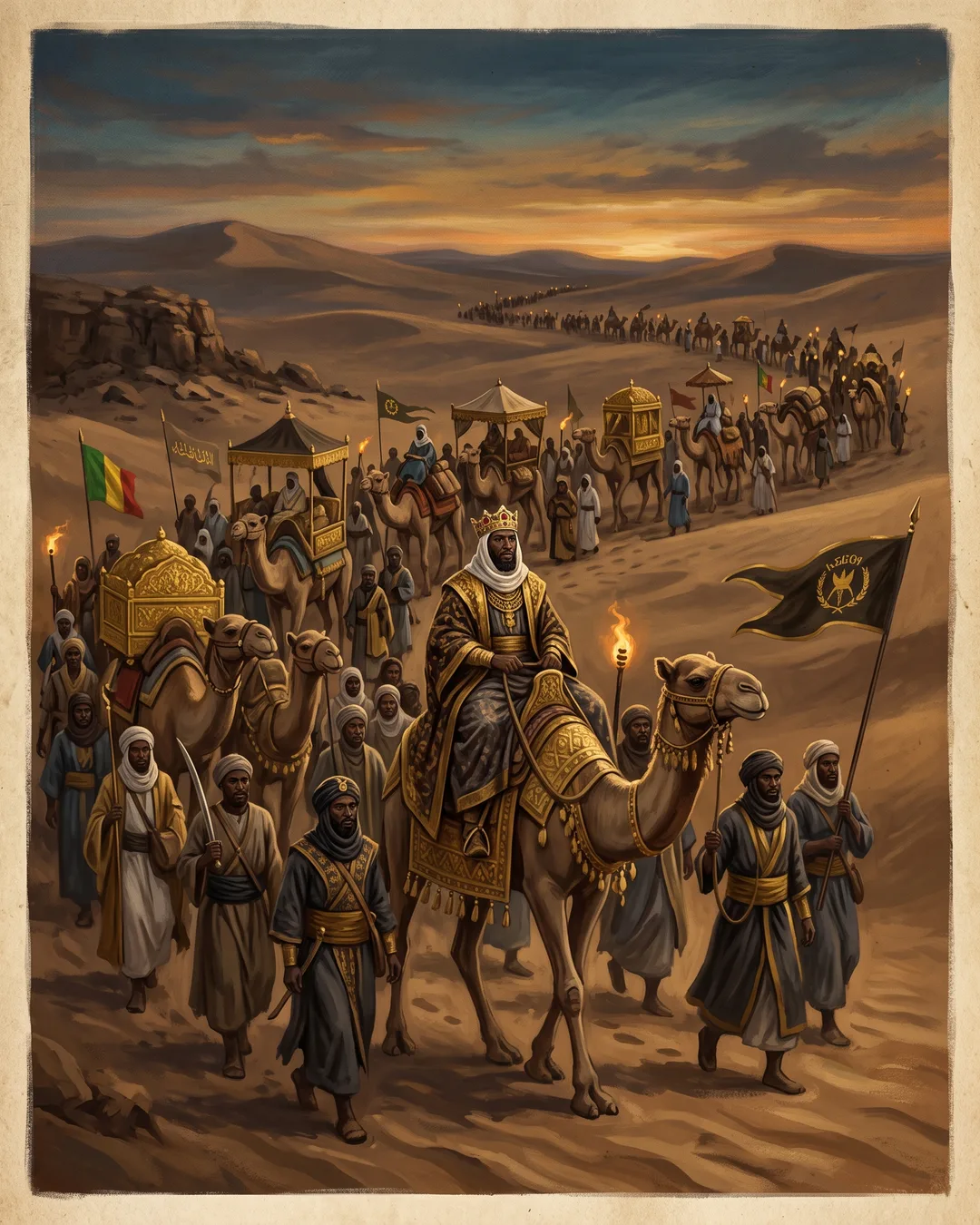
The reported scale of the hajj caravan is enormous: thousands of attendants and soldiers, camel trains carrying gold, and enslaved people bearing gold staffs, moving north-east across the desert to Cairo and on to Mecca. In Egypt he distributed and spent so much metal, according to accounts gathered a decade later, that its value in local markets fell and had not recovered years afterwards. The same sources say he ran short on the return leg and borrowed from Cairo merchants at punishing rates, a detail the legend usually omits.
Modern lists naming him the richest person in history are entertainment, not economics; no data exists that would allow his wealth to be measured against a modern fortune. What the journey did achieve was diplomatic. He returned with scholars, jurists and the Andalusian poet and architect Abu Ishaq al-Sahili, who is credited with work on major buildings at Gao and Timbuktu, and he arrived home a recognised figure in the wider Islamic world rather than the ruler of a distant frontier.
Books, mud brick, and a map
Under his patronage Timbuktu and Djenne grew into centres of trade and teaching, with mosques rebuilt in the mud-brick style that still defines them and libraries stocked by book buying in Cairo and Fez. The scholarly reputation of Timbuktu peaked later, under Songhai rule, and the surviving Timbuktu manuscripts, hundreds of thousands of them, mostly date from those later centuries. Their dramatic evacuation ahead of jihadist occupation in 2012 was a rescue of that whole accumulated tradition, not only of Musa's age.
Word travelled. The Catalan Atlas produced for the French court around 1375 shows a crowned African king seated south of the Sahara holding a large nugget, an image that fixed Mali in the European imagination as a source of unimaginable gold and helped drive later Portuguese voyages down the coast. Mali itself declined through the fifteenth century and was absorbed by Songhai. The pilgrimage remains its clearest surviving signal, refracted through the eyes of everyone except the Malians.


