Bonn to Vienna
Beethoven was baptized in Bonn in December 1770, the son of a court singer who drilled the boy harshly in hopes of producing a second Mozart. By his teens he was supporting the family as a court musician; at twenty-one he moved to Vienna, where he studied briefly and stormily with Haydn and conquered aristocratic salons as a pianist whose improvisations reportedly left listeners in tears. Unlike earlier composers, he never took a permanent court or church post, living instead from publishing, concerts and the subsidies of admiring patrons, a precarious new model of the independent artist.
The early Vienna years produced sonatas and chamber music that stretched Classical forms from within, including the Pathetique and Moonlight sonatas. Patrons tolerated behavior no servant-musician could have risked: he quarreled, insulted counts and moved apartments constantly. The independence was real but never comfortable. Throughout his life Beethoven bargained hard with publishers, sometimes selling the same work twice, and his finances swung between adequacy and anxiety, especially as Austria's wartime currency collapsed around him.
The Heiligenstadt Testament
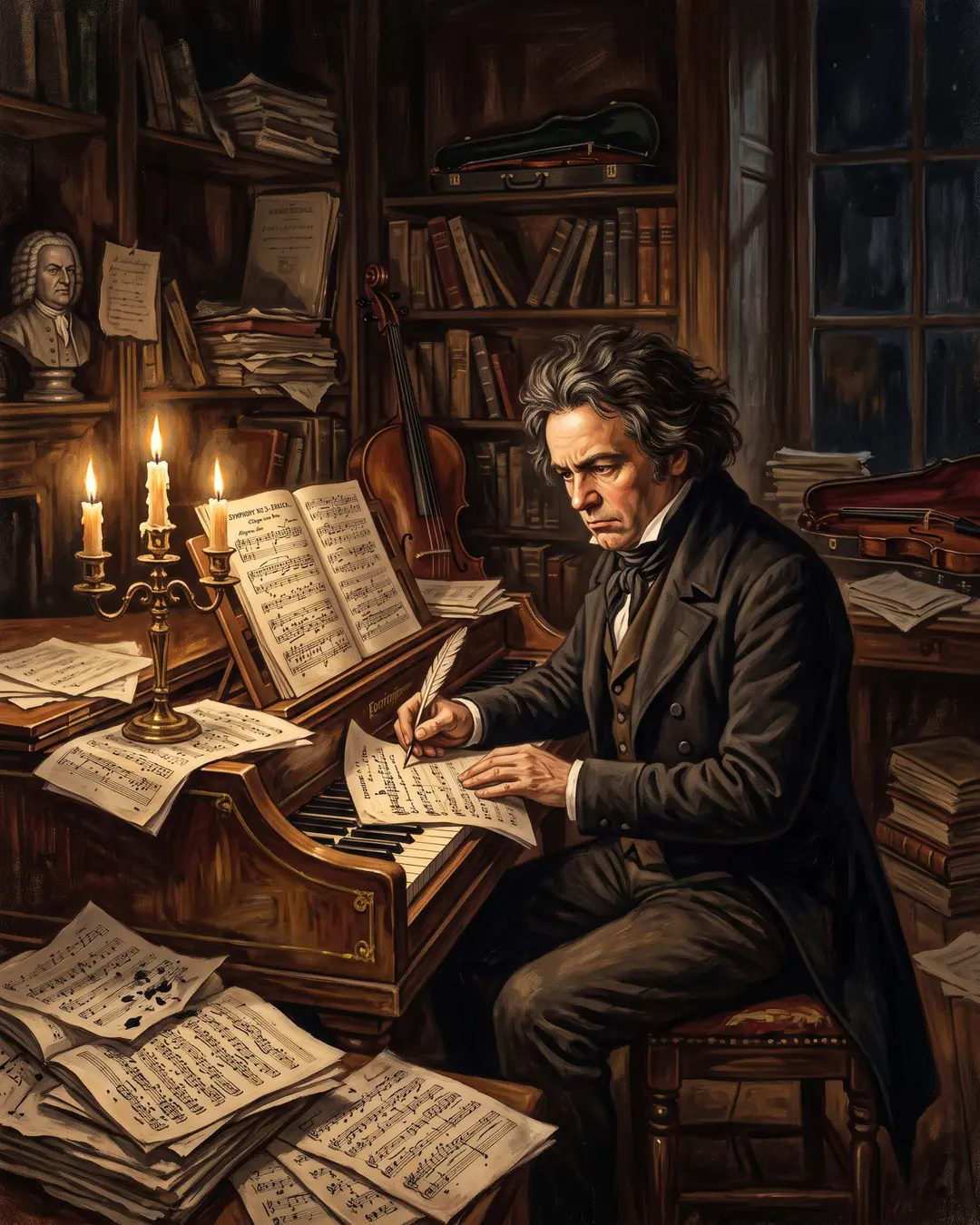
His hearing began failing in his late twenties, with roaring and whistling that made conversation humiliating for a celebrated musician. In 1802, in the village of Heiligenstadt, he wrote a letter to his brothers, found only after his death, confessing that the affliction had brought him close to suicide and that only his art held him back. He resolved, as he put it, to seize fate by the throat. What followed was the extraordinary middle period: the Eroica symphony, whose dedication to Napoleon he furiously scratched out when Bonaparte crowned himself emperor, the Fifth Symphony, the Violin Concerto and his lone opera, Fidelio.
These works redefined what instrumental music could claim to be about: struggle, liberation, moral seriousness. Audiences and critics grasped the scale quickly, and by the 1810s Beethoven was the most famous composer in Europe even as he withdrew socially. Visitors communicated with him through notebooks, the conversation books, hundreds of which survive and record his daily life in fragments: quarrels over housekeepers, prices of fish, arguments about politics and art conducted in pencil across a cafe table.
Late style
The final decade was shadowed by a corrosive legal battle for guardianship of his nephew Karl, whom Beethoven loved possessively and made miserable; in 1826 the young man attempted suicide. Nearly deaf, ill and increasingly isolated, the composer produced music of astonishing interiority: the Missa Solemnis, the last piano sonatas, and the late string quartets whose dissonances and forms baffled contemporaries and now stand among the summits of Western music. At the 1824 premiere of the Ninth Symphony, witnesses recalled that he had to be turned around to see the applause he could not hear.
He died in Vienna in March 1827; schools closed and a crowd in the tens of thousands followed the coffin. His shadow defined the following century, inspiring and oppressing successors from Brahms to Wagner, and the Ninth's choral setting of Schiller's Ode to Joy has been claimed by movements of nearly every political stripe, from revolutionaries to the European Union. The man was difficult, suspicious and often unhappy; the work insists, more forcefully than perhaps any other body of music, that suffering can be made into form.


