An Outsider by Birth
Li Bai was born in 701, most likely in Central Asia, in the garrison town of Suyab in what is now Kyrgyzstan, before his family moved to Sichuan when he was a child. The details are uncertain and the family's own accounts were probably improved later, including a claim of descent from the Tang imperial house. What matters is that he grew up on the frontier of the empire, in a merchant household, outside the settled scholar-official families that produced most poets of the period.
That background helps explain the shape of his career. He never sat the civil service examinations, either barred by his family's commercial status or unwilling to submit to them, and instead sought advancement by writing to officials and cultivating a reputation as a wandering swordsman and Daoist adept. He married into the family of a former chancellor, studied with recluses in the mountains, and roamed the Yangtze valley, building a legend as someone who could not be contained by an office.
The Court and the Rebellion
Around 742 the reputation worked. Emperor Xuanzong summoned him to Chang'an and appointed him to the Hanlin Academy, where he wrote occasional poems for court entertainments and was celebrated as an ornament of the most cosmopolitan capital on earth. It lasted about two years. He was dismissed, perhaps for drunkenness, perhaps for offending powerful eunuchs, and left with a gift of gold and no position. On the road afterward he met Du Fu, and the two greatest poets of the language spent a season together, writing poems about each other.
When An Lushan's rebellion tore the empire apart in 755, Li Bai attached himself to Prince Yong, a son of the emperor who was raising forces in the south. The prince was declared a rebel by his own brother, the new emperor, and defeated. Li Bai was imprisoned and sentenced to exile in Yelang, a remote southwestern posting that amounted to a slow death sentence. A general amnesty reached him while he was still traveling, and he turned back down the Yangtze, elated and ruined.
A Thousand Poems and One Legend
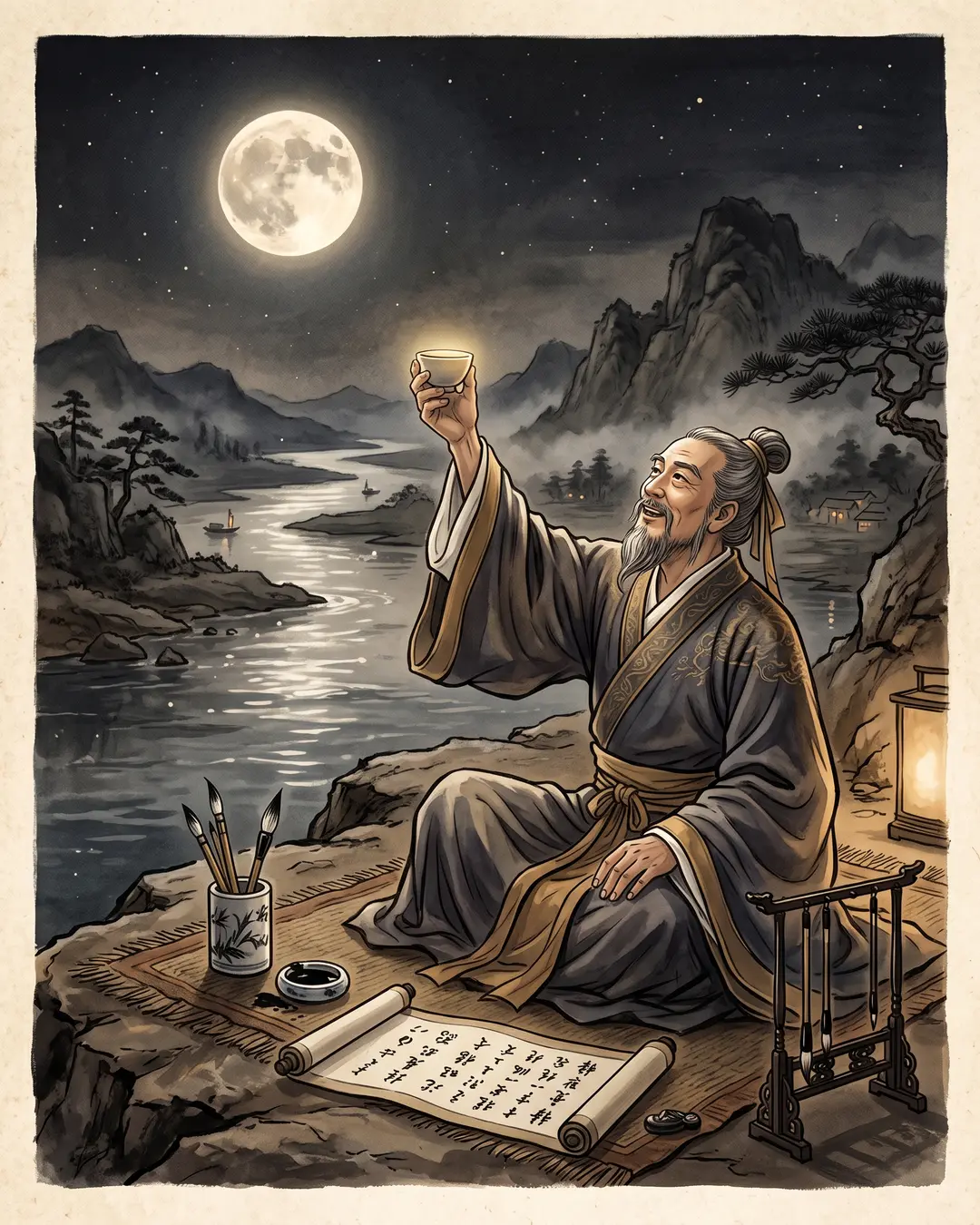
He died in 762 at Dangtu, in the house of a relative, Li Yangbing, who gathered his surviving manuscripts and wrote the preface that preserved them. Roughly a thousand poems circulate under his name, though attribution in Tang poetry is unreliable and later admirers were happy to supply what they thought he should have written. The favorite legend, that he drowned drunk while trying to embrace the moon's reflection in the river, appears long after his death, and is almost certainly a story invented to match the poems.
The poems themselves are quick, unforced, and full of wine, moonlight, mountains, exile, and friendship, written in older song forms rather than the strict regulated verse his contemporary Du Fu perfected. Chinese readers have paired the two ever since as the immortal and the sage, spontaneity against discipline. In the twentieth century Ezra Pound's loose English versions, made from the notebooks of Ernest Fenollosa, introduced him to Western readers under a Japanese form of his name, an accident that says much about how literature travels.


