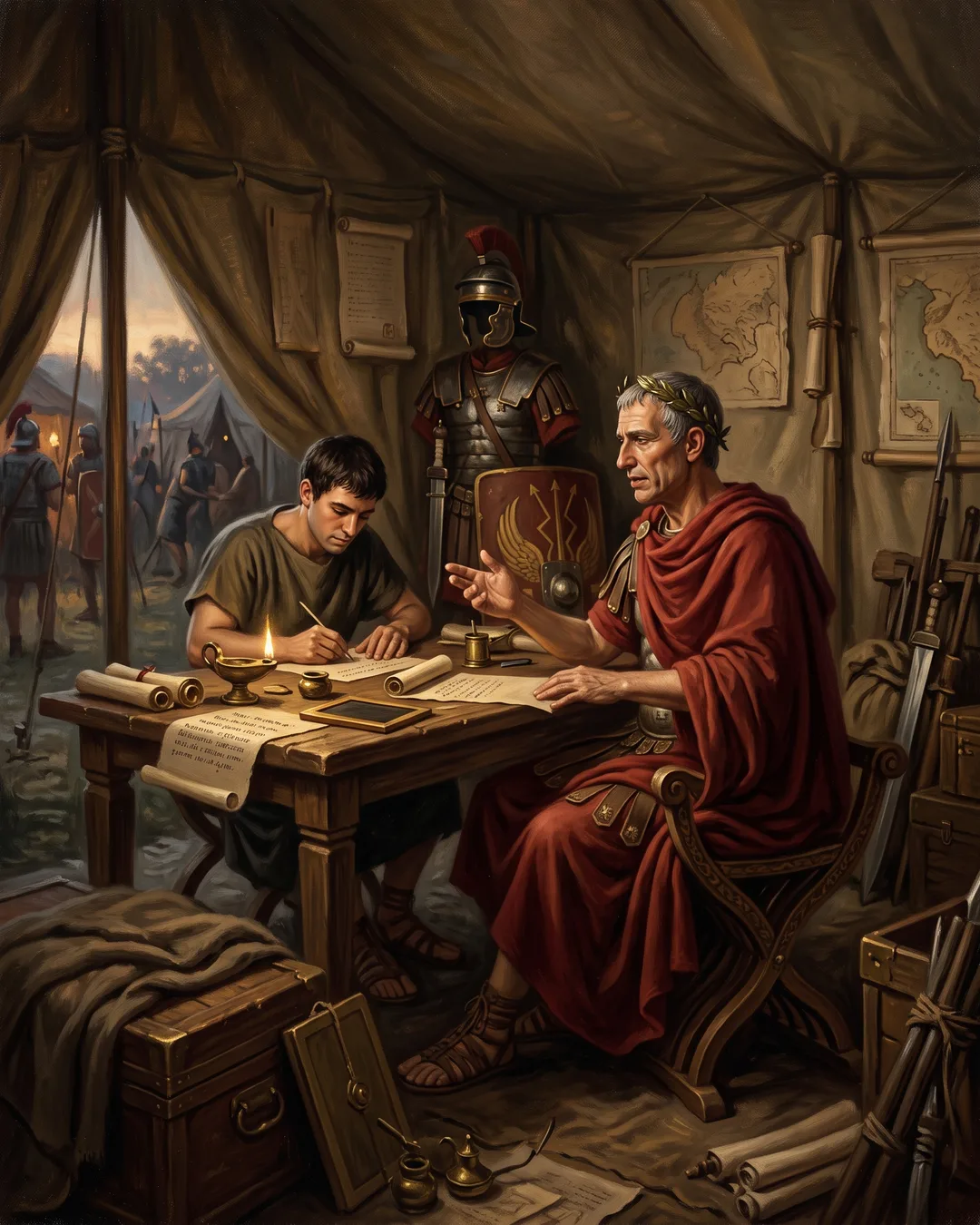
A Patrician on the Losing Side
Gaius Julius Caesar was born in 100 BCE into an old patrician family of modest recent influence, and married into the faction of Marius just as Sulla's forces took Rome. Ordered to divorce his wife, he refused, went into hiding, and survived by the intercession of relatives. Captured by pirates in the Aegean as a young man, he was ransomed, raised a fleet on his own initiative, hunted them down, and had them crucified. The anecdote comes from later biographers, but the pattern it describes holds for everything that followed.
He climbed the Roman ladder on borrowed money, spending enormously on games and public works, and won election as pontifex maximus in 63 while deep in debt. In 60 he formed a private compact with Pompey, Rome's greatest general, and Crassus, its richest man, and used it to take the consulship. His year in office was marked by open intimidation of colleagues and disregard for auspices, and he left it needing both a command and immunity from prosecution.
The Conquest of Gaul
Gaul gave him both. Between 58 and 50 BCE he campaigned across territory that is now France, Belgium, and beyond, twice crossing the Rhine and twice landing in Britain, and he wrote the commentaries that made the war famous in a lean third-person Latin still used to teach the language. Plutarch reports a million Gauls killed and a million enslaved. Those numbers are ancient estimates rather than counts, but no serious account denies that the campaigns involved mass killing, starvation sieges, and enslavement on an industrial scale.
Even in Rome, some found it intolerable. After a massacre of the Usipetes and Tencteri during a truce, Cato proposed in the Senate that Caesar be handed over to the Germans as a war criminal, a motion that went nowhere against a commander enriching the treasury and his own supporters. The final revolt under Vercingetorix ended at Alesia in 52 BCE with a double ring of siegeworks and the surrender of a leader who was displayed in a triumph six years later and then executed.
The Crossing and the Ides
Ordered by the Senate to give up his army in 49 BCE, Caesar led a legion across the Rubicon into Italy rather than stand trial as a private citizen. The civil war took him to Greece, where he broke Pompey at Pharsalus, to Egypt, where he backed Cleopatra against her brother, and to Africa and Spain, where the last resistance was crushed at Munda. He governed through a policy of publicized clemency, pardoning enemies and appointing them to office, which built loyalty and also left many of his killers alive.
As dictator he was genuinely effective: he reformed the chaotic calendar into a solar year still recognizable in our own, settled veterans and the poor in colonies, extended citizenship, and reorganized debt. But he accumulated titles until in 44 BCE he was named dictator in perpetuity, and the fiction of a restored republic became impossible to maintain. Sixty senators stabbed him on the Ides of March. The result was not liberty but thirteen more years of civil war, ending with his heir Augustus as sole ruler.


