A Universe Built from Polyhedra
Johannes Kepler was born in 1571 in Weil der Stadt, a small free town in southwest Germany, to a family with little money and less stability; his father was a mercenary who vanished, his mother a healer whose herbal knowledge would later nearly destroy her. A scholarship student at Tuebingen, he absorbed Copernican astronomy from Michael Maestlin while training for the Lutheran ministry. In 1596 his Mysterium Cosmographicum proposed that the five Platonic solids, nested inside one another, fixed the spacing of the six known planets. The idea was wrong, but gloriously bold.
That first book reveals the paradox historians still wrestle with. Kepler was at once a mystic and a rigorist. He believed God had built the cosmos on geometric archetypes, and he cast horoscopes all his life, partly from conviction and partly because astrology paid bills that astronomy never did. Yet he also insisted, unusually for his time, that a theory must match observation to the last arcminute. When his most beautiful models failed the data, he abandoned them. That stubborn honesty, more than any single discovery, is what makes him modern.
Tycho's Data and the War with Mars
In 1600 Kepler joined Tycho Brahe in Prague, the Danish astronomer whose decades of naked-eye observations were the finest ever made. The partnership was tense; Tycho guarded his numbers, and Kepler chafed at piecework. When Tycho died suddenly in 1601, Kepler succeeded him as imperial mathematician and inherited the data, though Tycho's heirs fought him for years over its use, a reminder that his laws rest on another man's life work. He then began what he called his war with Mars, whose orbit refused every arrangement of circles he could devise.
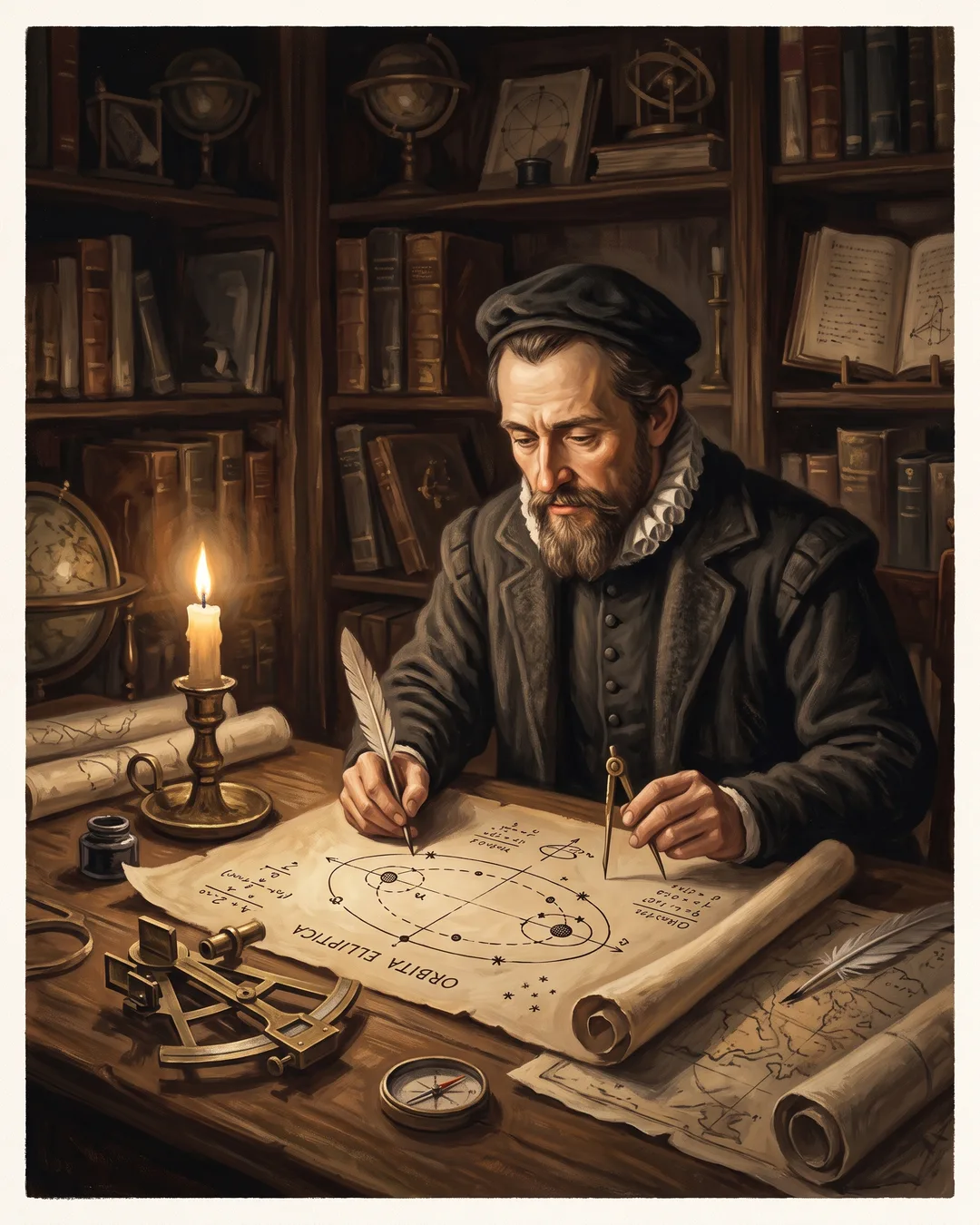
An error of eight arcminutes, tiny but stubbornly real, forced him to abandon two thousand years of circular dogma. In Astronomia Nova of 1609 he announced that Mars travels an ellipse with the sun at one focus, sweeping out equal areas in equal times. In Harmonice Mundi of 1619 he added the precise relation between a planet's distance and its period, embedded in speculations about celestial music. He also wrote pioneering optics, championed logarithms, and in 1627 published the Rudolphine Tables, which predicted planetary positions with accuracy no one had approached before.
Plague, War, and a Witch Trial
Kepler's science was done amid ruin. The Thirty Years War drove him from city to city; Lutheran authorities barred him from communion over his unorthodox views on the Eucharist, a wound he felt deeply; disease took his first wife and several of his children. From 1615 to 1621 he interrupted everything to defend his elderly mother, Katharina, against charges of witchcraft in Wuerttemberg, drafting much of the legal argument himself. She was imprisoned for months and threatened with torture, and she died soon after her release, broken by the ordeal.
He died at Regensburg in 1630, traveling to collect salary long owed to him, and war erased his grave within a few years. The epitaph he composed said he had measured the skies and now measured the shadows of the earth. Newton later showed why Kepler's laws hold, raising universal gravitation on their foundation. The man himself resists tidy categories: astrologer and empiricist, exile and believer, a scientist whose greatest discoveries came from refusing to let a lovely theory survive an ugly fact.


