An Orphan in a Family Trade
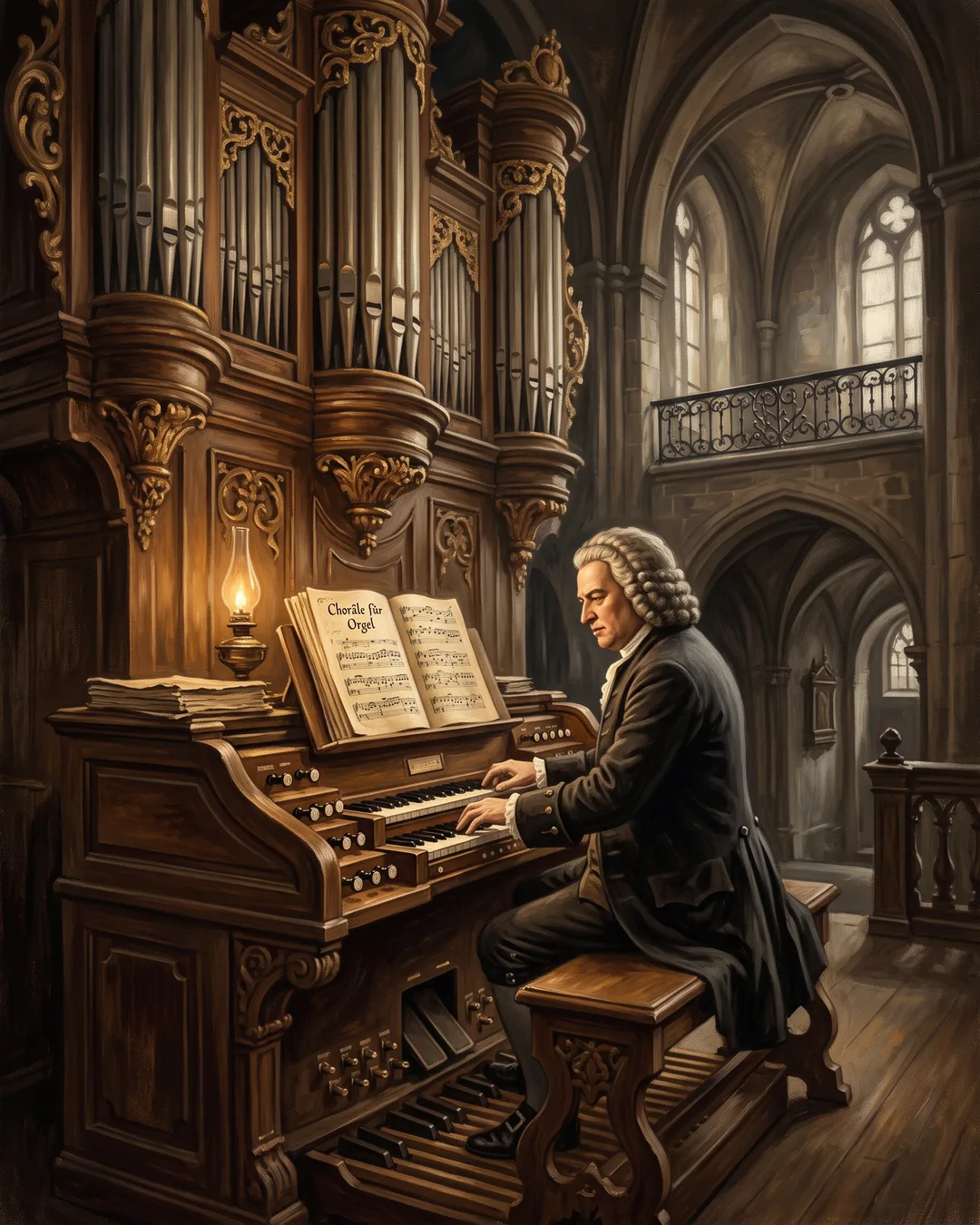
Johann Sebastian Bach was born at Eisenach in 1685 into a clan so thick with musicians that in parts of Thuringia the word Bach was used loosely for a town player. Both parents died before he turned ten, and he was taken in by his elder brother Johann Christoph, an organist, who taught him keyboard and gave him access to the manuscripts he copied by hand. Formal instruction mattered less than that copying. He learned composition by transcribing Buxtehude, Vivaldi, Frescobaldi, and others, absorbing techniques from every tradition he could reach.
His first posts show a young man with more talent than tact. At Arnstadt he was reprimanded for confusing the congregation with elaborate chorale variations, for a street brawl with a bassoon student he had insulted, and for allowing an unauthorized young woman into the choir loft. He had also walked some two hundred and fifty miles to Lubeck to hear the aging Buxtehude play, and stayed roughly four months instead of the four weeks he had been granted. In 1717 the Duke of Weimar had him jailed for nearly a month for pressing to resign.
Leipzig, Third Choice
The happy years were at Cothen, from 1717, where a music-loving prince kept a fine ensemble and required no church music, and where the Brandenburg Concertos were assembled and dedicated in 1721 to a margrave who appears never to have had them performed. When the Leipzig post of Thomaskantor came open in 1723, the council wanted Telemann, then Graupner, and settled on Bach only after both declined. One councillor is recorded complaining that since the best could not be had, mediocre men would have to be accepted.
For twenty-seven years he ran the music of Leipzig's principal churches, taught Latin and singing to boys he found poorly trained, and produced cantatas at a rate that still seems physically improbable, along with the St Matthew Passion and the Mass in B Minor. He fought the council over money, over authority to appoint musicians, and over the quality of the students. He also took on the university's Collegium Musicum, giving weekly concerts in a coffee house and writing secular works for a paying audience that his employers did not control.
Forgotten, Then Not
He married twice. His cousin Maria Barbara died suddenly in 1720 while he was traveling; Anna Magdalena Wilcke, a professional singer, became his second wife in 1721 and copied so much of his music that certain manuscripts long thought autograph are in her hand. Of twenty children, about half survived infancy, and several sons became famous composers whose fashionable style made their father sound archaic. By the 1730s critics were already calling his writing turgid and overloaded, and he answered with music of even greater density.
Late in life his sight failed. Two operations by the traveling English oculist John Taylor left him blind and probably hastened his death in July 1750. Anna Magdalena died in poverty ten years later, and much of the unpublished music was scattered among heirs, with substantial losses. Musicians never entirely lost him, since Mozart and Beethoven studied what circulated, but the wider public rediscovery began in 1829 when the young Mendelssohn conducted the St Matthew Passion in Berlin, seventy-nine years after the composer's death.


