A clergyman's daughter
Jane Austen was born in 1775 at Steventon rectory in Hampshire, the seventh of eight children of a bookish country clergyman. The household read aloud, staged amateur theatricals and treated the teenage Jane's outrageous parodies, now called the juvenilia, as family entertainment. By her early twenties she had drafted versions of what became Sense and Sensibility, Pride and Prejudice and Northanger Abbey. A London publisher rejected the second of these unread in 1797, and another bought the third for ten pounds and simply never printed it. Her twenties ended without a single published word.
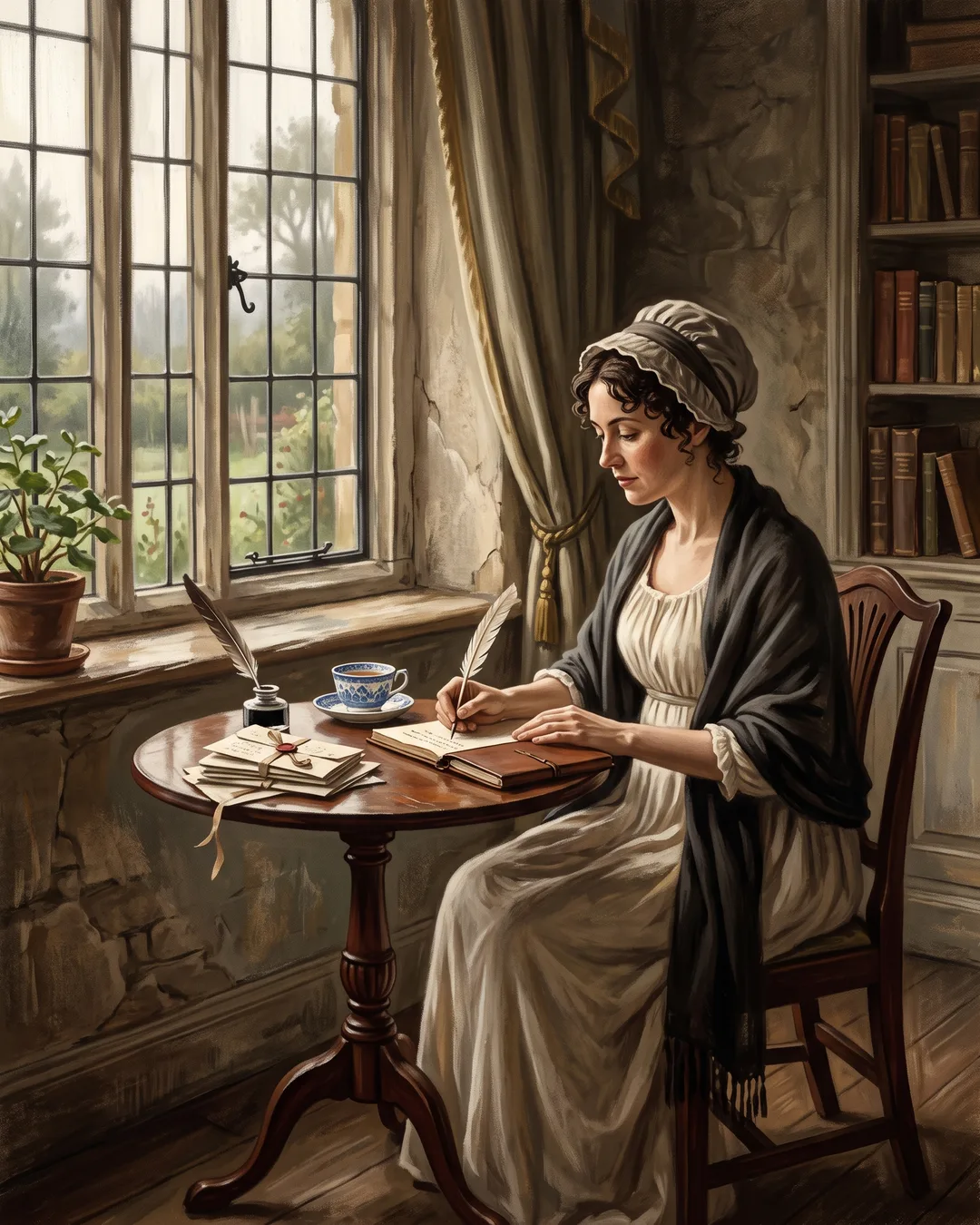
In 1801 the family moved to Bath, a city she seems not to have loved, and after her father's death in 1805 Austen, her sister Cassandra and their mother lived on relatives' contributions, moving between lodgings. The writing largely stalled for nearly a decade. What changed everything was a house: in 1809 her brother Edward, adopted by rich cousins, installed the women in a cottage at Chawton on his Hampshire estate. There, at a small table, she revised the old manuscripts and wrote three new novels in seven years.
Anonymous and exact
Sense and Sensibility appeared in 1811 credited only to A Lady, and Austen remained anonymous in print all her life, though the secret leaked into London society. Pride and Prejudice followed in 1813, then Mansfield Park and Emma, the latter dedicated, at the request of a royal librarian she privately mocked, to the Prince Regent. Her earnings were real but modest, a few hundred pounds across her lifetime, and she tracked them carefully; money is never incidental in her fiction, where incomes, settlements and inheritances are specified with an accountant's rigor.
Her technical innovation was as quiet as her plots. Austen perfected free indirect discourse, letting the narration slide in and out of a character's self-deceptions so that readers judge and sympathize in the same sentence. The novels contain no battles, though the Napoleonic wars hum in the background of naval brothers and quartered militias, and slavery's economy shadows Mansfield Park. Working within two inches of ivory, as she described her scope to a nephew, she built comedies whose real subject is the ethics of perception: how people misread each other, and what it costs.
Death and slow ascent
In 1816 her health began to fail, with symptoms that have prompted retrospective guesses from Addison's disease to lymphoma; no diagnosis is certain. She kept writing, completing Persuasion and beginning the unfinished Sanditon, whose heroine-observer mocks invalids even as its author weakened. She died in Winchester in July 1817, aged forty-one, and was buried in the cathedral under a stone that praised her character without mentioning that she wrote. Months later her brother Henry published Persuasion and Northanger Abbey together with a notice finally naming the author.
The Victorians knew her mainly through a nephew's affectionate 1869 memoir, which softened a sharp-tongued professional into gentle Aunt Jane, an image her surviving letters, full of acid, complicate; Cassandra burned or censored most of the rest, leaving biographers permanent gaps. The critical ascent came later, and by the twentieth century she stood beside Shakespeare in the English canon. Today the six novels are perpetually filmed, imitated and argued over, and their author, who never signed her name to them in print, is among the most recognized writers on earth.


