Glenlair and the Habit of Asking
James Clerk Maxwell was born in Edinburgh in 1831 and raised at Glenlair, the family estate in Galloway, where relatives recalled a boy who demanded to know how everything worked and would not accept an answer that stopped at the surface. His mother, who directed his early education, died of cancer when he was eight. Sent to the Edinburgh Academy, he arrived in home-made country clothes and was mocked for it, then quietly outpaced the room. He published his first paper, on a method for drawing oval curves, at fourteen.
He read at Edinburgh and then at Cambridge, where he took the mathematical tripos in 1854. His first major result came in 1859, when he won the Adams Prize for showing that the rings of Saturn could be neither solid nor liquid, since either would be torn apart, and must instead consist of vast numbers of independent particles. The argument was confirmed by spacecraft more than a century later. It also drew him toward the statistical treatment of enormous populations of moving bodies.
Gases, Colour, and a Working Partnership
Applying that approach to gases, Maxwell derived the distribution of molecular speeds that carries his name and, with Ludwig Boltzmann's later extension, founded statistical mechanics. Theory required testing. He and his wife, Katherine Mary Dewar, ran long and physically unpleasant experiments on the viscosity of air in a heated room of their London house, work in which she managed the temperature measurements over hours. He credited her role in the resulting papers, and later historians have argued that her contribution has still been undervalued.
He also worked on how the eye handles colour, establishing that three primaries suffice to reproduce the visible range and building a spinning disc to prove it. In 1861 he directed the making of the first durable colour photograph, an image of a tartan ribbon assembled from three separate exposures through red, green and blue filters. The photographer Thomas Sutton took the plates. The emulsions of the day were nearly blind to red, and the demonstration succeeded partly by an accident of ultraviolet sensitivity.
A Dynamical Theory of the Field
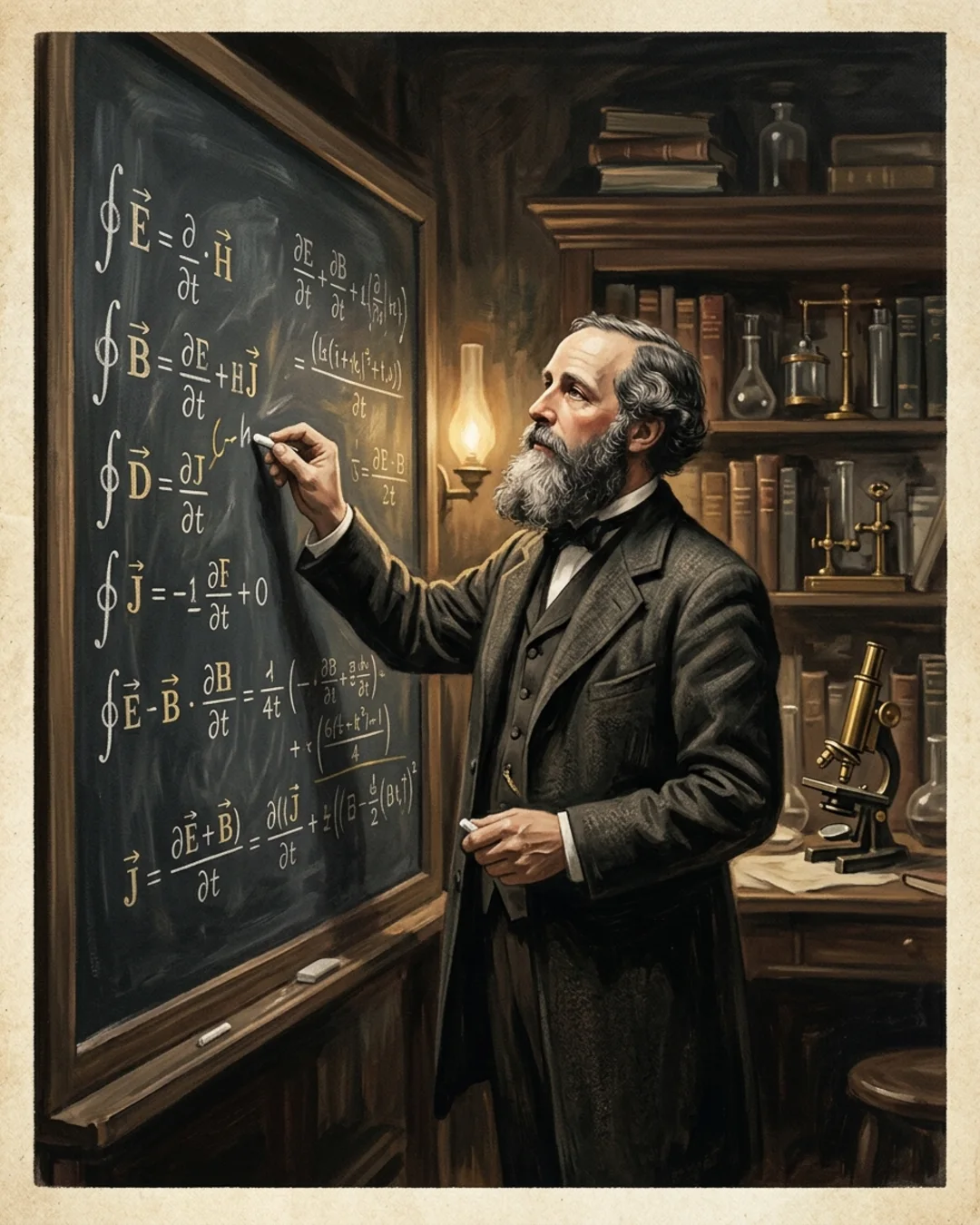
Taking Faraday's lines of force seriously, Maxwell built a mechanical model of the space between magnets, then discarded the machinery and kept the mathematics. In 1865 he presented a dynamical theory of the electromagnetic field, showing that disturbances in it must travel at a speed calculable from purely electrical measurements. That number matched the measured speed of light closely enough to force the conclusion that light is an electromagnetic wave. His Treatise of 1873 set out the full structure. No one had previously extracted a constant of such consequence from bench measurements alone.
The famous four equations are not quite his. Maxwell wrote a larger set in a cumbersome notation, and Oliver Heaviside and others later compressed them into the vector form now taught. Heinrich Hertz generated and detected the predicted waves in 1887, eight years after Maxwell died of abdominal cancer at forty-eight, the same disease and roughly the same age as his mother. He had spent his last years as the first director of the Cavendish Laboratory at Cambridge. Einstein later described his own work as standing on the foundations Maxwell laid.


