Carthage Rebuilds in Spain
Hannibal was born in 247 BCE at Carthage, the son of the general Hamilcar Barca, while the first war against Rome was grinding toward a defeat that cost his city Sicily and an enormous indemnity. Hamilcar took the family to Iberia to build a new base of silver, manpower, and trade. Polybius records that Hannibal, decades later, told the Seleucid king Antiochus how his father had made him swear as a child never to be a friend to Rome, which is as close to the man's own voice as the sources come.
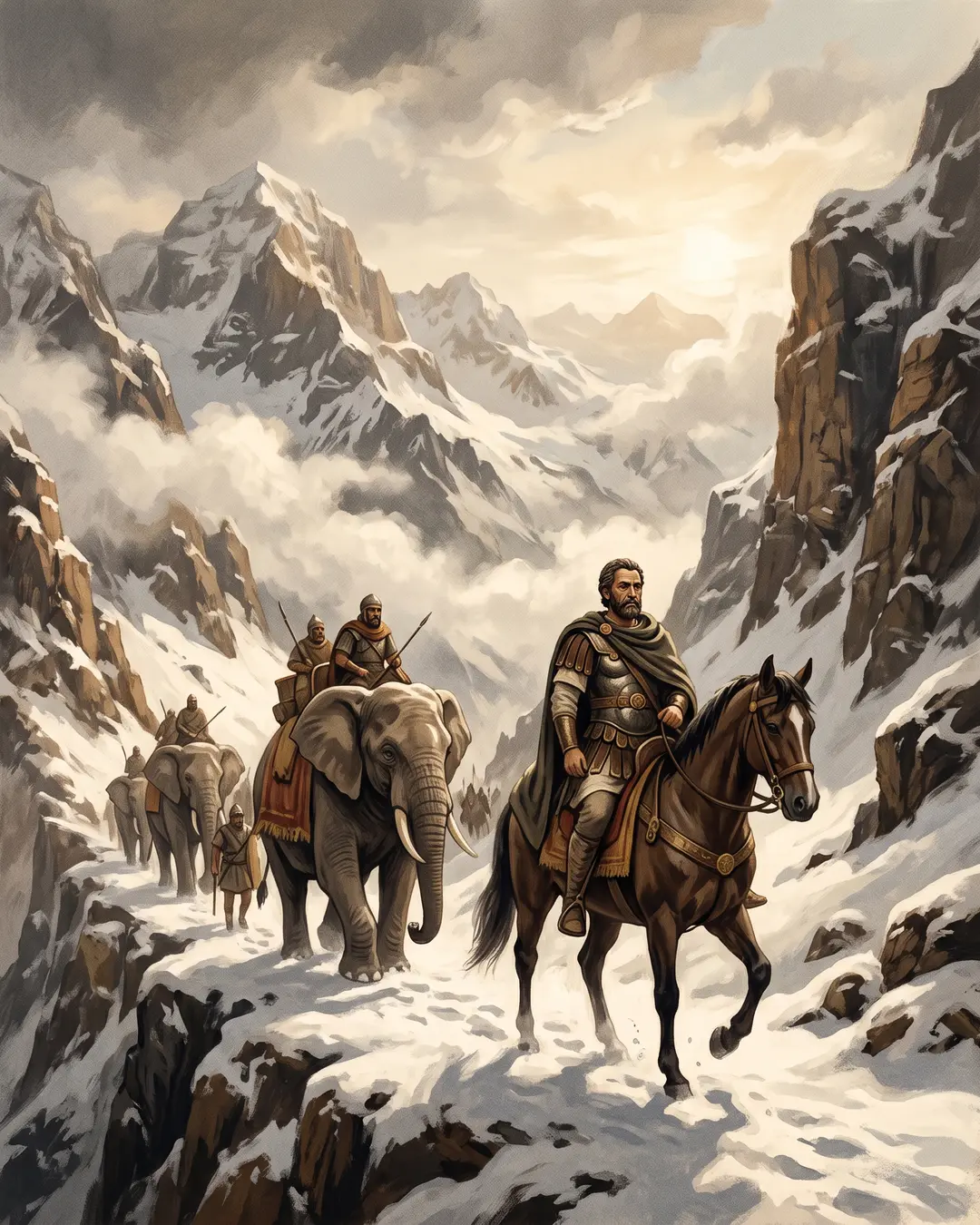
He took command in Spain at about twenty-six after his father and brother-in-law died, and in 219 he besieged Saguntum, a city under Roman protection. When Rome demanded his surrender and Carthage refused, the second war began. In 218 he marched an army with elephants from Iberia across the Pyrenees, through hostile Gaul, and over an Alpine pass whose identity historians still dispute, losing perhaps half his men to cold, ambush, and exhaustion, and arriving in Italy with an army no one had expected.
Cannae and the Long Stalemate
He then destroyed three Roman armies in under two years. At the Trebia he lured a consul across a freezing river into a hidden flanking force; at Lake Trasimene he trapped an entire column in mist against the water; and at Cannae in 216 he deliberately let his center give way, drew the massed Roman infantry into a sack, and closed cavalry behind them. Ancient estimates of Roman dead run from fifty to seventy thousand in a single day, and the maneuver is still taught in military academies as the model of double envelopment.
He did not march on Rome, and Livy preserves the reproach of his cavalry commander Maharbal that he knew how to win a victory but not how to use one. The criticism is too easy. He had no siege train, no secure supply, and a strategy that depended on Rome's Italian allies defecting, which most did not. Rome refused to negotiate, raised new legions, and under Fabius Maximus avoided battle while wearing him down. Fifteen years in Italy left him undefeated in the field and slowly stranded.
Zama, Exile, and the Missing Voice
The war was decided elsewhere. His brother Hasdrubal was killed bringing reinforcements at the Metaurus in 207, and Publius Cornelius Scipio conquered Iberia and then invaded Africa. Recalled in 203 to defend Carthage, Hannibal faced Scipio at Zama in 202 with an inexperienced army and elephants that Roman ranks opened lanes to let pass. He lost, and Carthage accepted terms that ended it as a power. Elected suffete afterward, he reformed the courts and public finances so effectively that the oligarchy denounced him to Rome.
He fled east, advised Antiochus III against Rome, saw that war lost too, and moved from court to court until he was cornered at the court of Prusias in Bithynia around 183 BCE, where he took poison rather than be handed over. Everything we know comes from Polybius, Livy, and other Greek and Roman writers. The histories written by the Greeks who traveled with him, Silenus and Sosylus, are lost, and Carthage left no surviving account of itself. The most feared enemy of Rome survives only in Rome's version.


