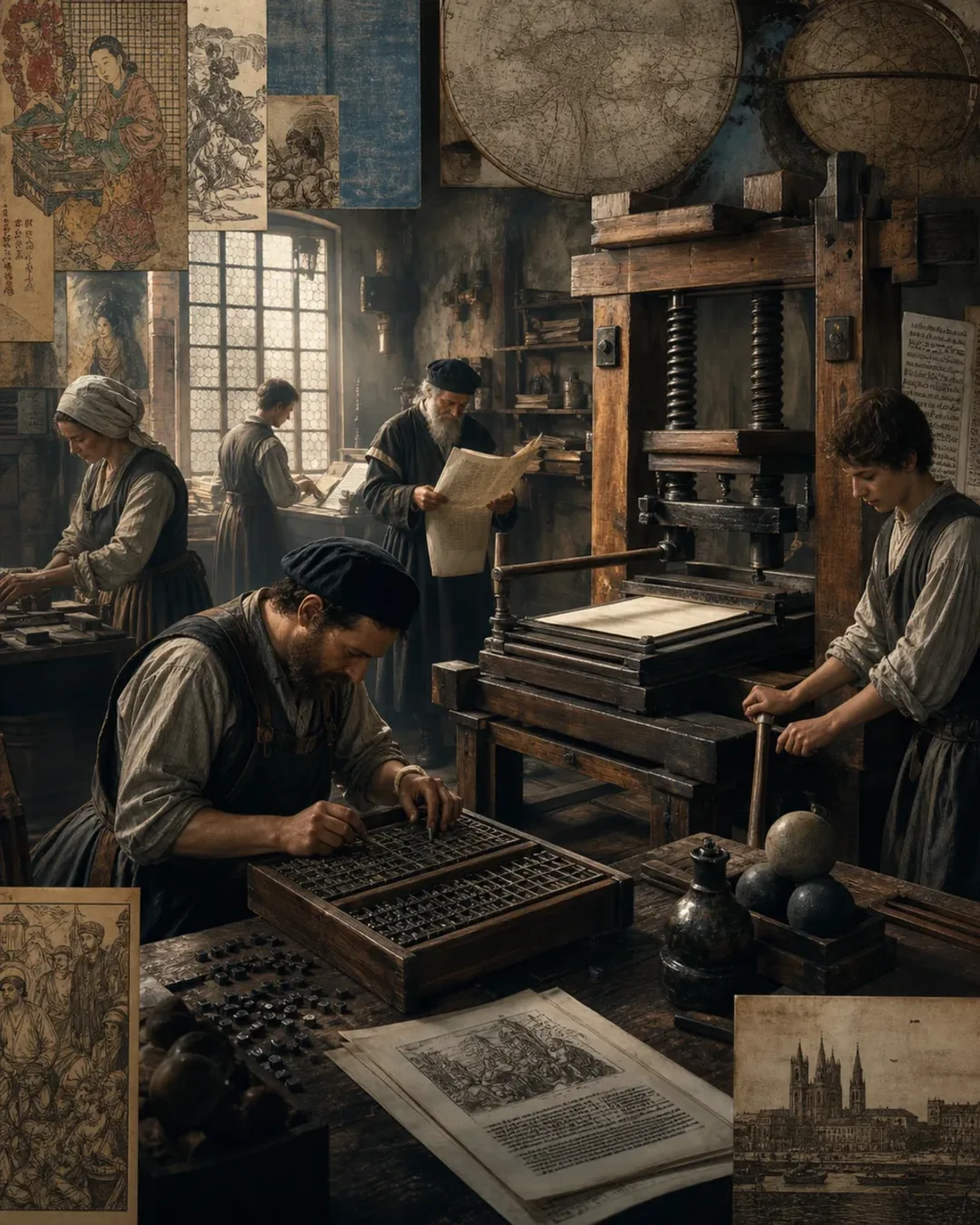
Begin before Gutenberg
Woodblock printing developed in East Asia centuries before Johannes Gutenberg. Movable type also has earlier histories: Bi Sheng used ceramic type in China in the eleventh century, and metal movable type was used in Korea. Any claim that one European invented printing erases these traditions.
Gutenberg's importance lies in a particular convergence in mid-fifteenth-century Mainz. He and his collaborators developed a practical European method for casting reusable metal type, formulated oil-based ink suited to it and adapted press technology to make many consistent impressions.
The workshop was the invention
Individual letters could be arranged, inked, pressed, redistributed and used again. The process demanded precision: type had to align, ink had to adhere and paper or vellum had to meet the form evenly. Skilled compositors, press workers, metalworkers and financiers made the system operate.
The book known as the Gutenberg Bible, produced in the 1450s, demonstrated that print could rival the visual authority of manuscripts. Decoration was still often added by hand. Early printed books did not instantly abandon scribal culture; they borrowed its forms while altering the speed and scale of reproduction.
A network, not a switch
Printing spread rapidly through European cities. It lowered the cost of producing multiple copies, stabilized some texts and supported new markets for religious, scholarly and practical works. It also accelerated propaganda, polemic and error. More copies did not guarantee more truth.
The transformation was gradual and uneven, tied to literacy, language, trade and political power. Gutenberg's legacy is best understood neither as the birth of printing nor as a lone flash of genius. It was a production system that other workshops could reproduce—and therefore a technology that could become infrastructure.


