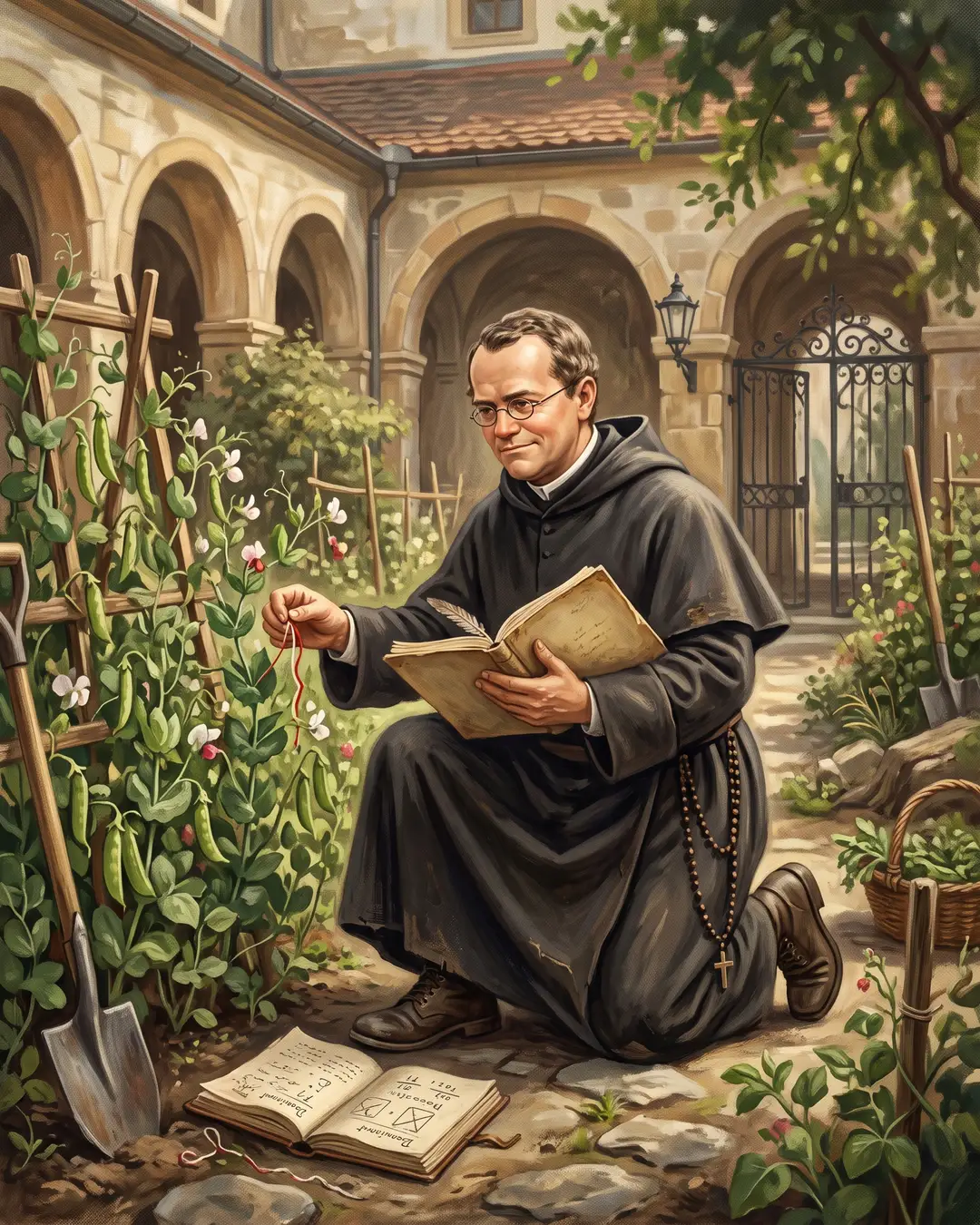
A Farmer's Son in a Habit
Johann Mendel was born in 1822 in Silesian Heinzendorf, now Hyncice in the Czech Republic, to a farming family who could not afford to keep him in school. Illness and poverty repeatedly interrupted his studies, and his younger sister gave up part of her dowry to help pay for them. In 1843 he entered the Augustinian abbey of St Thomas in Brno, taking the name Gregor. The choice was as practical as it was devout: the abbey was a center of teaching and research where a poor, gifted student could think without starving.
He was a poor parish priest, distressed by sick calls, and was moved to teaching instead. Twice he sat the examination for a state teaching certificate, in 1850 and again in 1856, and twice he failed, the second time despite two years of study at the University of Vienna under the physicist Christian Doppler and the botanist Franz Unger. Vienna gave him something better than a certificate: training in experimental physics, in combinatorial mathematics, and in the plant hybridization debates then unsettling botany.
Twenty-Eight Thousand Plants
Between 1856 and 1863 he grew peas in the monastery garden and greenhouse, choosing a species that self-pollinates reliably and that came in clean either-or forms. He worked with seven characters, including seed shape, seed color, flower position, and stem length, and he counted, by his own account, tens of thousands of plants. The decisive move was mathematical. Earlier hybridizers had described their results; Mendel tallied ratios across generations and found the three-to-one pattern that suggested paired hereditary factors separating during reproduction.
He read his results to the Natural History Society of Brno in 1865 and published them in its proceedings the following year. The paper was distributed to libraries across Europe and provoked almost nothing. He wrote to Carl Nageli, one of the leading botanists of the day, who was politely unconvinced and urged him to repeat the work with hawkweed. Hawkweed, unknown to either of them, often reproduces without fertilization, so the results were incoherent. Mendel spent years on a plant that could not have confirmed him.
Rediscovery and Its Complications
Elected abbot in 1868, he was consumed by administration and by a long, principled fight against a new tax on religious houses that he refused to pay. His scientific work stopped. He died in January 1884 of kidney disease, and papers in his rooms were burned, a routine clearing that destroyed material historians would give a great deal to read. His obituaries praised the abbot and the meteorologist, since he had kept careful weather records, and barely mentioned the peas.
In 1900 three botanists, Hugo de Vries, Carl Correns, and Erich von Tschermak, arrived at similar conclusions and found his paper, and inheritance suddenly had a founder. The canonization brought scrutiny: in 1936 the statistician Ronald Fisher showed that Mendel's ratios fit the expected values more closely than chance should allow, a puzzle still argued over and usually blamed on unconscious selection or an assistant's tidiness rather than fraud. He never used the word gene, and the theory named for him was assembled by others from his careful arithmetic.


