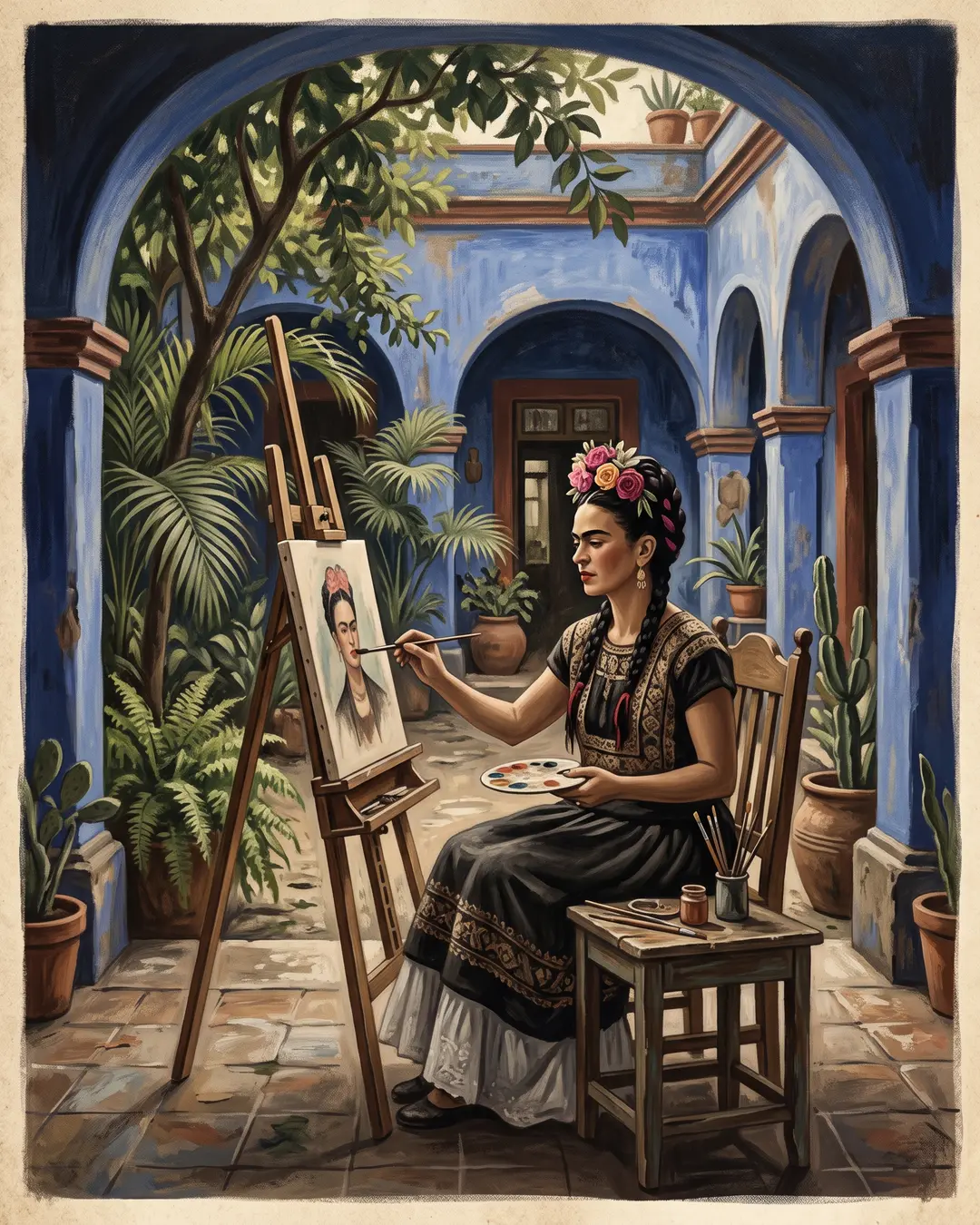
Coyoacan, polio, and a handrail
She was born Magdalena Carmen Frida Kahlo y Calderon in Coyoacan in 1907, though she often gave 1910 instead, aligning her birth with the outbreak of the Mexican Revolution. Her father Guillermo was a German-born photographer who taught her to retouch prints and to look hard at faces. Polio at the age of six left one leg thinner than the other and earned her a cruel nickname at school. She entered the elite Escuela Nacional Preparatoria as one of a small minority of girls and intended to study medicine.
In September 1925 the wooden bus she was riding was struck by a streetcar. A metal handrail entered her hip and exited through her pelvis; her spine, collarbone, ribs and right leg were broken. She spent months immobilised, and roughly thirty operations followed over the next three decades. Her mother had a mirror fixed to the canopy of her bed and an easel adapted so she could paint lying down. The self-portrait became her subject partly because she was the only sitter available.
Diego, the party, and the label she rejected
She showed her early canvases to the muralist Diego Rivera, twenty years her senior and already a national figure. They married in 1929, divorced in 1939 and remarried the following year, through a run of affairs on both sides, including her relationship with Leon Trotsky, who lodged at her family's Casa Azul in 1937. She joined the Communist Party, and her politics were not decorative: they shaped her dress, her subjects and her hostility to the American industrialists whose commissions supported the couple's travels.
Her paintings borrow the format of the retablo, the small votive panel offered in thanks for surviving disaster, and combine it with pre-Hispanic imagery and the Tehuana costume she adopted as a deliberate statement of Mexican identity. When Andre Breton visited in 1938 he declared her a natural Surrealist. She disliked the description and said repeatedly that she painted her own life rather than dreams. The work is closer to medical illustration and folk devotion than to European automatism.
Late recognition, and the face on the tote bag
Her first solo exhibition opened at the Julien Levy Gallery in New York in 1938; a Paris show followed in 1939, where the Louvre bought a small self-portrait, reportedly the first work by a twentieth-century Mexican artist to enter its collection. Recognition at home came late. In 1953 a Mexico City gallery gave her a solo show while she was too ill to stand, so she arrived by ambulance and received guests from a four-poster bed installed in the gallery. Her right leg was amputated below the knee that year.
She died in July 1954, aged forty-seven. The official cause was pulmonary embolism; the final entry in her diary and the absence of an autopsy have kept the question of suicide open. Wider fame arrived only in the 1970s and 1980s, carried by feminist art historians and by Hayden Herrera's 1983 biography. Since then her image has been printed on almost everything sold, a commercial afterlife that tends to smooth away the communism, the pain and the unsentimental strangeness of the paintings themselves.


