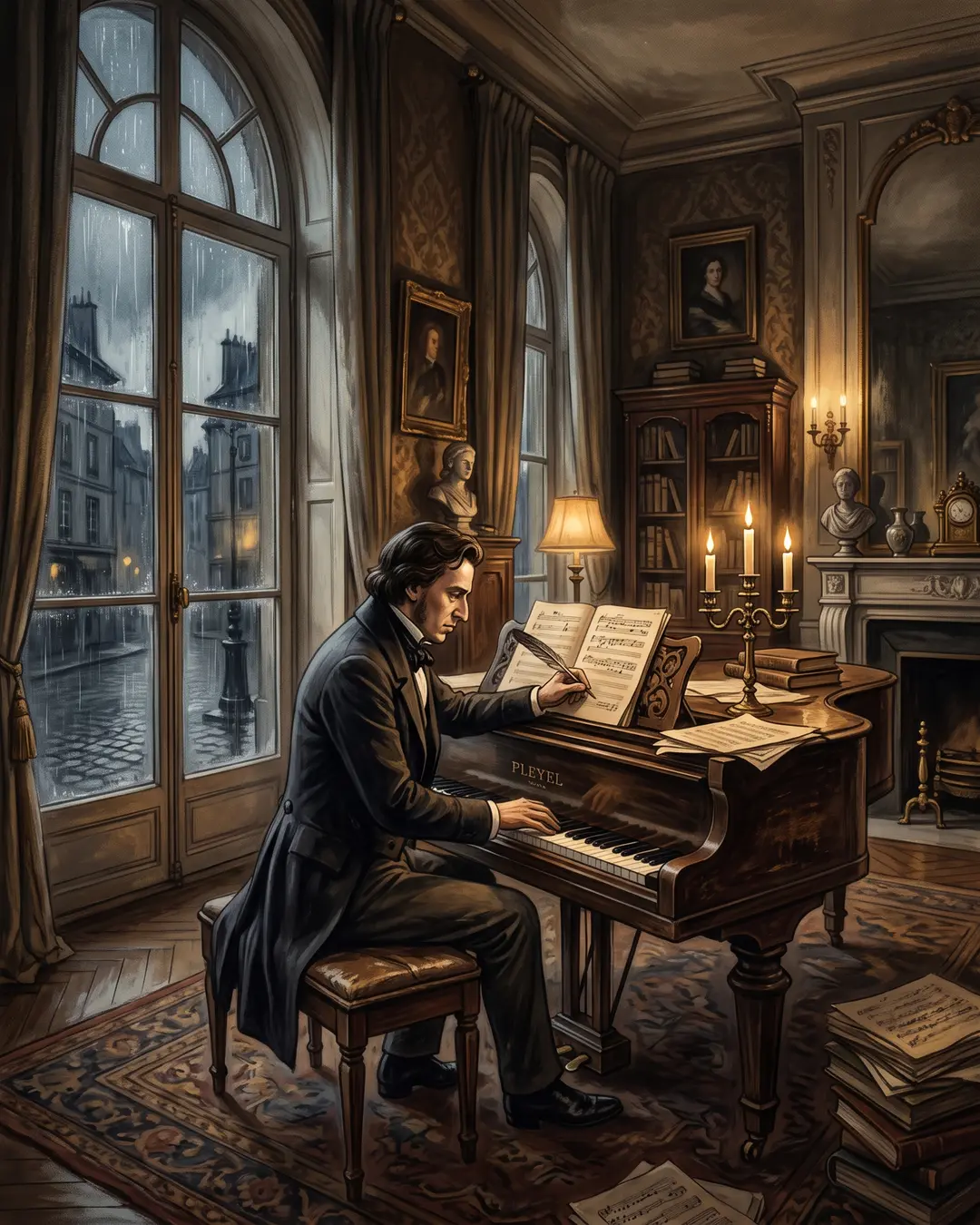
Warsaw Prodigy, Permanent Exile
Fryderyk Chopin was born in 1810 at Zelazowa Wola near Warsaw, son of a French emigrant father and a Polish mother, and the city knew early what it had: he was published at seven and playing aristocratic salons soon after. His conservatory teacher Jozef Elsner wisely refused to standardize him, noting in a report that the boy's peculiar manner was genius and should be left alone. In November 1830, carrying a silver cup of Polish soil given by friends, the twenty-year-old left to make his name abroad.
Weeks later Warsaw rose against Russian rule; the uprising was crushed in 1831 while Chopin, stranded and sick with guilt in Stuttgart, poured his fury into pages that legend links to the Revolutionary Etude. He settled in Paris among the exiles of the Great Emigration, never to see Poland again. Rather than pursue the concert circus of Liszt and the virtuosi, he built a rarer career: exquisitely paid lessons, publishing, and perhaps thirty public concerts in a lifetime, played mostly for candlelit rooms of listeners he could see breathing.
The Poet of the Piano, Precisely
The Romantic label hides a rigorous craftsman. Chopin composed slowly, agonizing over single bars, and confined himself almost entirely to the piano, an instrument he rethought from inside: fingering that let melody sing over stretched harmonies, pedaling like breath, rubato he taught as strict freedom, the left hand keeping time while the right bends it. The nocturnes refine a form learned from the Irishman John Field; the twenty-four preludes distill whole dramas into a page; the ballades invented a genre. Schumann's famous review of his variations announced a genius; Chopin, characteristically, disliked the fuss.
Exile shaped the content. His mazurkas and polonaises transmuted Polish dance rhythms into concert music of the first rank, and for compatriots scattered across Europe they became portable national territory, defiance in three-four time. His decade with the novelist George Sand, who sheltered and managed his fragile health at Nohant, coincided with his deepest work, including the B-flat minor sonata with its funeral march. The disastrous Majorca winter of 1838, coughing in a damp monastery beside a balky piano, has become shorthand for the whole myth: beauty produced at the body's expense.
Sixty Pieces of Earth
The end was slow and public. Tuberculosis, the probable culprit debated by modern physicians who also propose cystic fibrosis, wasted him through the 1840s; the break with Sand in 1847 removed his best protection. A final tour of Britain in 1848, played for polite audiences he found exhausting, finished his strength. He died in Paris in October 1849, at thirty-nine, asking that Mozart's Requiem be sung at his funeral. Following his explicit wish, his sister carried his heart back to Warsaw in a jar of spirits; it rests in a pillar of the Holy Cross Church.
His published legacy is small, roughly two hundred and thirty works, nearly all for solo piano, and none of it has ever left the repertoire. Every pianist since must pass through him; the Warsaw competition that bears his name has crowned careers since 1927. During the Nazi occupation, playing Chopin in Poland was banned as an act of nationalism, which was accurate: he had turned a partitioned, erased country into something that could be performed, and therefore could not be erased.


