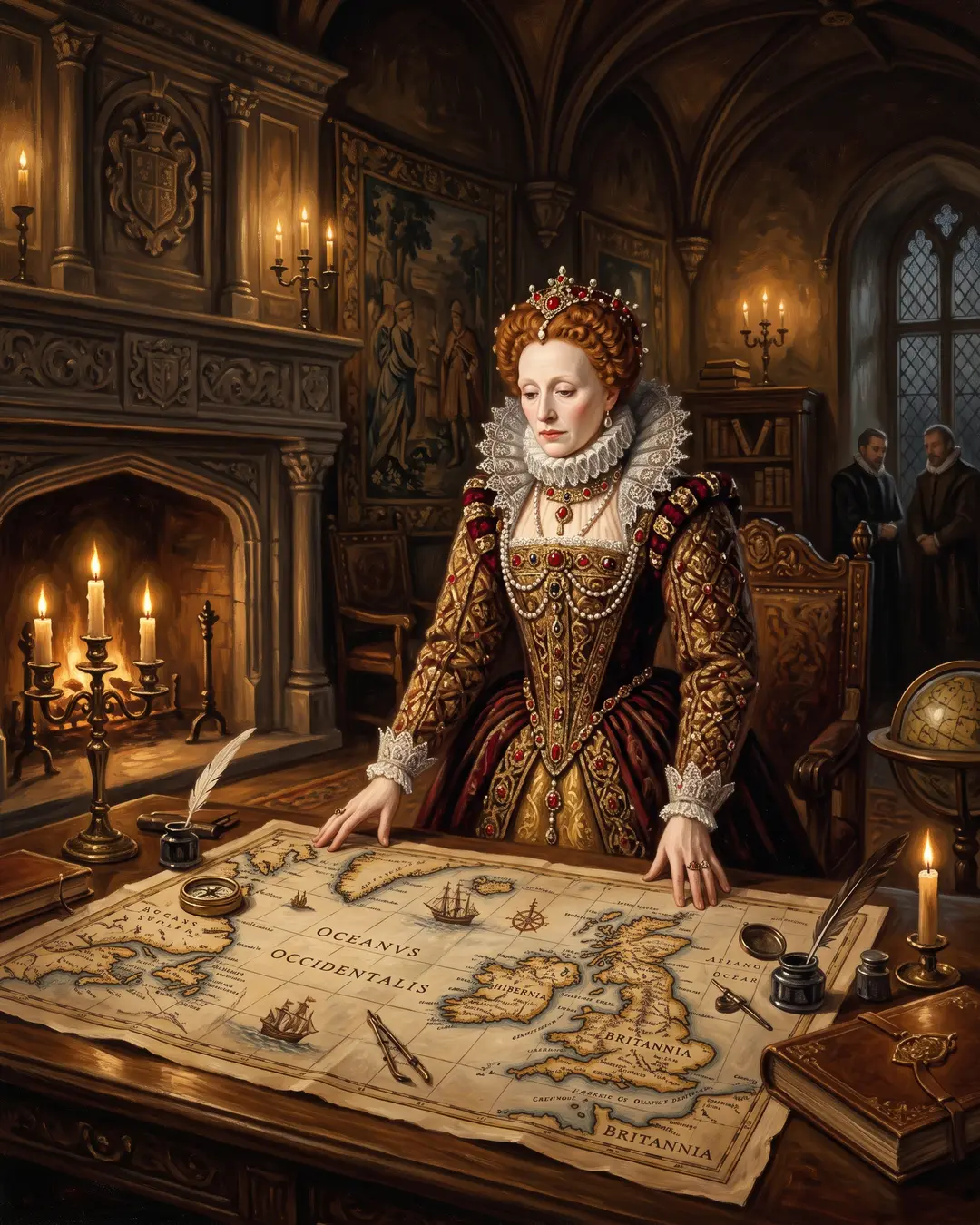
A Dangerous Apprenticeship
Elizabeth was born in 1533 to Henry VIII and Anne Boleyn, whose failure to produce a son cost her her head three years later. The child was declared illegitimate, restored to the succession by statute, and raised in the households of stepmothers, receiving an exceptional humanist education in Latin, Greek, French, and Italian. Adolescence was perilous. A scandal involving Thomas Seymour taught her at fifteen what rumor could do to a princess, and under her Catholic half-sister Mary she spent two months in the Tower in 1554, suspected of treason she consistently denied.
She came to the throne in November 1558 at twenty-five, inheriting a bankrupt treasury, a lost war, and a country whipsawed between religious settlements. The 1559 Acts of Supremacy and Uniformity created a church that was Protestant in doctrine and conservative in appearance, deliberately broad enough for most subjects to live with. She preferred outward conformity to interrogation of conscience, but the accommodation had limits, and Catholic priests were later executed as traitors, particularly after the pope excommunicated her in 1570.
Cousins, Councillors, and the Armada
The longest crisis of her reign was her cousin Mary, Queen of Scots, who fled to England in 1568 and became a magnet for plots. Elizabeth kept her captive for nineteen years, resisting Parliament's demands for execution, until Walsingham's agents proved Mary's involvement in the Babington conspiracy. She signed the death warrant in 1587, then raged when it was carried out and imprisoned her secretary William Davison for delivering it. Whether the fury was genuine remorse or a shield for the diplomatic consequences abroad, no one has settled to this day.
In 1588 Philip II sent the Armada. English gunnery, fireships at Calais, and above all the weather broke the invasion, and Elizabeth's speech to the troops at Tilbury entered national memory. The aftermath is less often told: thousands of English sailors died of typhus and hunger in the weeks after the victory, unpaid and rotting in port ships, while their commanders begged the Crown for money. Her instinct for economy, so useful against ministers who wanted grand wars, could be pitiless toward the men who won them.
The Cost of Gloriana
Her reputation rests partly on a controlled image. Portraits were regulated, the aging face replaced by an ageless mask of pearls and jewels, and the refusal to marry converted from weakness into the cult of the Virgin Queen. Behind it lay hard calculation: an unmarried queen with a foreign match unmade could keep France and Spain guessing for decades. The strategy left the succession unsettled until her final hours, and courtiers spent her last years secretly corresponding with James VI of Scotland, the heir she would not publicly name.
Ireland shows the other face of the reign. The Nine Years' War ended in English victory through deliberate destruction of crops and the famine that followed, and the Munster plantations dispossessed Irish landholders to settle English colonists. At home, monopolies granted to favorites provoked such anger that in 1601 she retreated in the address later called the Golden Speech, and the same Parliament passed the Poor Law that framed English welfare for centuries. She died in March 1603, having outlasted almost everyone who ever underestimated her.


