The Timid Niece
Eleanor Roosevelt was born in New York in 1884 to beauty and wreckage: her mother, who called her Granny for her seriousness, died when she was eight, her alcoholic father two years later. Theodore Roosevelt's awkward niece found herself at an English boarding school under the feminist educator Marie Souvestre, who taught her to think and to speak. Married in 1905 to her cousin Franklin, she spent fifteen years in dutiful child-raising and social apprenticeship, by her own account a timid appendage to an ambitious man and his dominating mother.
Two catastrophes forged the public Eleanor. In 1918 she discovered Franklin's affair with Lucy Mercer; the marriage survived as a political partnership with separate emotional lives. In 1921 polio paralyzed him, and she became his legs, eyes, and ears, touring, inspecting, reporting, while building her own base among union women, reformers, and Democratic organizers. The honest record includes what she outgrew: the casual antisemitic and class prejudices of her set, documented in early letters, which decades of activism visibly burned away, one of the more hopeful arcs in American public life.
A New Kind of First Lady
From 1933 she rebuilt the role: the first First Lady press conferences, often limited to women reporters so editors were forced to employ some; a syndicated column, My Day, six days a week for decades; unannounced descents into coal mines, migrant camps, and segregated hospitals as the New Deal's most restless inspector. She pushed her husband constantly, and publicly when necessary: in 1939, when the Daughters of the American Revolution barred the Black contralto Marian Anderson from Constitution Hall, Eleanor resigned her membership, and the concert moved to the Lincoln Memorial's steps before seventy-five thousand people.
Her civil rights record ran well ahead of the administration's: friendships and alliances with Mary McLeod Bethune and Walter White, sitting defiantly in the aisle between white and Black sections at a segregated Birmingham meeting, championing the Tuskegee airmen and anti-lynching legislation her husband, hostage to Southern committee chairmen, declined to spend capital on. She fought the wartime internment of Japanese Americans inside the administration and lost, then visited the camps; her compromises with Franklin's politics, accepted for access, are part of any honest accounting of both Roosevelts.
Article One
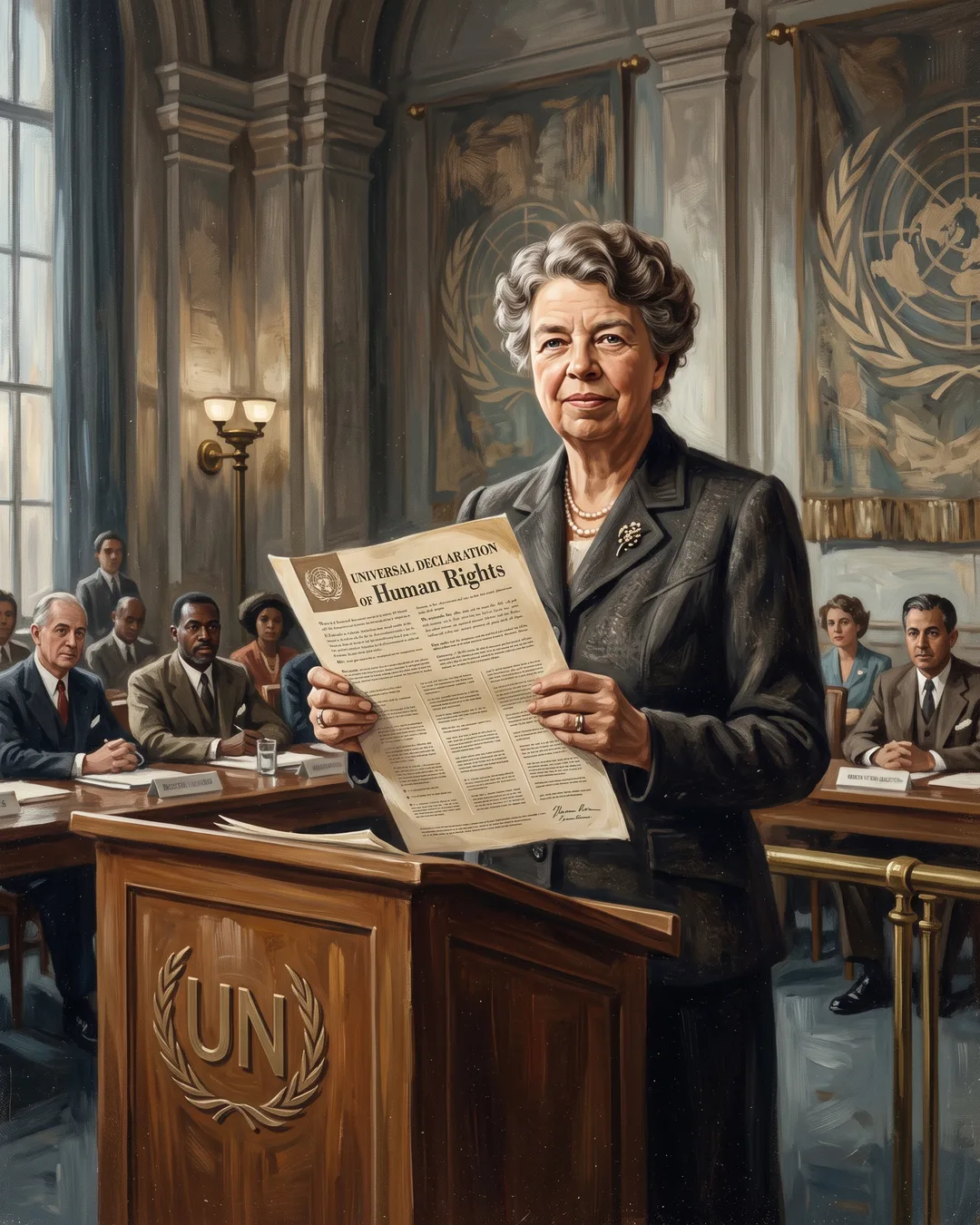
Widowed in 1945, she expected retirement; Truman instead sent her to the new United Nations, where doubting diplomats watched the amateur outmaneuver them. As chair of the Human Rights Commission she drove the drafting of the Universal Declaration of Human Rights through eighty-some meetings, mediating between Western, Soviet, Latin American, and Asian conceptions of dignity, and on December 10, 1948, the General Assembly adopted it without a dissenting vote, though with abstentions. She called it a Magna Carta for all mankind, and its thirty articles now underlie the world's human rights law.
She spent her last years as the Democratic Party's conscience, chairing Kennedy's commission on the status of women and writing to the end; she died in November 1962, mourned, as Truman had already named her, as First Lady of the World. Adlai Stevenson's eulogy said she would rather light a candle than curse the darkness. The plainer measure is procedural: a woman who held no elected office remains the standard against which the influence of every unelected public figure, and most elected ones, is still measured.


