Out of Siberia
Dmitri Ivanovich Mendeleev was born in 1834 at Tobolsk in western Siberia, the youngest of a very large family whose exact size is still disputed in the sources. His father, a school director, went blind and died; his mother reopened a family glass works to keep the household, and the factory then burned. Convinced that her last child was exceptional, she took him thousands of miles west in search of an education, secured him a place in St Petersburg, and died within months of arriving.
He trained as a teacher, contracted a lung disease that doctors thought would kill him, recovered in Crimea, and returned to a scientific career that ran through Heidelberg and then the University of St Petersburg. At the Karlsruhe congress of 1860 he heard Stanislao Cannizzaro argue for a consistent system of atomic weights, a proposal that finally made the elements comparable to one another. Everything he did afterwards depended on that numerical footing being reliable. He was thirty-five and writing a textbook when the decisive idea arrived.
Cards, Gaps, and Predictions
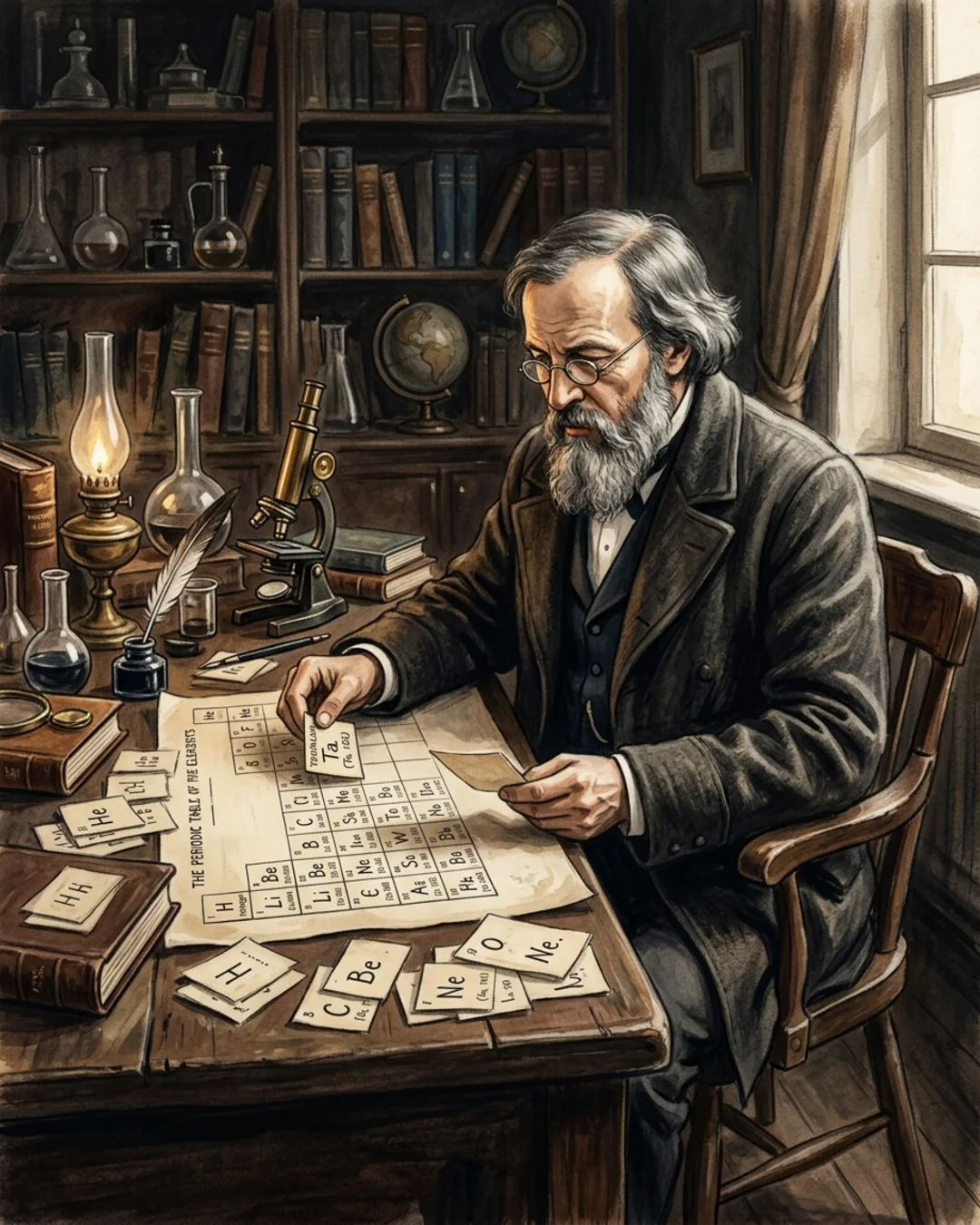
Writing a textbook forced the issue. Needing an order in which to present the known elements, Mendeleev arranged their properties on cards and shuffled them until, in 1869, the pattern of recurring behaviour against rising atomic weight resolved. He was not alone. Alexandre-Emile Beguyer de Chancourtois, John Newlands, William Odling and Julius Lothar Meyer had all seen something similar, and Meyer's version was in some respects more precise. Priority was contested at the time and remains a fair subject of argument.
What set Mendeleev apart was nerve. Where the sequence misbehaved he assumed the measurements were wrong and reordered anyway, and where it left a hole he declared that an undiscovered element belonged there and described its likely weight, density and chemistry in advance. Gallium arrived in 1875, scandium in 1879 and germanium in 1886, each close to specification. Predictions that can fail publicly and do not are the strongest evidence a system can offer, and chemistry accepted the table. Lothar Meyer later acknowledged that he had lacked the nerve to predict.
The Public Man and the Legends
Mendeleev was a restless administrator as much as a chemist. He advised on the Russian oil industry, argued for protective tariffs, ascended alone in a balloon in 1887 to observe a solar eclipse when the pilot could not fit, and directed the Bureau of Weights and Measures. He resigned his professorship in 1890 after carrying a student petition to the ministry. The widely repeated claim that he fixed the strength of Russian vodka at forty per cent is a myth; his dissertation on alcohol and water concerned densities, not policy.
He resisted the discovery of the noble gases before conceding they formed a new group, and he never accepted that atoms had internal structure, a position the next generation swept aside. The 1906 Nobel Prize in Chemistry went to Henri Moissan by a narrow committee vote, and Mendeleev died the following year without it. In 1955 a new element was named mendelevium, a form of recognition that outlasts any prize and sits, appropriately, in the table he built. He died in St Petersburg in 1907, honoured at home and abroad.


