A minor official from Lu
Kong Qiu, known in the West as Confucius, was born in 551 BCE in the small state of Lu, in today's Shandong province, during the slow disintegration of the Zhou political order. His family belonged to the minor gentry and had little money; tradition says he worked in his youth keeping granaries and livestock. He rose to modest office in Lu, but his political career stalled, and in middle age he left home to travel for years between rival courts, offering counsel to rulers who listened politely and rarely acted on it.
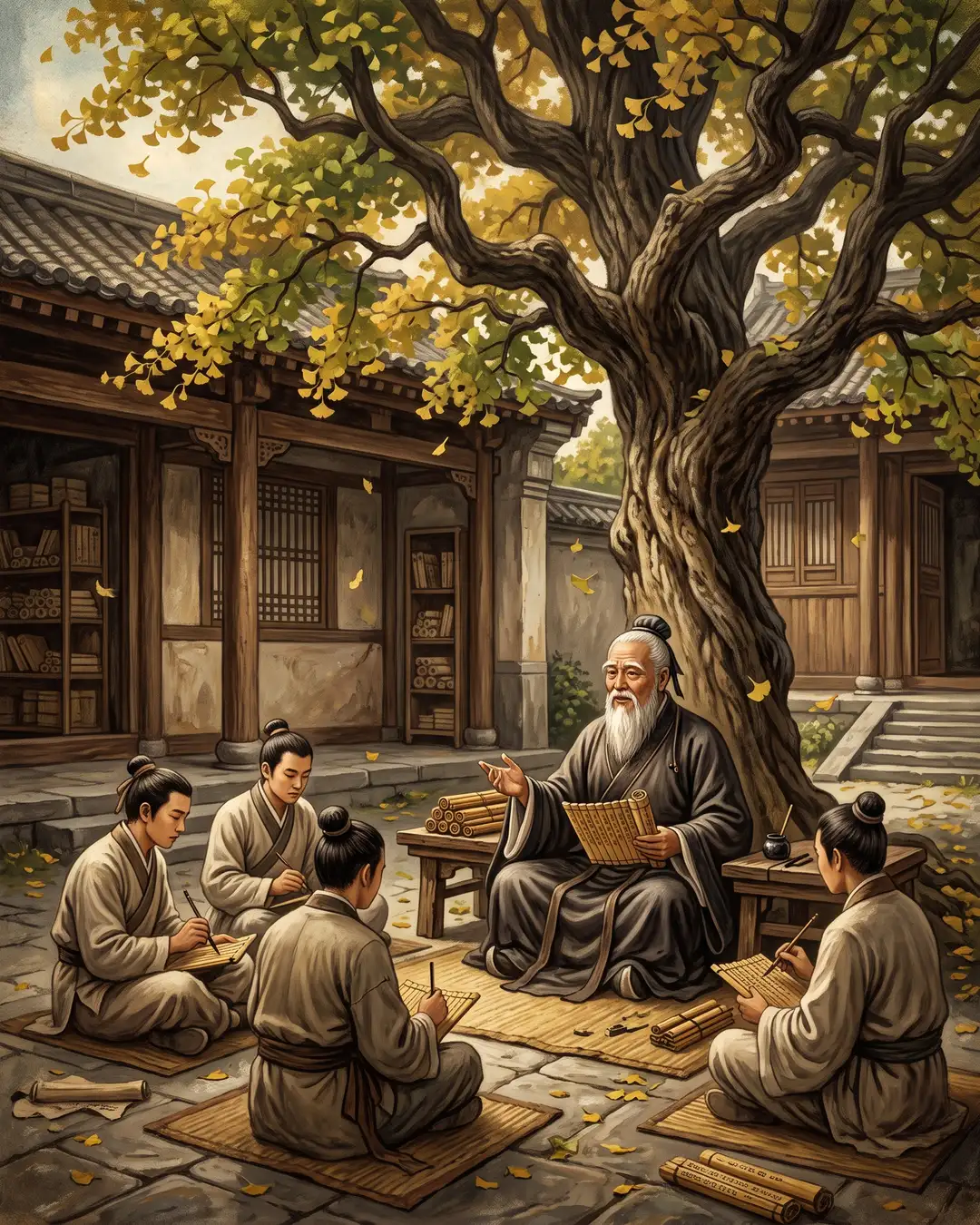
He returned to Lu in old age and died in 479 BCE, reportedly convinced his teaching had come to nothing. What survived was his classroom. Confucius accepted students regardless of wealth, an unusual practice in an aristocratic age, and trained them in ritual, poetry, history and the conduct of government. The bond between teacher and disciple became the vehicle of his influence: it was students, and students of students, who carried his sayings across the following centuries and gradually turned a provincial teacher into the foundation of a tradition.
Known through other hands
Confucius wrote no book of doctrine. The Analects, the classic most closely tied to him, is a compilation of sayings and short scenes assembled by followers over generations after his death, and scholars still debate which layers reflect the historical teacher. Later biographies, such as the one in Sima Qian's history written some four centuries on, mix record with legend. This does not make him unknowable, but it means every portrait is partly a reconstruction, and the traditions honoring him have often refashioned him to serve their own needs.
The core teachings are nonetheless coherent. Confucius taught ren, usually translated as humaneness, expressed through li, the rituals and courtesies that give shape to shared life. He held that good government rests on the moral example of rulers rather than on punishments, that family devotion trains the sympathies a society depends on, and that people should be measured by conduct and learning rather than birth. His ideal figure, the junzi or cultivated person, was defined by character rather than ancestry, a quietly radical idea in a hereditary world.
An afterlife larger than the life
Centuries after his death, Han dynasty emperors adopted Confucian teaching as state orthodoxy, and from the Tang and Song dynasties onward mastery of the classics became the gateway to China's civil service examinations. His ideas traveled to Korea, Japan and Vietnam, shaping law, schooling and family life across East Asia. Temples were raised in his honor, and his descendants in Qufu were ennobled for generations. The teacher who could not find a willing patron became, in death, the most institutionally successful thinker in Chinese history.
The legacy has always been argued over. Critics ancient and modern have charged Confucianism with entrenching hierarchy, subordinating women and encouraging deference to power; twentieth-century reformers attacked it as the dead weight of the past, and Mao-era campaigns vilified Confucius by name. Yet the tradition has repeatedly renewed itself, and his thought is studied again in China and debated worldwide. Both the reverence and the criticism answer the same fact: few people have had their remembered words carried so far, for so long, by so many other hands.


