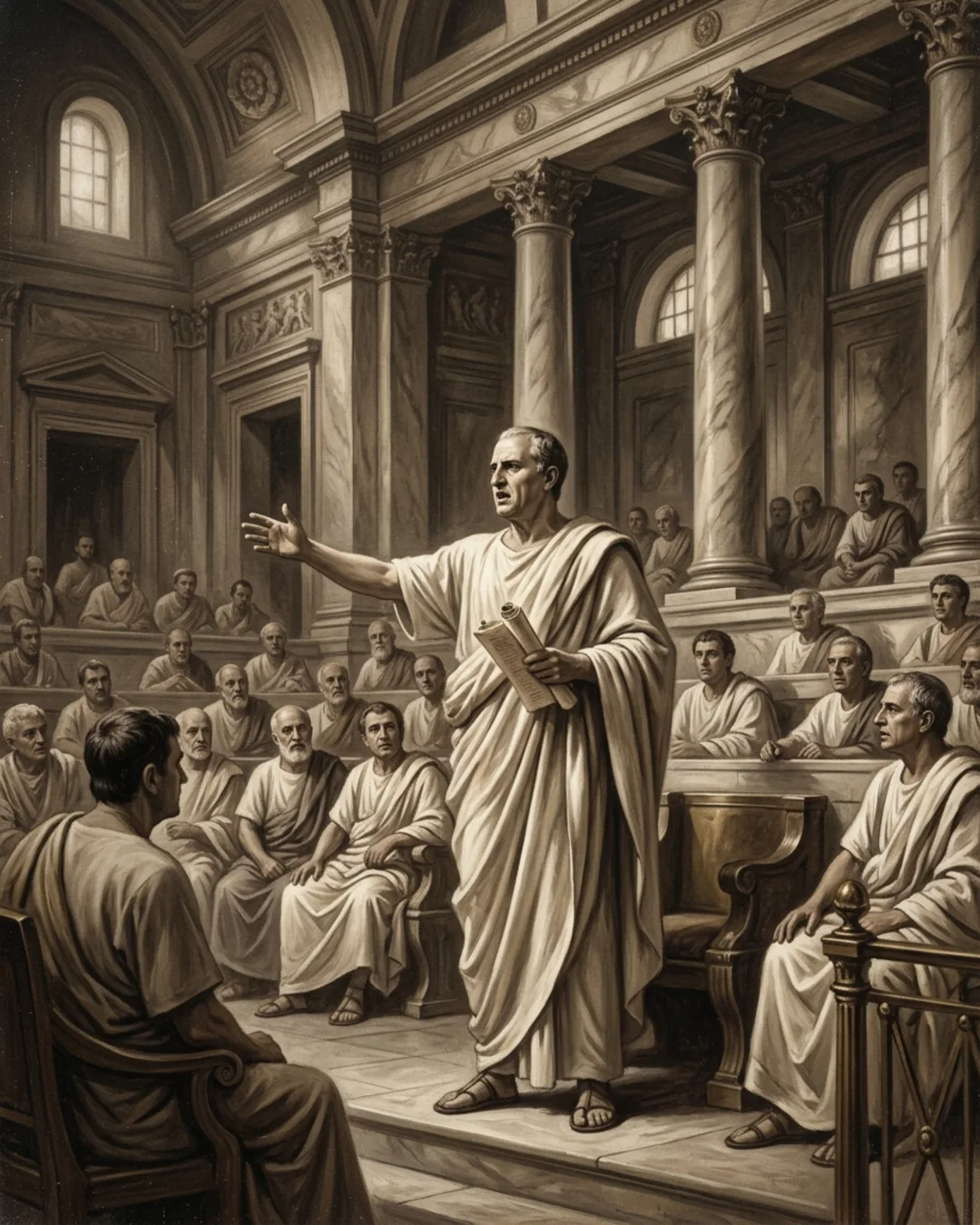
A New Man From Arpinum
Marcus Tullius Cicero was born in 106 BCE at Arpinum, a hill town southeast of Rome, into a well-off equestrian family with no senatorial ancestors. In a political culture where office followed inherited name, that made him a novus homo, a new man, and closed most doors. He opened them with his voice. Trained in rhetoric at Rome and then in Greece and Rhodes, he built a reputation in the courts, most spectacularly by prosecuting Verres, the plundering governor of Sicily, in 70 BCE and driving him into exile before the trial concluded.
He climbed every rung at the earliest legal age and reached the consulship in 63 BCE, the first new man in three decades to do so. That year Catiline, a bankrupt aristocrat whom Cicero had beaten at the polls, conspired to seize power. Cicero exposed the plot in a series of speeches that schoolchildren still translate, and had five conspirators executed without trial on the senate's authority. It was the summit of his career and the wound that never healed: in 58 an enemy tribune drove him into exile for exactly that decision.
The Republic He Could Not Save
Recalled after eighteen months, he found the ground gone. Pompey, Caesar and Crassus had arranged Roman politics privately between them, and Cicero's constitutional vision, a concord of the orders in which senate and equestrians governed together under law, had no army behind it. He compromised, defended men he despised, took a provincial governorship in Cilicia that he performed honourably, and chose Pompey's side in the civil war. Caesar won, and pardoned him. Cicero withdrew from public life, and his daughter Tullia died in 45, a grief he could not write himself out of.
Those enforced idle years produced the philosophy. In rapid succession he wrote on the nature of the gods, on ends, on duties, on friendship and old age, on divination, deliberately building a Latin vocabulary for Greek ideas where none existed. He invented or fixed terms that European thought still uses. His own position was moderate scepticism, weighing arguments rather than adopting a system, and his aim was frankly political: to give Roman public men a philosophical grounding for the obligations he thought they were abandoning.
The Last Gamble
Caesar's murder in 44 BCE brought him back. Cicero had no part in the conspiracy but welcomed it, and then made a calculation: he would use the nineteen-year-old Octavian against Mark Antony, whom he attacked in fourteen ferocious speeches called the Philippics. He is said to have believed the young man could be praised, honoured and discarded. Octavian instead came to terms with Antony and Lepidus, and the three drew up proscription lists. Cicero's name was on them, reportedly at Antony's insistence and without Octavian's objection.
He was caught near Formiae in December 43 and killed, and his head and hands were nailed up in the forum where he had spoken. What survives is extraordinary in its intimacy: roughly nine hundred letters, many to his friend Atticus, in which he is vain, indecisive, self-pitying and shrewd by turns, often within a paragraph. Almost no other ancient figure can be watched changing his mind in private. Petrarch's rediscovery of those letters in 1345 shocked readers who had known only the statesman, and helped begin the Renaissance.


