From Venice to a Paris Courtroom
Christine was born in Venice about 1364. Her father, Tommaso da Pizzano, was a physician and astrologer recruited to the court of Charles V of France, and the family moved to Paris while she was small. She grew up around the royal library, one of the great book collections of the age, and later insisted that her father had encouraged her learning while her mother would have preferred her at the spindle. At fifteen she married Etienne du Castel, a notary of the royal chancery, in what she described as an unusually happy match.
Within a decade both men were dead. Charles V died in 1380, her father soon after, and her husband was carried off by plague in 1390, leaving Christine at about twenty-five with three children, her mother and a niece to support. Salaries owed to her husband went unpaid, creditors circled, and she spent years in litigation over property she could not prove was hers. She wrote about that period with unusual precision: not as a spiritual trial but as an education in how the law treats a woman without a man to speak for her.
Making a Living From the Book Trade
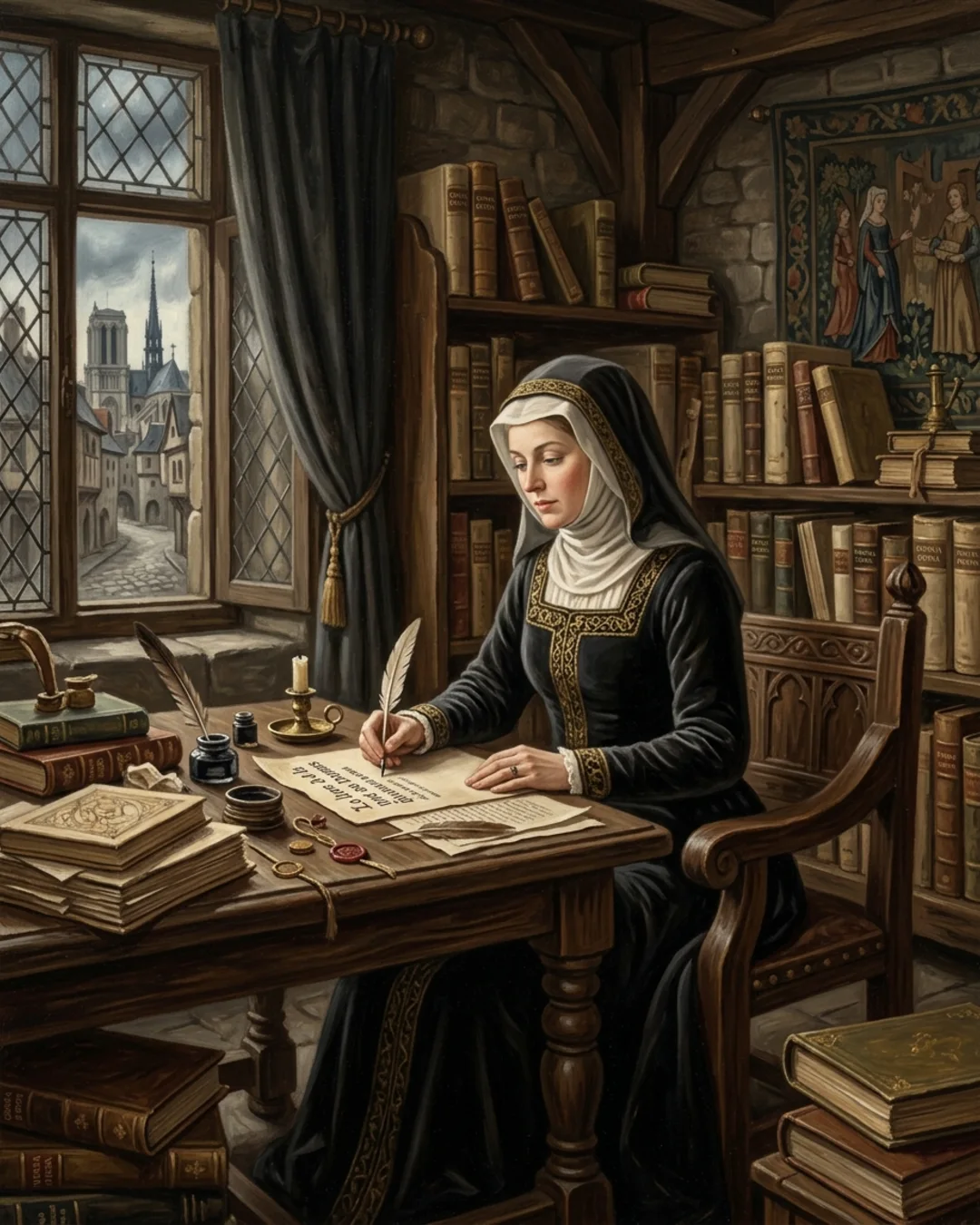
She began with lyric poetry, ballades of loss that found an audience among the aristocracy, and built from there into a working enterprise. She supervised the copying and illumination of her own manuscripts, assembling luxury presentation volumes for patrons including Queen Isabeau of Bavaria, Louis of Orleans and Philip the Bold of Burgundy. Several surviving codices were produced under her direct oversight, and scholars have identified a scribal hand in them that is very probably her own. In a culture of patronage rather than royalties, she made her books objects worth commissioning.
Her range widened until it covered nearly everything a courtly intellectual could write: a biography of Charles V commissioned by his brother, a treatise on the art of war and chivalry drawing on Vegetius, political advice to a fractured kingdom, and consolation literature. As the Armagnac and Burgundian factions dragged France toward civil war, she wrote directly to princes urging restraint. The advice was ignored. Her later works carry the weariness of a writer who could see the catastrophe coming and had no power beyond argument.
The Quarrel and the City
Around 1401 she entered a public exchange of letters with senior royal officials over the Romance of the Rose, the most admired French poem of the age, whose second part she condemned for its contempt toward women and its coarseness. She was outnumbered and outranked, and her opponents treated her with a mixture of condescension and irritation. She had the letters copied and circulated as a dossier, which is why the debate survives. It is one of the first literary controversies in Europe in which a woman set the terms of the argument.
Out of that came The Book of the City of Ladies, finished about 1405, in which the figures of Reason, Rectitude and Justice help her build a walled city from the lives of women drawn from history, scripture and legend, answering the slanders of learned men case by case. Its companion volume gave practical counsel to women across the social range. She retired to a convent as the war worsened, and in 1429 broke a long silence with a poem in praise of Joan of Arc, the last work known to be hers.


