A Secret Kept for Life
Charles Dickens was born at Portsmouth in 1812, the son of a naval pay clerk whose optimism about money never matched his income. In 1824 John Dickens was imprisoned for debt in the Marshalsea, and his twelve-year-old son was sent to paste labels on pots of boot blacking in a rat-run warehouse by the Thames for six shillings a week. The episode lasted months, not years, and it never left him. He told almost no one, not even his children, confiding it in adulthood only to his friend and biographer John Forster.
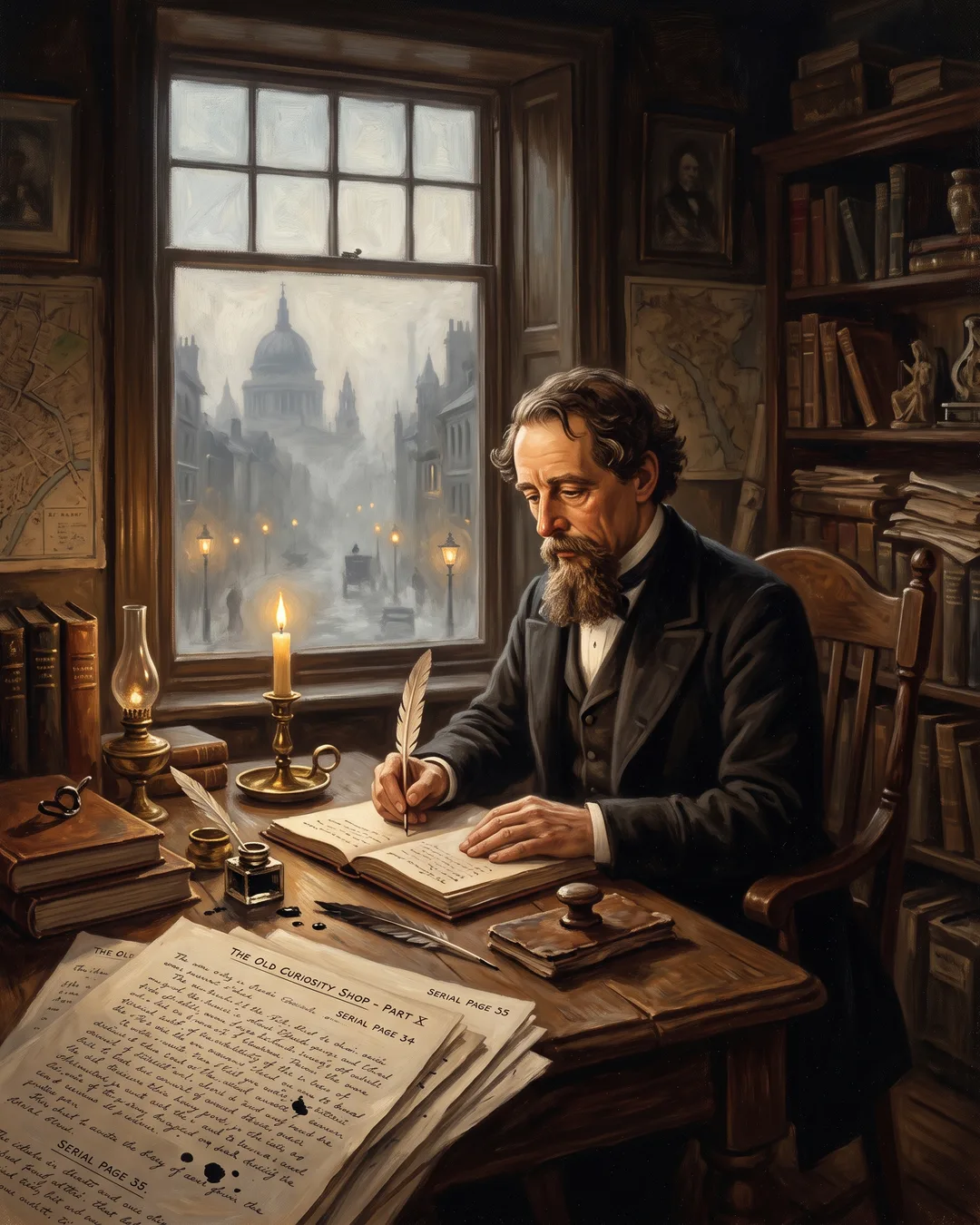
Released by a small inheritance, the family put him back in school, and he then taught himself shorthand and became one of the fastest parliamentary reporters in London. That apprenticeship in listening shows in everything he wrote. His sketches of city life led to The Pickwick Papers in 1836, issued in cheap monthly parts, and the serial format made him the first mass-market celebrity author in English. He was twenty-four, and for the rest of his life he wrote against a deadline that he mostly set himself.
The Novelist as Campaigner
Oliver Twist put a workhouse child at the center of a national bestseller, and Dickens kept aiming his fiction at institutions: the Chancery courts in Bleak House, industrial utilitarianism in Hard Times, debtors' prisons in Little Dorrit. He spoke for sanitary reform and ragged schools, edited weekly magazines, and with the heiress Angela Burdett-Coutts ran Urania Cottage, a home meant to give women leaving prostitution a route to emigration and work. He was not a systematic thinker, and his politics were closer to furious sympathy than to any program.
He could also be blind in ways his readers challenged. The relentless labeling of Fagin as the Jew in Oliver Twist drew a protest letter in 1863 from Eliza Davis, a Jewish reader who told him what the portrait did. He revised later editions, cut many of the references, and created the benevolent Riah in Our Mutual Friend, a correction that some critics find gracious and others find clumsy. It remains one of the few documented cases of a Victorian giant being argued out of a prejudice by a stranger.
Fame, Cruelty, and Collapse
In 1858, after twenty-two years of marriage and ten children, he separated from Catherine Dickens, and did something unforgivable to modern eyes: he printed a statement in his own magazine implying his wife was unfit and mentally unwell, then pressured relatives to take sides. He had by then met the young actress Ellen Ternan, whose place in his life he concealed for the rest of it. The public moralist of the English hearth managed his private conduct with the ruthlessness of a man protecting a brand.
He drove himself with public readings, performing the murder of Nancy from Oliver Twist to audiences who fainted, while his pulse raced dangerously afterward. In 1865 he survived the Staplehurst railway crash, climbing back into a hanging carriage to retrieve his manuscript and never fully recovering his nerve. He died of a stroke at Gad's Hill in June 1870 with The Mystery of Edwin Drood half finished, and was buried in Westminster Abbey, in a national ceremony rather than the modest funeral his will had requested.


