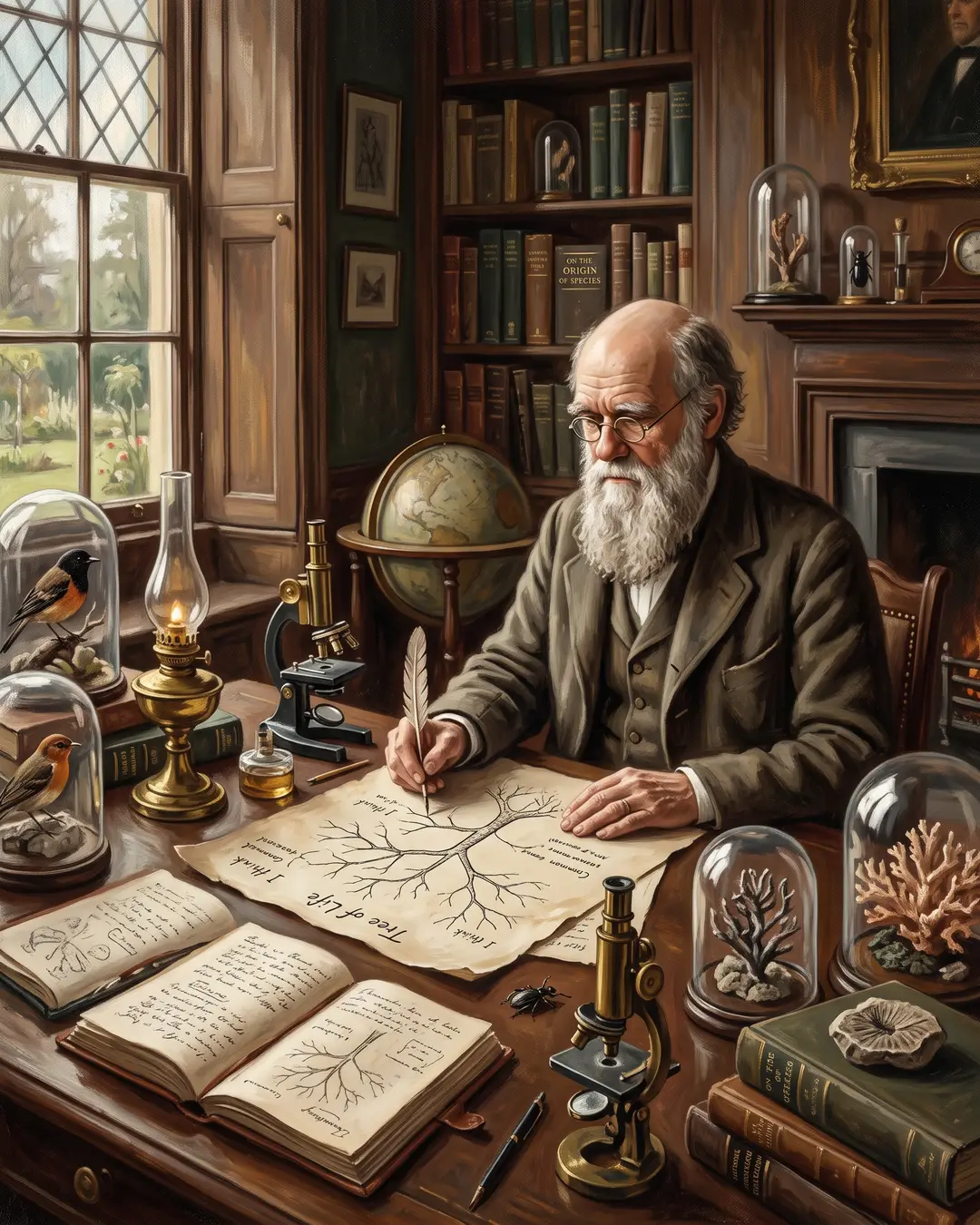
A young gentleman on a survey ship
Charles Darwin was twenty-two, a medical dropout and reluctant divinity student, when he joined HMS Beagle in 1831. He was not the ship's official naturalist; that role initially belonged to the surgeon Robert McCormick. Darwin sailed as a gentleman companion for Captain Robert FitzRoy, a devout and volatile officer who wanted an educated table companion on a long coastal survey. For five years Darwin collected fossils in Patagonia, walked the Andes, and shipped crate after crate of specimens back to England, where his reputation was quietly built by the naturalists who unpacked them.
The Galapagos revelation of popular memory did not happen on the islands. Darwin labelled his bird specimens carelessly and had to reconstruct their origins later using notes kept by FitzRoy and by the ship's crew. It was the ornithologist John Gould, working in London in 1837, who told him that the drab little birds were not a jumble of finches, blackbirds and grosbeaks but a related group of distinct species. The idea that would define Darwin's life arrived in a museum, through another man's expertise.
Barnacles, grief and delay
By 1838 Darwin had the mechanism. Reading Thomas Malthus on population pressure gave him the final piece: more offspring are born than can survive, small variations are inherited, and the differences compound. He wrote a thirty-five-page abstract in 1842 and a longer essay in 1844, then sealed the essay with instructions to his wife Emma to publish it if he died. He did not publish it while he lived. Instead he spent eight years dissecting barnacles, producing a monograph so exhaustive that his children reportedly assumed all fathers studied them.
The delay had several sources, and dishonesty was not among them. Darwin was chronically, mysteriously ill; his eldest daughter Annie died in 1851, a loss that hollowed what remained of his Christian belief; and Emma, whom he loved deeply, was troubled by where his reasoning led. He had also watched anonymous evolutionary speculation savaged by the scientific establishment. He wanted the case armoured with evidence before he made it. Caution, grief and perfectionism kept the most consequential idea in nineteenth-century biology in a drawer.
Wallace, and what others did with the theory
In June 1858 a parcel arrived from Alfred Russel Wallace, a self-financed collector working in the Malay Archipelago. It contained an essay describing natural selection in terms close to Darwin's own. Darwin was stricken. His friends Charles Lyell and Joseph Hooker arranged a joint reading at the Linnean Society that July, pairing Wallace's essay with extracts of Darwin's earlier writing. Wallace, thousands of miles away, was not consulted and learned of the arrangement afterward. He accepted it graciously, but the priority question has never entirely settled.
On the Origin of Species appeared in November 1859 and sold out immediately. Darwin avoided human evolution until The Descent of Man in 1871, a book that carries the racial and gender assumptions of its class and century, and that modern readers should not soften. He loathed slavery and argued for the unity of humankind, yet within decades others were citing him to justify eugenics and imperial conquest. Herbert Spencer supplied the phrase survival of the fittest; the politics built on it were not Darwin's, but they were built.


