Thirty years of campaigning
Charles, son of Pepin the Short, was born around 747 into the Carolingian family that had taken the Frankish crown from the Merovingians a few years earlier. He shared the kingdom uneasily with his brother Carloman until Carloman's death in 771 left him sole ruler, and he spent the next four decades on horseback. He annexed the Lombard kingdom of Italy in 774, absorbed Bavaria, destroyed the Avar khaganate on the Danube and carried its accumulated treasure west.
The Saxon wars lasted thirty-two years and were the darkest of them. Conquest was tied to conversion: capitularies imposed death for refusing baptism or for cremating the dead in the old way, and in 782 at Verden the sources record the mass execution of several thousand Saxon captives in a single day. A failed campaign in Spain in 778 cost him a rearguard ambushed by Basques in the Pyrenees, an incident that three centuries later became the Song of Roland, with Muslim armies substituted for the actual attackers.
Christmas Day, 800
In Rome on 25 December 800, Pope Leo III placed a crown on his head and the assembled congregation acclaimed him emperor, the first in western Europe since the fifth century. His biographer Einhard claims he would not have entered the church that day had he known what was planned, a statement most historians treat as diplomatic cover rather than surprise. The coronation offended Constantinople, which had its own emperor, and it took until 812 for the Byzantines to grant him the title at a carefully reduced value.
Government mattered more than ceremony. He issued capitularies on everything from weights and coinage to the conduct of monks, reformed the silver currency into a system that outlasted his empire by a thousand years, and sent out paired inspectors, one lay and one clerical, to audit counts and bishops in his name. It was an administration held together by personal loyalty, hard riding and the assumption that the ruler was responsible for the salvation of his subjects as well as their taxes.
The script that survived the empire
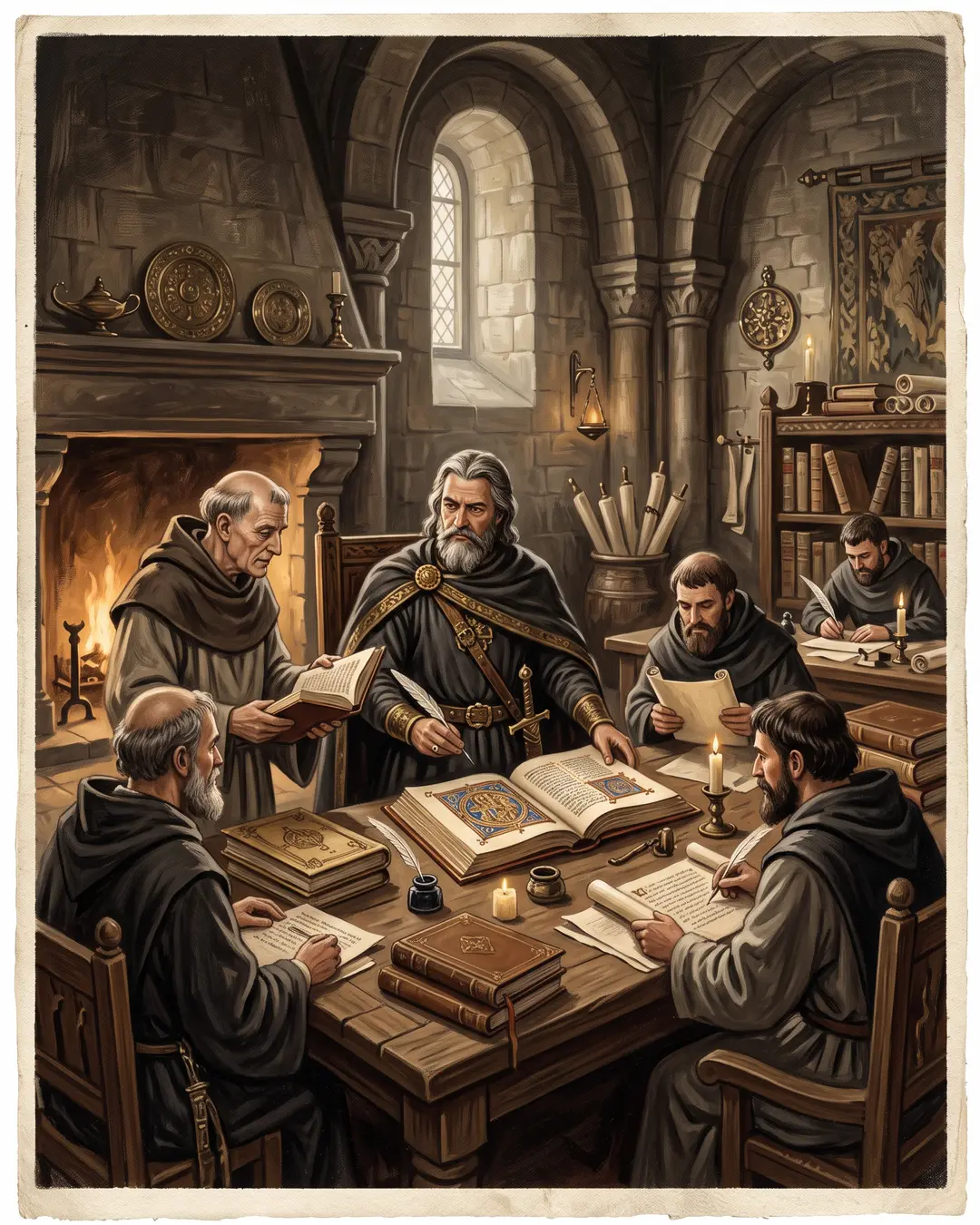
At Aachen he assembled scholars from across Europe: Alcuin of York, the Lombard historian Paul the Deacon, the Visigothic poet Theodulf of Orleans, and Einhard, who wrote his life on a Roman model. They standardised the liturgy, set up cathedral and monastery schools, corrected the text of the Bible and organised the systematic copying of older manuscripts. For a great many Latin classical works, the oldest surviving copy we possess is a Carolingian one; without that programme they would simply be gone.
Out of the scriptoria came Carolingian minuscule, a clear, spaced, unambiguous hand with recognisable lower-case letters and word breaks. Renaissance humanists mistook it for genuine Roman writing and revived it, which is why it stands behind the typefaces on this page. Einhard says the emperor kept writing tablets under his pillow to practise letters late at night, and made little progress. The empire itself was divided among his grandsons at Verdun in 843; the handwriting outlived it.


