An Outsider Takes the Throne
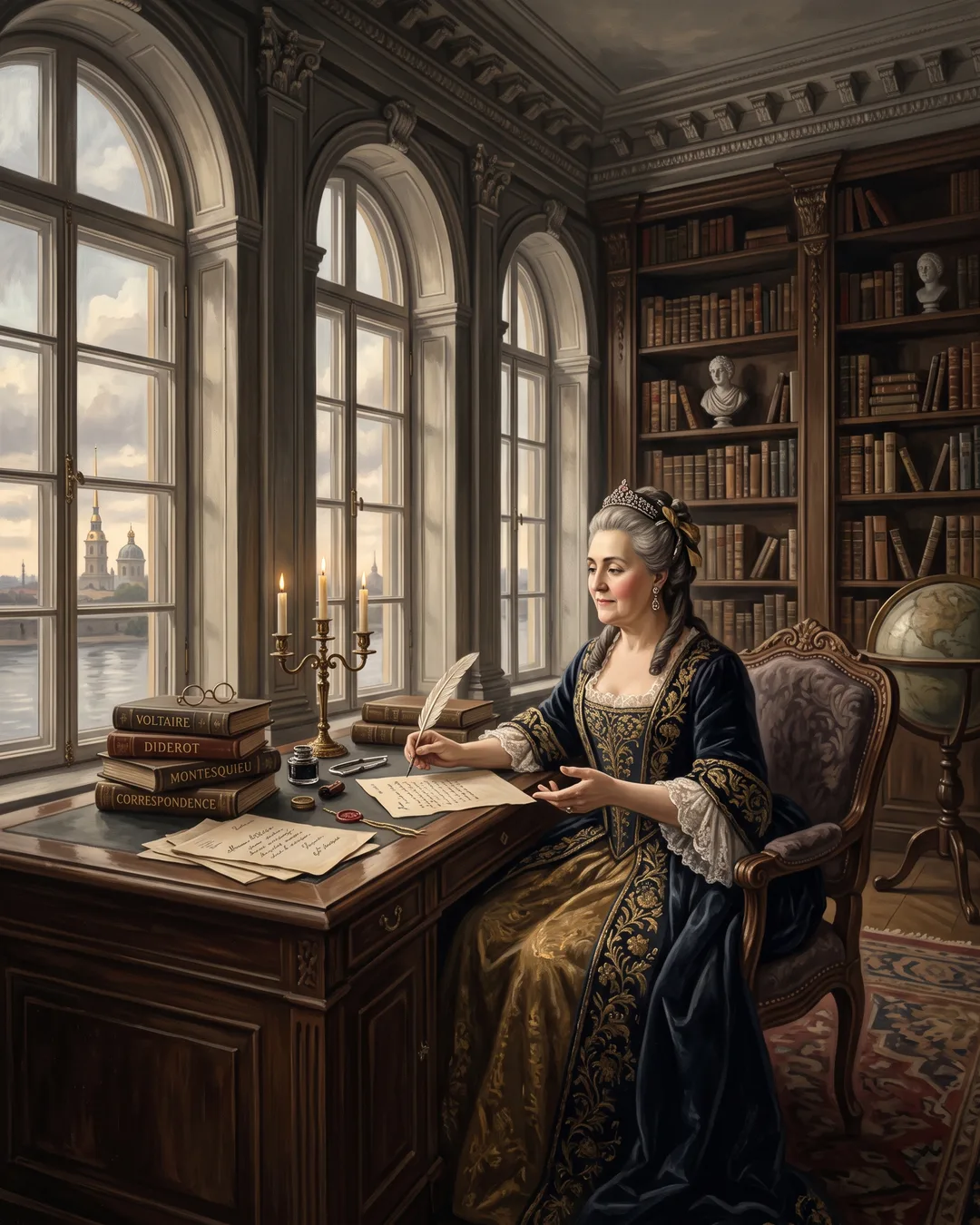
She was born Sophie of Anhalt-Zerbst in 1729 at Stettin, daughter of a minor Prussian general, and was brought to Russia at fourteen to marry the heir to the throne. She converted to Orthodoxy, took the name Catherine, learned Russian with determination, and endured eighteen years of a miserable marriage to Peter, a man whose loyalty to Frederick the Great outraged the officer corps. She read Montesquieu, Tacitus, and Voltaire in the isolation of those years, and she built alliances among the guards regiments who would later decide her fate.
Peter III became emperor in January 1762 and was deposed in July by a conspiracy Catherine led with the Orlov brothers. Days later he was dead at Ropsha, killed in a scuffle according to a hasty letter from Alexei Orlov. No document proves she ordered it, and no serious account treats her as merely a bystander who profited. She took the throne with no hereditary claim of her own, which is why the rest of her reign was an argument, made in laws and buildings and wars, that she deserved it.
Reform on Paper, Serfdom in Fact
In 1767 she summoned a Legislative Commission of delegates from most social ranks and gave them the Nakaz, an instruction drawn heavily from Montesquieu and Beccaria that argued against torture and capital punishment. The commission debated for a year and a half and produced no code. She funded schools, founded the Smolny Institute for noblewomen, expanded provincial administration, and in 1768 took the new smallpox inoculation publicly from the English physician Thomas Dimsdale to persuade a suspicious court to follow.
The Pugachev rebellion of 1773 to 1775, a vast rising of Cossacks, serfs, and Old Believers behind a man claiming to be the murdered Peter III, ended her experiments. Pugachev was executed and the state's answer was to strengthen the nobles who had held the line: the Charter of 1785 confirmed their privileges, and landowners gained wider power over the people they owned. Serfdom was extended into newly annexed lands including left-bank Ukraine. The empress who wrote to Diderot about liberty presided over the deepest bondage in Europe.
Empire, Slander, and Legacy
Abroad she was relentlessly successful. Two wars against the Ottomans won the northern Black Sea coast, Crimea was annexed in 1783, and three partitions erased Poland from the map with Prussia and Austria. Grigory Potemkin, her former lover and lifelong political partner, governed and colonized the south. The story that he built painted fake villages to fool her on tour comes from a hostile diplomat and is largely a myth, one of many invented to explain a woman with power, of which the notorious tale about a horse is the crudest and most baseless.
The French Revolution hardened her. She turned on the writers she had encouraged, exiling Alexander Radishchev for a book describing peasant suffering and imprisoning the publisher Nikolai Novikov. She died of a stroke in November 1796, leaving an empire far larger, a court that spoke French, and the Hermitage collection that still anchors Russian art. Her legacy remains genuinely double: an administrator of real skill and curiosity who chose, at every decisive moment, the interests of the nobility over the millions she ruled.


