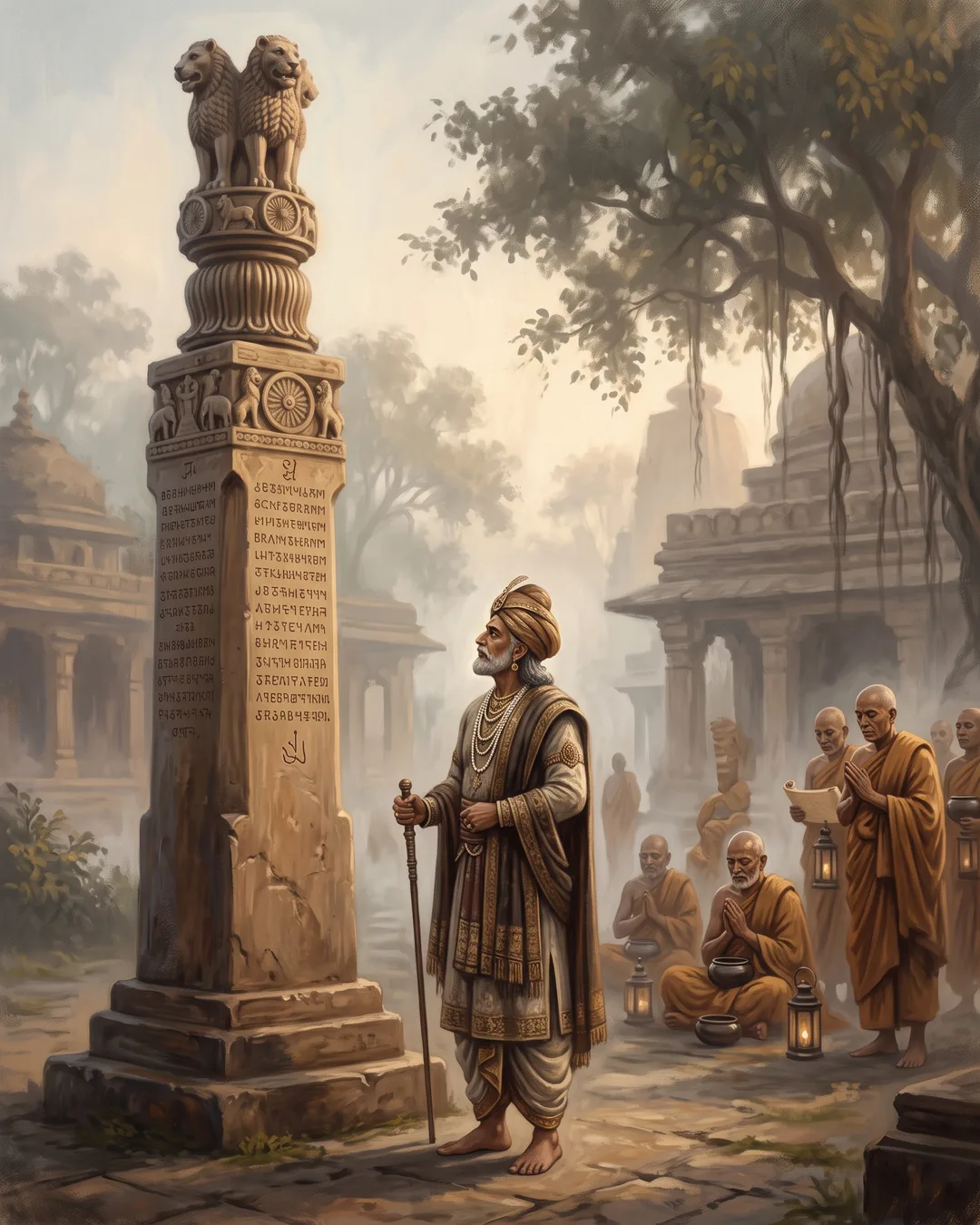
The third Maurya
Ashoka was the grandson of Chandragupta Maurya, who had built an empire covering most of the Indian subcontinent, and he ruled it from about 268 to 232 BCE. Buddhist literature composed centuries after his death, including the Ashokavadana and the Sri Lankan chronicles, describes a cruel young king who murdered his brothers and kept a torture house, before conversion transformed him. Those texts had a story to tell about the power of the teaching, and their portrait of the wicked early Ashoka should be read with that purpose in view.
What survives from his own reign is a very different kind of evidence: inscriptions cut into boulders and polished sandstone pillars from Afghanistan to the south of India. They are written in Prakrit dialects using the Brahmi and Kharoshthi scripts, and at Kandahar in Greek and Aramaic, which tells us something about the reach of his administration and about the Hellenistic world on his frontier. They are the earliest deciphered writing in India after the still-unread Indus seals.
Kalinga, and a policy called dhamma
The thirteenth Rock Edict describes the conquest of Kalinga on the eastern coast around 260 BCE and states the toll: a hundred thousand killed, a hundred and fifty thousand deported, and many more dead afterwards. The text then says the king felt remorse, and turned to dhamma. It is an extraordinary document, a ruler advertising the horror of his own victory, though it is worth noting that this particular edict was not inscribed in Kalinga itself, where the local population read a different set of instructions.
His dhamma was less a state religion than a civic ethic: restraint from injury to living beings, respect for parents, teachers and ascetics, generosity, and above all tolerance between sects, since praising your own faith by attacking another harmed both. He appointed officers to promote it, planted shade trees and wells along the roads, and provided medical care for people and animals. He also patronised the Buddhist sangha directly and, by tradition, sent his son Mahinda as a missionary to Sri Lanka.
Lost, and found by a script
The Mauryan empire fragmented within fifty years of his death, the Brahmi script fell out of use, and the pillars became anonymous monuments that later rulers occasionally moved and admired without being able to read. Recovery came in 1837, when James Prinsep, working at the Calcutta mint, deciphered Brahmi and found the edicts issued by a king calling himself Beloved of the Gods, of Gracious Countenance. The Sri Lankan chronicles supplied the missing identification, and Ashoka rejoined history.
Modern India took him up: the lion capital from Sarnath became the state emblem in 1950 and the wheel from his pillars sits at the centre of the flag. The edicts themselves resist hagiography. He kept his army and his conquests, told the forest peoples that the king still had power to punish, and offered condemned prisoners three days of grace rather than abolishing the death penalty. He is more interesting as a ruler negotiating limits than as a saint.


