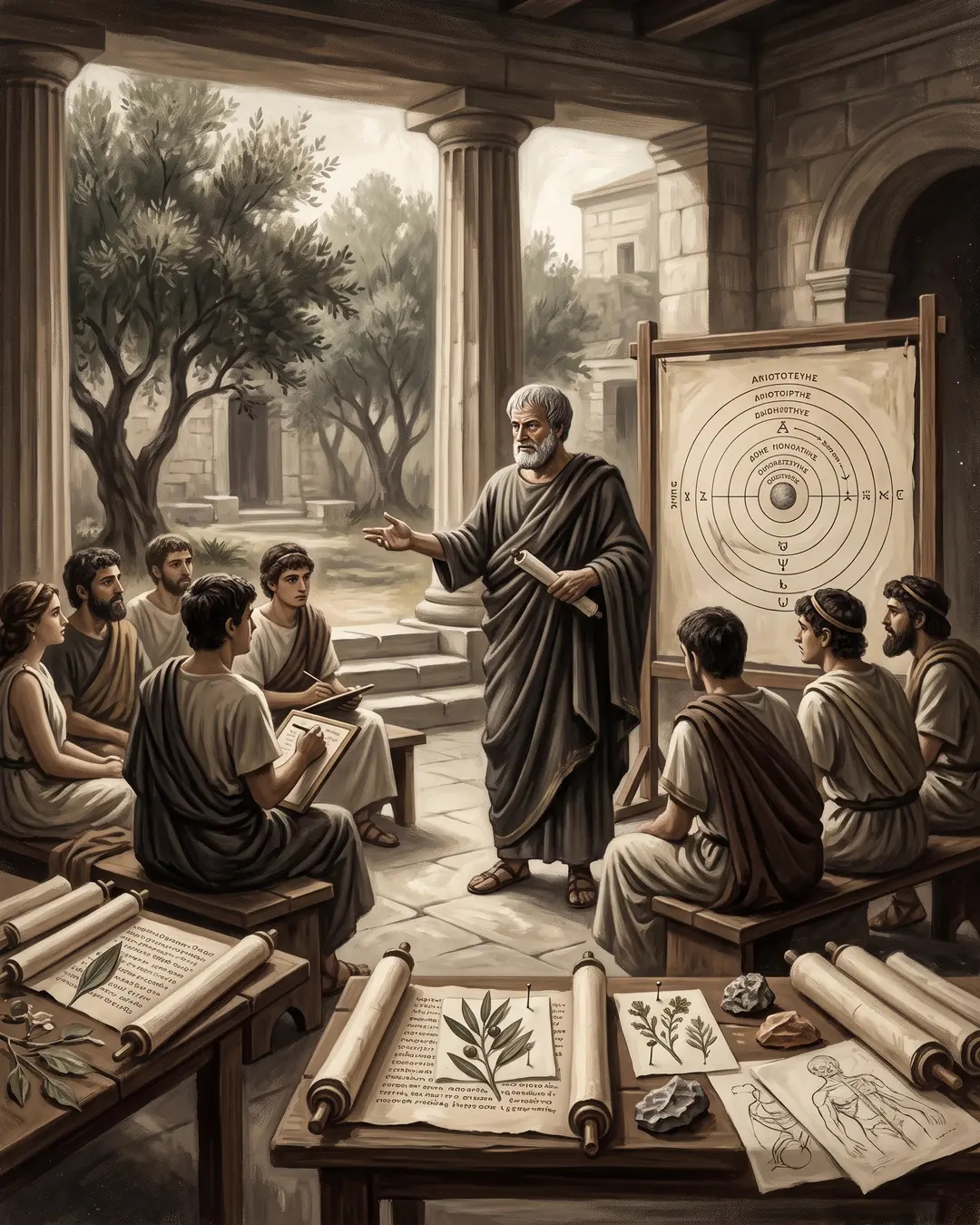
Twenty years in another man's school
Aristotle was born in 384 BCE at Stagira in northern Greece, the son of Nicomachus, a physician attached to the Macedonian court. At seventeen he went to Athens and joined Plato's Academy, where he remained for two decades, first as student and then as a colleague who increasingly disagreed with the master. When Plato died in 347 the leadership passed to his nephew Speusippus, and Aristotle left. He spent years at Assos and on Lesbos, where he and his student Theophrastus dissected and described marine life.
From 343 he tutored the young Alexander of Macedon, an association that later made him politically vulnerable in Athens. In 335 he returned and founded his own school, the Lyceum. Almost nothing survives of the polished dialogues that ancient readers admired for their style; what we have are dense working treatises, closer to lecture notes, which were edited into their present shape by Andronicus of Rhodes some three centuries later. The most influential prose in Western philosophy was never meant for publication.
Syllogisms, causes, and squid
He invented formal logic essentially from nothing, setting out the syllogism and the rules for valid inference in a system that stood unchallenged until the nineteenth century. He analysed explanation into four causes, material, formal, efficient and final, and argued that things are compounds of matter and form. Ethics he treated as a practical science: virtue is a disposition built by habit, aimed at a flourishing life, and typically lying between two vices. The Poetics gave later criticism its vocabulary of imitation, plot and catharsis.
His biology is the least read and most impressive part. He described several hundred species, dissected many, and got things right that were not confirmed again for two thousand years, including the specialised reproductive arm of the octopus and the placental attachment of a species of shark. He also got things badly wrong, placing intelligence in the heart, treating the brain as a cooling organ, and accepting that some creatures generate spontaneously from mud. He was an observer, not an experimenter, and observation has limits.
The authority problem
After his death in 322 BCE the texts travelled further than the man. Syriac and Arabic translators carried them east, and al-Farabi, Ibn Sina and above all Ibn Rushd produced commentaries that made him a living philosopher again. Those commentaries returned to Latin Europe in the twelfth and thirteenth centuries, where Thomas Aquinas fused Aristotelian method with Christian doctrine and the schools began calling him simply the Philosopher. Few thinkers have ever been read so continuously across three religions and a dozen languages.
The cost was that his physics and cosmology hardened into orthodoxy. Galileo's real opponents were Aristotelians defending a system, not the man who had told them to look at animals. Harder still are the passages in the Politics justifying slavery as natural for certain people and describing women as deficient in the capacity to rule themselves, arguments quoted for centuries by those who profited from them. Reading him honestly means holding the logic, the octopus and the apology for bondage in the same hand.


