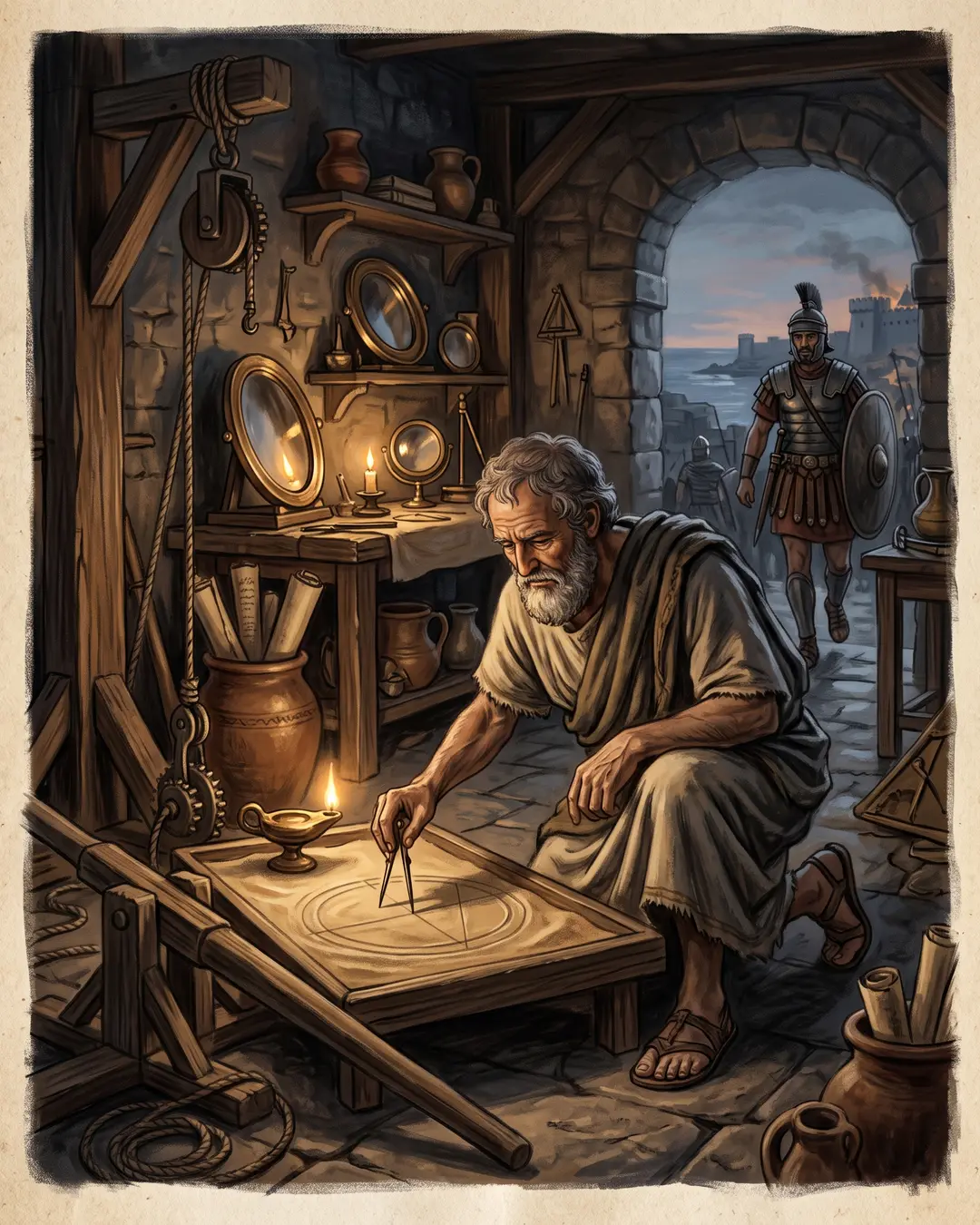
Syracuse, and the stories that grew
Archimedes was born about 287 BCE in Syracuse, a wealthy Greek city on the Sicilian coast, and a remark in his own Sand Reckoner suggests his father Phidias was an astronomer. He seems to have studied at Alexandria, since he corresponded for years with mathematicians there, including Conon of Samos, Dositheus and Eratosthenes, sending them theorems and occasionally, by his own account, a false one to catch those who claimed results they had not proved.
Almost every famous anecdote about him comes from Roman writers generations later. The bath and the cry of eureka appear first in Vitruvius, roughly two centuries after the event, and the displacement test described there would be too crude to settle the question of a debased crown; his own treatise On Floating Bodies points to a far more sensitive weighing method. The burning mirrors that supposedly set Roman ships alight have been tested repeatedly and never convincingly reproduced.
Proofs, machines, and a method he kept quiet
The mathematics needs no legend. By inscribing and circumscribing regular polygons of ninety-six sides, he trapped the ratio of circumference to diameter between two fractions we would write as 3.1408 and 3.1429. He squared the parabola, established the law of the lever and the principle of buoyancy that carries his name, and proved that a sphere has two thirds the volume and surface of the cylinder that encloses it. He asked for that figure on his tomb, and Cicero reported finding the overgrown monument in 75 BCE.
How he found these results was hidden until 1906, when the Danish scholar Johan Ludvig Heiberg examined a prayer book in Constantinople whose parchment had been washed and rewritten. Beneath the liturgy lay The Method, in which Archimedes explains that he first discovered theorems by imagining figures balanced on a lever, slice against slice, and only afterwards proved them rigorously. It amounts to a mechanical route to integration. The manuscript vanished again, resurfaced at auction in 1998, and was imaged at the Walters Art Museum.
The siege and the soldier
In the Second Punic War Syracuse changed sides, and the Roman general Marcellus besieged it from 214 BCE. Ancient historians credit Archimedes with the defensive engines that held the walls for two years: catapults calibrated for different ranges, and a crane with a grappling hook that could lift the prow of a ship out of the water. He is said to have regarded these devices as trivial beside his geometry, though that judgement reaches us through Plutarch, who admired philosophical detachment.
The city fell in 212 BCE and he was killed, reportedly while working on a diagram and despite Marcellus having ordered that he be spared. Plutarch offers three incompatible versions of the scene, which suggests nobody knew. His works passed through Arabic mathematics and returned to Europe in Renaissance translations that Galileo and Newton read closely. The palimpsest showed the twentieth century something else again: how close a mind in the third century BCE had come to reasoning with the infinite.


