Leaving Earth
Apollo 11 lifted from Kennedy Space Center on 16 July 1969 atop a Saturn V. Neil Armstrong, Edwin 'Buzz' Aldrin and Michael Collins travelled inside a command module with less living space than the scale of the mission suggests. Their flight depended on years of testing and the work of roughly 400,000 people across government, universities and industry.
Four days later Armstrong and Aldrin entered the lunar module Eagle while Collins remained in Columbia. During descent, the guidance computer sounded program alarms. Mission control determined the computer was overloaded but still handling its essential tasks. Armstrong then steered past a hazardous landing area as the fuel margin narrowed.
Tranquility Base
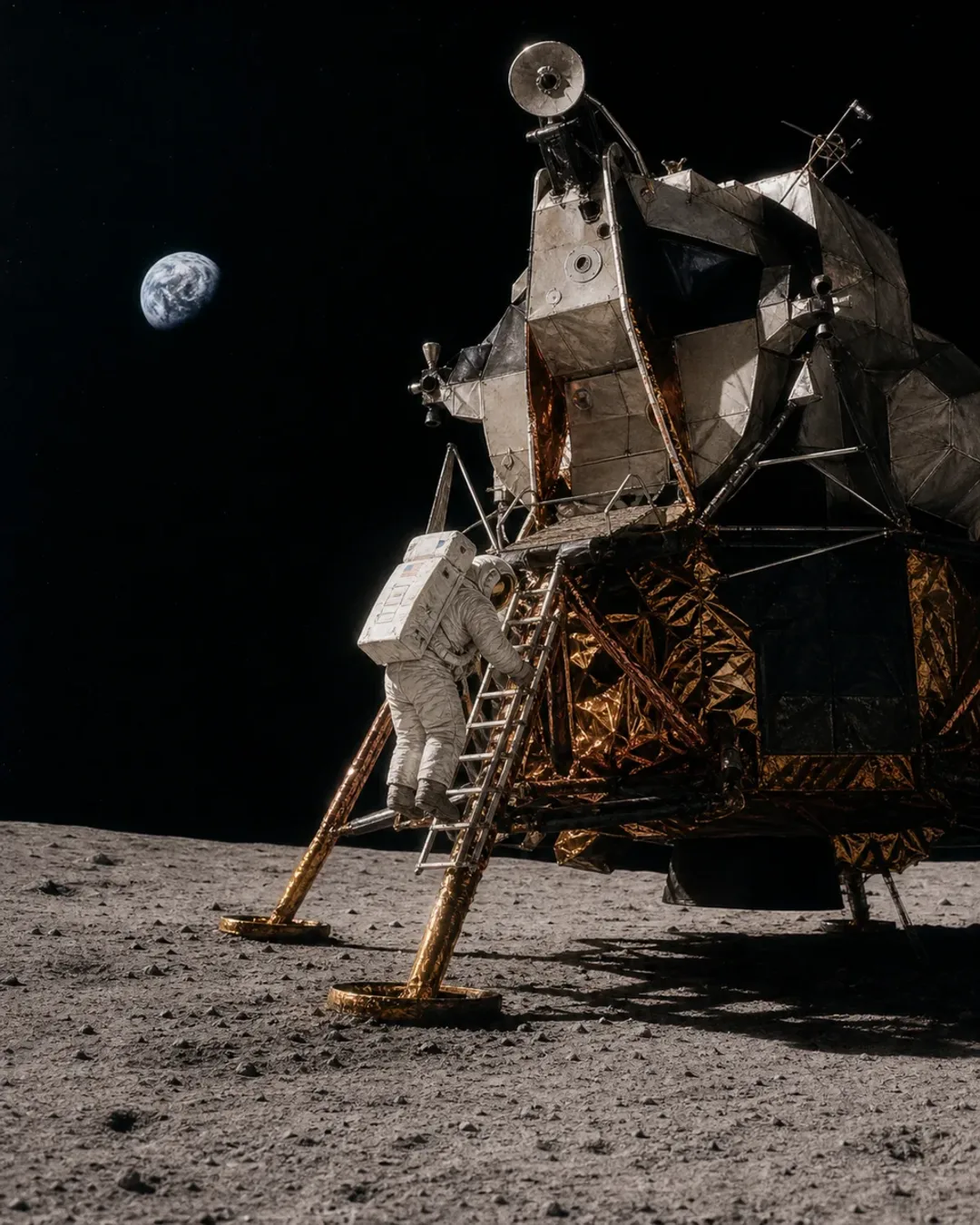
Eagle landed in the Sea of Tranquility at 20:17 UTC on 20 July. More than six hours later, Armstrong descended the ladder, followed by Aldrin. They spent about two and a half hours outside, set up experiments, photographed the site and collected about 21.5 kilograms of lunar material.
The live broadcast made the event feel immediate across borders, even as audiences experienced it through grainy black-and-white television. Estimates of the global audience vary, but hundreds of millions watched. A place once known only through reflected light became a landscape with footprints, tools and a horizon.
The difficult return
The mission was not complete at the first step. Eagle had to launch from the Moon and rendezvous with Collins in orbit. Columbia then carried the crew back through Earth's atmosphere, splashing down in the Pacific on 24 July. Because scientists could not rule out biological contamination, the astronauts entered quarantine.
Apollo 11 was a Cold War achievement, funded and accelerated by geopolitical competition. It was also a demonstration of collective systems engineering: procedures, redundancy, simulation and judgment working together. The enduring image is one person on the surface; the deeper story is a network learning how to bring three people home.


