Unemployable, not unintelligent
The story that Einstein failed mathematics is false and unusually persistent. Born in Ulm in 1879 and raised in Munich, he was ahead of his class in mathematics and physics and impatient with everything else, including the rote drill and deference of German schooling. He finished his training at the Zurich Polytechnic in 1900 with good marks and no job, having annoyed the professors whose recommendations he needed. For two years he tutored privately and applied unsuccessfully for assistantships across Europe.
A friend's father found him a post as a third-class examiner at the Swiss Patent Office in Bern in 1902. The work suited him: assessing electrical timing devices sharpened his thinking about simultaneity, and it left evenings free. He read philosophy and physics with two friends in a group they jokingly called the Olympia Academy, and married Mileva Maric, a Serbian physicist who had been the only woman in his Zurich cohort. Their correspondence shows her as a working partner, though claims of hidden co-authorship remain unproven.
1905, and then the harder decade
In 1905 he published four papers in a single volume of the Annalen der Physik. One explained the photoelectric effect by treating light as discrete quanta. One used Brownian motion to give powerful evidence that atoms are real. One dismantled absolute time by taking the constancy of the speed of light seriously. A short fourth paper drew out the consequence that mass and energy are two accounts of the same thing. He was twenty-six, still examining patents, and still not employed by any university.
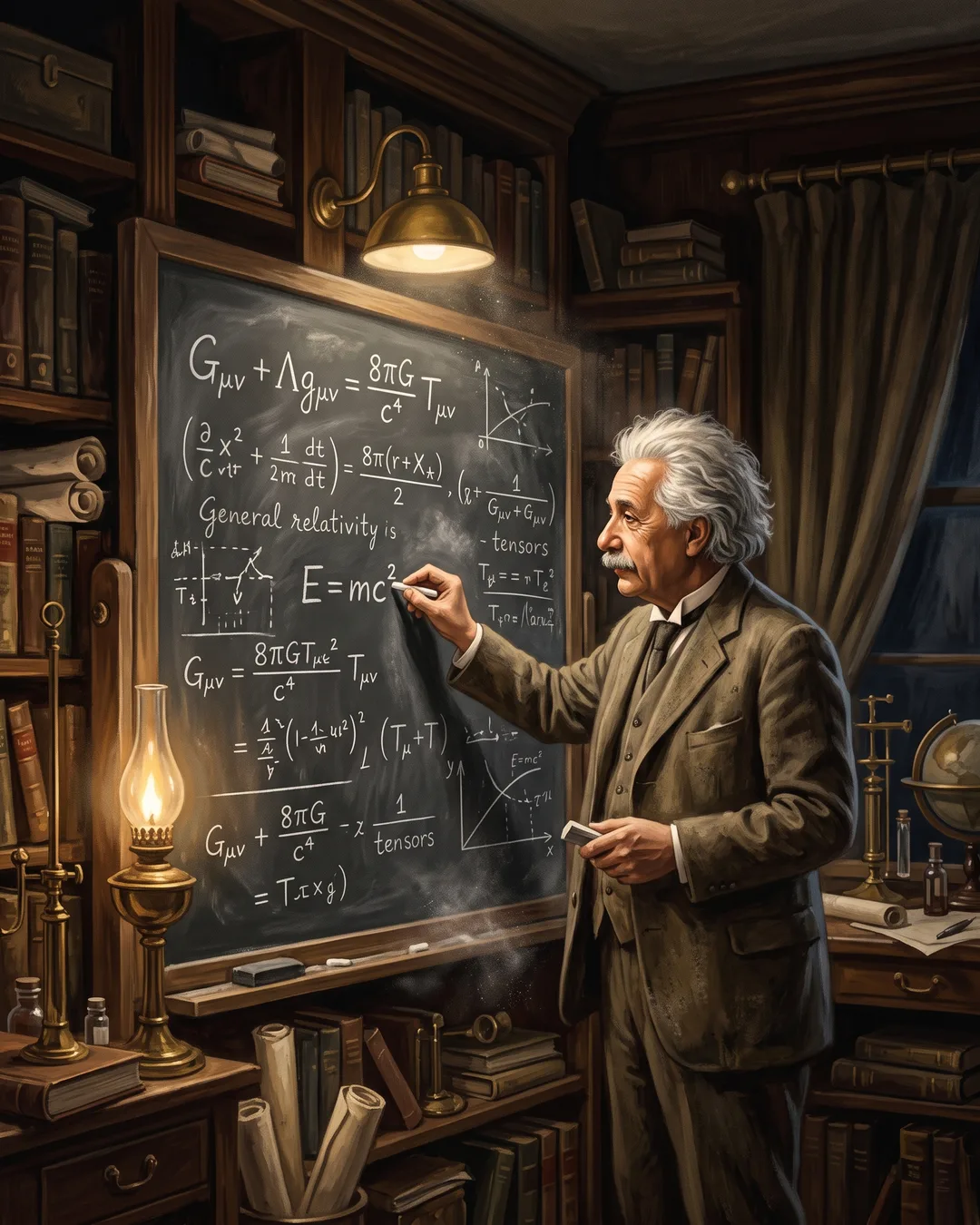
General relativity took eight more years and did not come easily. He needed the differential geometry his friend Marcel Grossmann taught him, published wrong versions along the way, and finished in November 1915 within days of David Hilbert deriving related field equations, a near-collision that historians have examined closely and generally resolve in Einstein's favour. Emmy Noether then supplied the theorem linking symmetries to conservation laws that the theory required. In 1919 an eclipse expedition led by Arthur Eddington reported starlight bending, and he woke up world-famous.
Exile, the letter, and the dice
The 1921 Nobel Prize was awarded for the photoelectric effect, the committee being unwilling to endorse relativity. He gave the prize money to Mileva as part of their divorce settlement. Through the 1920s German nationalists attacked relativity as Jewish physics; in 1933, while abroad, he learned his property had been seized and never returned. Princeton's Institute for Advanced Study took him in. In 1939 he signed a letter drafted with Leo Szilard warning Roosevelt about German fission research, a step he later called his one great mistake.
He was denied security clearance and took no part in building the bomb, and afterwards campaigned for international control of nuclear weapons and against segregation in the United States. His long dispute with quantum mechanics was the intellectual centre of his last decades: the 1935 paper with Boris Podolsky and Nathan Rosen argued that the theory must be incomplete. Later experiments on Bell's inequalities went against him. He hunted a unified field theory until his death in 1955 and did not find one.


