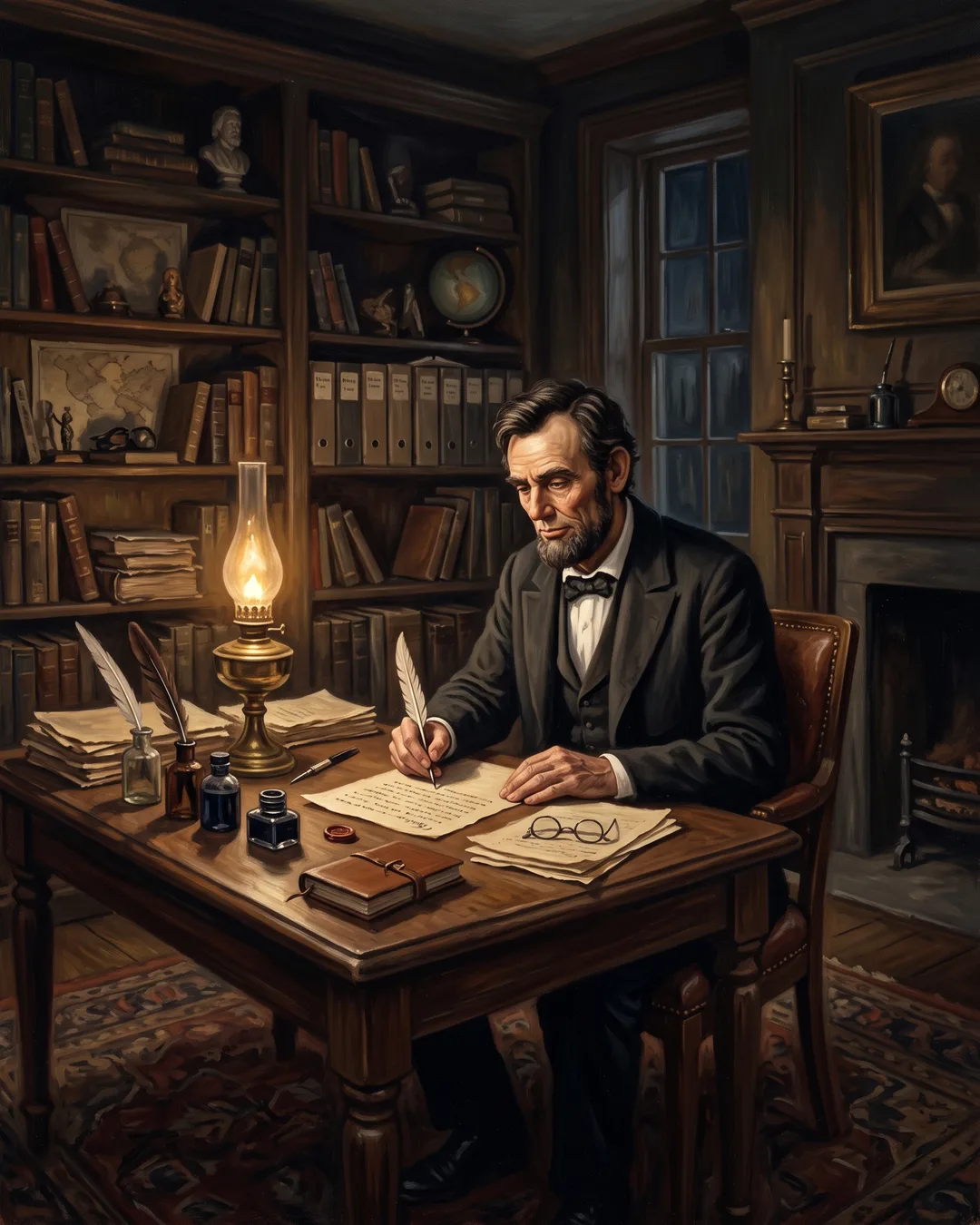
Frontier Schooling
Abraham Lincoln was born in a Kentucky log cabin in 1809 and raised in Indiana and Illinois by a father who valued labor over books. His mother died when he was nine. He estimated his formal schooling at less than a year in total and educated himself through borrowed grammars, Euclid, Shakespeare, and the King James Bible, whose cadences shaped every important speech he wrote. He worked as a rail-splitter, boatman, storekeeper, and postmaster, served briefly as a militia captain in the Black Hawk War, and read law on his own.
Elected to the Illinois legislature and then to a single term in Congress, he damaged his early prospects by demanding that President Polk identify the exact spot where American blood had been shed to start the Mexican War. He returned to a lucrative law practice representing railroads and ordinary litigants across the circuit. The Kansas-Nebraska Act of 1854 pulled him back into politics, and his 1858 Senate debates with Stephen Douglas made him nationally known despite losing the seat.
War, and the Limits He Set
Those debates also record what modern admirers prefer to skip. At Charleston, Lincoln denied favoring political and social equality between Black and white Americans, and for years he promoted voluntary colonization schemes to settle freed people outside the United States. He hated slavery consistently and considered it a moral wrong; he did not begin as an egalitarian. In 1861, secession came anyway, on the strength of what Southern leaders believed his election meant, and he took office defending a Union he insisted could not lawfully be dissolved.
He waged the war with an expansive view of executive power, suspending habeas corpus, allowing military arrests of civilians, and being overruled in principle by Chief Justice Taney in the Merryman case, which he ignored. He also approved the hanging of thirty-eight Dakota men in Minnesota in December 1862, the largest mass execution in American history, after reviewing the trials and commuting the sentences of two hundred and sixty-five others. Mercy and severity in the same order is the sort of decision his admirers rarely quote.
Emancipation and After
The Emancipation Proclamation of January 1863 was a war measure written by a lawyer. It freed people only in territory then in rebellion, exempting loyal border states and occupied areas, and its practical force depended on the advance of the army. It also opened the way to enlisting Black soldiers, and roughly two hundred thousand Black men served in Union forces, changing the war's manpower and its meaning. Lincoln then spent his political capital pushing the Thirteenth Amendment through the House in January 1865 to make abolition permanent.
At Gettysburg in November 1863 he redefined the war in under three hundred words as a test of whether government by the people could endure. In his second inaugural he offered no triumph, only a bleak reckoning with the shared guilt of the whole nation and a plea for reconstruction without malice. Days after Lee surrendered, and after publicly suggesting voting rights for some Black men, he was shot at Ford's Theatre and died on April 15, 1865, leaving the hardest work unbegun.


